

If you search for IP2 network, you may find different explanations. Some describe it as a decentralized, privacy-focused network, while others use “IP2” to refer to unrelated IP services or live-streaming communities. In technical contexts, however, the term is often associated with I2P (Invisible Internet Project), a decentralized and encrypted peer-to-peer network designed for private communication and services.
In this guide, IPFighter explains what an IP2 network can mean, why it is often linked to I2P, how I2P works, its main use cases, benefits and limitations, and how it compares with privacy technologies such as VPNs and Tor.
1. What is the IP2 network?
IP2 network is not a standardized internet protocol name in the same way as IPv4, IPv6, or TCP/IP. The term is used inconsistently online, which is why its meaning can depend heavily on context.
In technical and privacy discussions, descriptions associated with “IP2 network” actually match I2P (Invisible Internet Project), a decentralized, encrypted peer-to-peer overlay network. Official I2P documentation describes I2P as a fully encrypted, peer-to-peer overlay network that enables private communication and applications such as websites, email, chat, and file sharing.
This is also why some online resources use “IP2” when discussing technologies such as I2P Router, I2PSnark, or I2P tunnels. Therefore, when researching an IP2 network, it is important not to assume that the term represents a separate, officially standardized network. In privacy-network discussions, “IP2” may be used as an informal or mistaken reference to I2P.

Definition of IP2 network
Discover more:
-
What is an IP address, and how does it work?
-
How to find IP address on Windows, Mac, iPhone, and Android devices
-
IP reputation check: How IPFighter scores your IP
2. How does the IP2 network work?
When IP2 network refers to the technical concept associated with I2P, its underlying architecture is based on decentralized routers, encrypted tunnels, and distributed network information.
Instead of sending traffic through one direct connection, I2P builds temporary tunnels through multiple participating routers. Its tunnels are unidirectional, meaning inbound and outbound traffic use separate paths. A simplified flow looks like this:
Sender → Outbound tunnel → Inbound tunnel → Destination
Each router only handles the portion of the communication required for its role. Combined with layered encryption, this makes it more difficult for an individual participant to see the entire communication path. I2P also maintains a distributed network database, known as the netDb, which helps routers discover information about other routers and destinations without relying on one centralized directory.
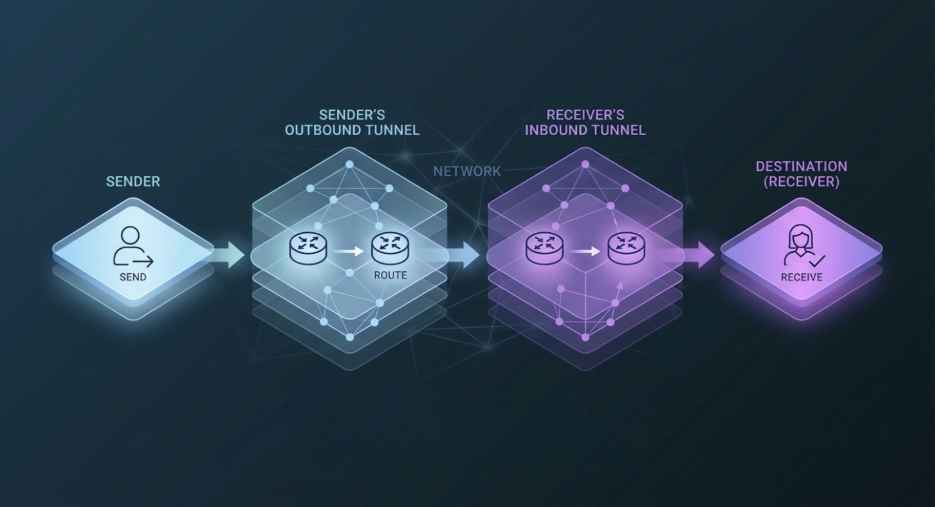
How does the IP2 network work
3. What is the IP2 network used for?
If you are using IP2 network to refer to I2P, the network supports four main types of privacy-focused applications:
-
Private communication: Encrypted communication is one of the main use cases. I2P supports private messaging, email, and other forms of communication that operate inside the network.
-
Anonymous or private browsing: Access to services hosted inside the network without directly exposing the user's public IP address. Unlike Tor, I2P is primarily designed for private services within its own network, not anonymous access to the public internet. For anonymous access to the public web rather than I2P's internal services, Thordata dedicated proxy service is typically used instead.
-
File sharing: File sharing and peer-to-peer applications are another important use case. I2P includes applications such as I2PSnark for torrenting within the network and can also support other peer-to-peer applications.
-
Messaging and email: I2P provides applications and services for encrypted email and chat. Its documentation specifically lists SusiMail and Irc2P among the applications available after connecting to the network.
-
Hosting private services: Users can host services inside the network. I2P supports its own internal naming system and hidden services, allowing websites and other applications to operate without being exposed through a conventional public IP address.
Overall, the common thread across these use cases is private, peer-to-peer communication within a decentralized network, rather than simply changing the public IP address used to access ordinary websites.

IP2 network use cases
4. What are the benefits of the IP2 network?
If IP2 network is being used to describe the privacy-focused architecture associated with I2P, its main benefits include:
-
Decentralization: The network does not rely on one central server to route all communication. Instead, participating routers collectively help move data between peers. This reduces dependence on a single organization or infrastructure provider.
-
Improved privacy: Encrypted, multi-hop tunnels make it more difficult for observers to identify both the source and destination of a communication. I2P is designed to prevent ordinary network observation from easily revealing a message’s contents, source, and destination.
-
Censorship resistance: Because traffic is distributed across multiple participating peers instead of being controlled by one central server, blocking the entire network can be more difficult. I2P also uses transports and network architecture designed to resist recognition and blocking.
-
User participation: Users are not limited to consuming network services. Their routers can also help forward traffic for other peers, contributing bandwidth and infrastructure to the network.
-
Support for decentralized applications: The network can support websites, messaging, email, file sharing, and other applications within its privacy-focused environment. This makes it more than just an anonymity layer for accessing conventional websites.
However, these benefits do not guarantee complete anonymity or perfect security. Privacy technologies can reduce certain risks, but their effectiveness still depends on the software implementation, network configuration, applications being used, and the user’s own behavior.
5. What are the limitations of the IP2 network?
Privacy-focused decentralized networks can improve privacy and reduce reliance on centralized infrastructure, but they also involve several practical trade-offs:
-
Higher learning curve: Users familiar with opening regular websites in Chrome may need time to understand concepts such as routers, tunnels, destinations, internal addresses, and network configuration.
-
Variable performance: Traffic may pass through multiple peers and tunnels, so latency and throughput can depend on network conditions, available peers, bandwidth, and routing efficiency. I2P is primarily optimized for services within its own network rather than serving as a general-purpose, high-speed gateway to the public internet.
-
Smaller ecosystem: The network does not offer access to every website or application available on the conventional web. Many services may be unavailable, require special configuration, or operate differently from their public-web versions.
-
No guarantee of complete anonymity: Privacy protection does not mean absolute anonymity. Even well-designed anonymity networks can face risks such as traffic correlation and timing analysis. The Tor Project documents these risks, while I2P's documentation emphasizes that users must configure and use the technology correctly to improve privacy.
Overall, the IP2 network concept or I2P when “IP2” is being used as an informal reference can provide valuable privacy and decentralization benefits, but it is not a universal replacement for the regular web, a VPN, or every other privacy tool.
6. How does an IP2 network compare with VPNs and Tor?
Although IP2/I2P, VPNs, and Tor can all be associated with online privacy, they are not interchangeable technologies.
|
Feature |
IP2 network |
VPN |
Tor |
|
Architecture |
Decentralized peer-to-peer network |
Centralized provider |
Distributed relay network |
|
Main focus |
Private services and P2P communication |
Private routing through a VPN provider |
Anonymous access to the internet |
|
Routing |
Unidirectional tunnels through peers |
VPN server(s) |
Multiple Tor relays |
|
Central provider |
No single VPN-style provider |
Yes |
No single service provider |
|
Typical use cases |
Hidden services, messaging, file sharing, P2P |
General private internet access |
Anonymous web browsing and onion services |
|
Ease of use |
Generally more technical |
Usually simple |
Moderate |
Read more:
-
What is a localhost IP? Understanding 127.0.0.1 in development
7. Is the IP2 network safe to use?
There is no simple yes-or-no answer because “IP2 network” can refer to different things. If you mean I2P, the network itself is built with encryption, decentralized routing, and privacy in mind.
However, that does not mean everything you do through I2P is automatically safe or anonymous. Your privacy can still be affected by:
-
How you configure the software and browser
-
The applications you use
-
Whether you reveal personal information
-
Files or content you download
-
Account activity that can be linked back to you
-
Potential traffic-analysis or correlation techniques
-
Security vulnerabilities in applications running on top of the network
I2P should therefore be viewed as a privacy-enhancing network, not a guarantee of complete anonymity or security.
Users should also understand what they are connecting to and avoid treating unfamiliar services or files as trustworthy simply because they are accessed through a privacy-focused network.

Is the IP2 network safe to use
8. Conclusion
So, what is an IP2 network? The term is not a standardized networking technology and may refer to different things depending on the context. In technical or privacy-related content, however, it often describes I2P - a decentralized, encrypted peer-to-peer network that uses routers, unidirectional tunnels, and a distributed database to support private websites, messaging, email, file sharing, and other internal services.
I2P can improve privacy, but it is not completely anonymous. It may require more technical setup, and connection speed can vary. Therefore, when you see IP2 network used in a technical context, check whether the source is actually referring to I2P.
9. FAQ
Is IP2 the same as I2P?
Not technically. I2P is the official name of the Invisible Internet Project, a decentralized encrypted peer-to-peer network. IP2 network is an ambiguous term that some sources use when describing technology that closely matches I2P.
What does I2P stand for?
I2P stands for Invisible Internet Project. It is a decentralized, encrypted peer-to-peer network designed primarily for private communication and services within the I2P ecosystem.
Is I2P a darknet?
Yes. I2P is an internal darknet designed mainly for private communication and services within the I2P network, unlike Tor, which also supports anonymous access to the public internet.
How do you access an I2P network?
Install the I2P software, run the I2P router, and configure a compatible browser or application. You can then access .i2p sites and services within the network.
Is I2P safer than a VPN or Tor?
There is no universal answer. I2P, VPNs, and Tor use different architectures and serve different purposes, with I2P focusing on private services and peer-to-peer communication within its own network.
Read more

Why do I keep getting CAPTCHA? Here's what may be triggering it


What is a CAPTCHA? The check that separates people from bots
What is a mesh network and when should you use one?
What is an IP2 network? How it works, uses, and benefits
Explaining how to know if you have a DNS leak

How to know if you have a WebRTC leak: Reading your results