

A "Chinese proxy" can mean two very different things: an IP inside mainland China, or an IP in Hong Kong. Many proxy providers offer limited mainland coverage, so Hong Kong IPs are a common substitute, but they do not behave like mainland IPs on every site. This guide explains which one you need, how to tell them apart, and what happened when we tested five Hong Kong proxy IPs from different providers.
Written by Valerie Thorne · Updated: Nov 20, 2026
IPFighter earns a commission if you buy through some links on this page. It does not affect our test results.
1. Mainland China IP vs Hong Kong IP: which do you need?
Hong Kong and mainland China sit on different internet networks. Mainland China filters international traffic, while Hong Kong has an open internet and fast links to the mainland. Chinese platforms often treat Hong Kong visitors as overseas users, so the same page can show different content, prices or availability depending on which side your IP is on.
|
Mainland China IP |
Hong Kong IP |
|
|
Typical networks |
China Telecom, China Unicom, China Mobile |
Hong Kong broadband and mobile networks, such as HKT, HKBN, China Mobile Hong Kong |
|
How Chinese platforms see you |
As a local mainland user |
Usually as an overseas or Hong Kong user |
|
Access to global sites |
Many foreign services are blocked |
Open access |
|
Availability from proxy providers |
Often limited or not offered |
Widely offered |
|
Good for |
Content, prices and search results shown only to mainland users |
Chinese-language browsing, global Chinese platforms, regional ad and SEO checks, Asia-focused data collection |
Start with a Hong Kong IP when you need Chinese-language content, want to see how a global Chinese platform looks to Asian visitors, or run research that does not depend on mainland-only results.
You need a mainland IP when a site or app shows a different catalogue, price or search result only to mainland users, or blocks overseas visitors entirely. In that case, a Hong Kong IP will not reproduce what a mainland user sees, and you should confirm that a provider actually sells mainland IPs before buying.
Note that a network name can mislead: China Mobile Hong Kong is a Hong Kong operator, so an IP on it is a Hong Kong IP, not a mainland one.
2. 5 Hong Kong proxy IPs we tested
These results come from our individual provider reviews. In each one, we loaded a Hong Kong IP into Chrome and checked it with IPFighter IP lookup, a speed test and a Google search. Each row is a single-IP spot check, not an average of the provider's Hong Kong pool.
|
Provider |
Proxy type |
Requested location |
Detected location |
IP score |
Proxy flag |
Download / upload (Mbps) |
Latency (ms) |
Full review |
|
Geonix |
Residential |
Hong Kong |
Kwai Chung, Hong Kong (Google) |
95 |
No |
6.8 / 26 |
571 |
|
|
RapidProxy |
Residential |
Tuen Mun, Hong Kong |
Tuen Mun (IPFighter); Victoria Peak (Google) |
90 |
No |
2.84 / 3.54 |
244 |
|
|
711Proxy |
Residential |
Hong Kong |
Hong Kong (IPFighter); New York, US (Google) |
89 |
No |
15.26 / 67.07 |
584 |
|
|
Thordata |
Residential |
Hong Kong |
Hong Kong (IPFighter); Ma On Shan, Hong Kong (Google) |
75 |
No |
7.65 / 13.2 |
138 |
|
|
CatProxies |
Residential (Standard) |
Kowloon, Hong Kong |
Kowloon (IPFighter); Texas, US (Google) |
65 |
Yes (datacenter) |
35.80 / 4.26 |
268 |
What the results show
Two of five "Hong Kong" IPs looked American to Google. IPFighter placed the 711Proxy and CatProxies IPs in Hong Kong, but Google placed them in New York and Texas. Different services use different location databases, so an IP sold as Hong Kong can still be treated as a US visitor by the site you care about.
IP quality ranged widely. Geonix scored 95 and RapidProxy 90 with no flags. At the other end, the CatProxies Standard IP scored 65 and was detected as datacenter, the only flagged IP in the group.
Speed was low for most. Only CatProxies passed 30 Mbps down; Geonix, Thordata and RapidProxy stayed under 8 Mbps. Thordata answered fastest at 138 ms, while 711Proxy and Geonix took over 570 ms. Hong Kong IPs from these pools suit browsing and light research better than bulk downloads.
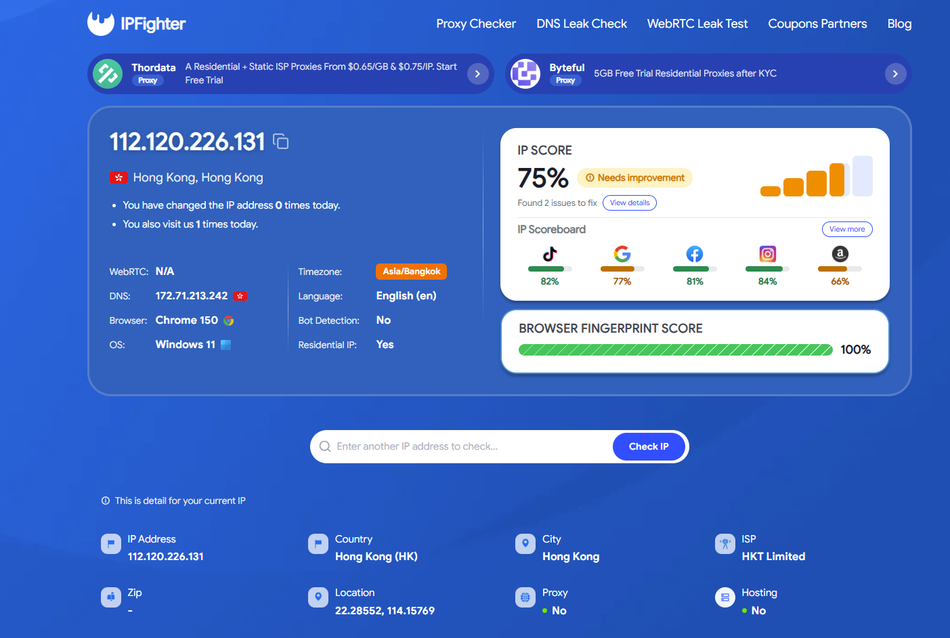
Thordata Hong Kong residential proxy IP test on IPFighter, IP score 75/100
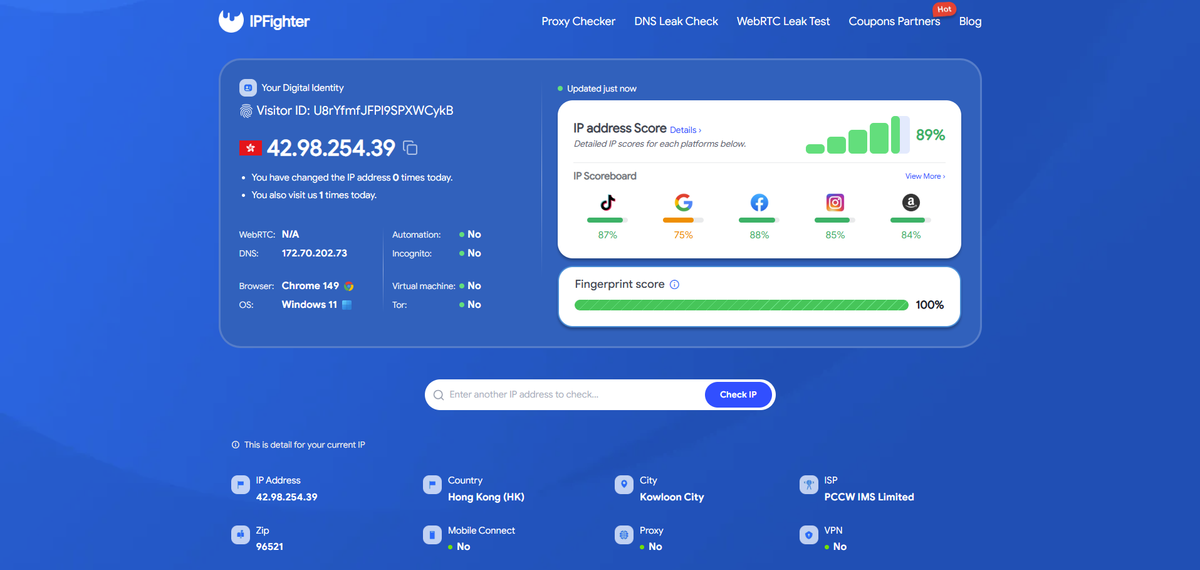
Google placed a 711Proxy Hong Kong IP in New York
3. How to check whether a "China" IP is really mainland
Providers label locations in different ways, and as our Hong Kong tests show, the label does not always match how websites see the IP. Run these checks before relying on an IP for China-related work.
-
Check the country and ISP on IP Lookup. A mainland IP should show China as the country and usually China Telecom, China Unicom or China Mobile as the ISP. If the country is Hong Kong, or the ISP is a Hong Kong network such as China Mobile Hong Kong, it is not a mainland IP.
-
Check the proxy and hosting flags. A datacenter flag, like the one on our CatProxies Hong Kong IP, means sites may treat the IP as a server rather than a home or mobile user.
-
Search Google from the proxy and check the location at the bottom of the results. This caught two of our five Hong Kong IPs being placed in the US.
-
Run the DNS Leak Test and WebRTC Leak Test. DNS servers or a WebRTC address in another country can reveal that the connection is not local.
-
Open the actual site you need. A Chinese platform's own region, language and catalogue settings are the final test of whether it treats you as a mainland or overseas
4. Using proxies for China: rules and limits
Mainland China regulates VPNs and cross-border network services, and the rules that apply depend on where you are and what you do. Using a proxy outside China to view publicly available Chinese websites, for example for market research or checking localized content, is a different situation from using unapproved tools inside mainland China.
Whatever IP you use, follow the law that applies to you and the terms of the platforms you access. Many Chinese platforms also require phone-number or identity verification for accounts, which a proxy does not change. This page is general information, not legal advice; if your work depends on operating inside mainland China, check the rules with a qualified local advisor.
5. Conclusion
For most Chinese-language browsing and regional research, a Hong Kong IP is enough; for anything a platform shows only to mainland users, you need a genuine mainland IP, and fewer providers offer one. Our five Hong Kong tests showed why checking matters: scores ranged from 65 to 95, one IP was flagged as datacenter, and two were placed in the US by Google. Whichever you choose, confirm the country, ISP and location with IPFighter before you rely on it.
You can also compare current partner offers on IPFighter Coupons Partners.
6. FAQ
Is a Hong Kong proxy the same as a Chinese proxy?
No. Hong Kong IPs run on Hong Kong networks, and Chinese platforms usually treat them as overseas visitors. A Hong Kong IP works well for Chinese-language browsing and regional research, but it will not show content, prices or search results that a platform reserves for mainland users.
Did you test any mainland China proxy IPs?
No. Our tests cover five Hong Kong IPs from Geonix, RapidProxy, 711Proxy, Thordata and CatProxies. If you buy a mainland IP elsewhere, check the country and ISP on IPFighter: a mainland IP usually belongs to China Telecom, China Unicom or China Mobile.
Which Hong Kong proxy scored best in your tests?
Geonix's Hong Kong IP scored highest at 95/100, and Google placed it in Kwai Chung, Hong Kong, though it downloaded only 6.8 Mbps. Thordata's IP answered fastest at 138 ms. The 711Proxy and CatProxies IPs both showed up in the US on Google, so check location before relying on any Hong Kong IP.
Why would a Hong Kong IP show up as the US?
Websites look up IP locations in their own databases, and these do not always agree. In our tests, IPFighter placed two IPs in Hong Kong while Google placed them in New York and Texas. If the site you care about sees the wrong country, the IP will not give you a Hong Kong or Chinese view of that site.
Read more

DuoPlus review: Convincing Android fingerprints, but mixed proxy and DNS results


IPPeak review: Clean, fast residential IPs with high latency and a weaker ISP result

LegionProxy review: 82.5% average IP score, but inconsistent city targeting
Aproxy review: Japan residential IP scores fell to 40%, while ISP speeds reached 200 Mbps

AstroProxy review: 90% IP scores, but slow speeds

FlashProxy review: Very fast and cheap, but low IP scores and DNS mismatches