Korean proxy service: How to choose one and compare the top providers

avatar
|

A Korean proxy service gives you access to South Korean IP addresses, allowing websites and online platforms to see your connection as coming from South Korea. This can be useful for checking Korean websites, localized content, market data, or services that depend on IP location.

However, “Korean proxy service” can also refer to Korean shopping or buying-agent services, which is a different concept. In this guide, IPFighter focuses on South Korea IP proxies and compares providers based on their publicly available proxy types, pricing, Korea coverage, targeting options, and trial policies.

1. What is a Korean proxy service?

A Korean proxy service routes your internet traffic through a proxy server or IP address located in South Korea. Instead of connecting directly to a website from your original IP, the website sees the Korean proxy's IP.

This makes Korean proxies useful when you need a South Korean IP address for location-specific browsing, research, automation, or testing.

Depending on the provider, a Korean proxy service may offer residential, mobile, ISP, or datacenter IPs. These proxy types differ in how their IPs are sourced, how stable they are, and which use cases they are best suited to.
korean proxy service - definition

Definition Korean proxy server

Discover more:

2. Best Korean proxy services: Quick comparison

There is no single Korean proxy service that is best for every use case. The right option depends on whether you need residential IPs, mobile connections, stable ISP proxies, a large Korean IP pool, detailed city or carrier targeting, or simply an affordable way to access South Korean IPs.

The providers below are ordered based on a combination of market visibility, publicly documented South Korea coverage, proxy types, and available targeting options. The comparison uses information published by the providers rather than direct performance tests.

Provider

Korean proxy types

Starting price

Best for

Oxylabs

Residential, Mobile, Datacenter

From $8/GB residential 

Large-scale and advanced targeting

Bright Data

Residential, ISP, Datacenter

From $1.40/IP datacenter

Broad proxy type coverage

Decodo

Residential, ISP, Mobile, Datacenter

From $3.75/GB residential

Affordable Korean residential proxies

Proxy-Seller

Residential, ISP, IPv4, 

From $1.65/pcs IPv4

Multiple proxy formats

SOAX

Residential, Mobile

From $5.00/GB

City and carrier targeting

Webshare

Residential, Datacenter

From $3.50/GB rotating residential

Budget users and simple access

Byteful

Residential, Datacenter, ISP, Mobile

From $3.25/GB residential

Korea-focused use cases

Infatica

Residential

From $4/GB residential

City-level Korean residential IPs

MarsProxies

Residential, ISP, Datacenter, Mobile

From $4.99/GB residential

Multiple Korean proxy types

FloppyData

Residential, ISP, Mobile, Datacenter

From $1/GB (starting from 14GB) residential

Low-cost proxy access

The table gives a quick overview, but pricing can vary by proxy type, bandwidth, IP quantity, and billing model. Check the individual provider details below before choosing a plan.

3. Top Korean proxy providers: Detailed reviews and analysis

The providers below are reviewed based on their South Korea proxy coverage, available proxy types, pricing, targeting options, and publicly available trial information.
3.1. Oxylabs

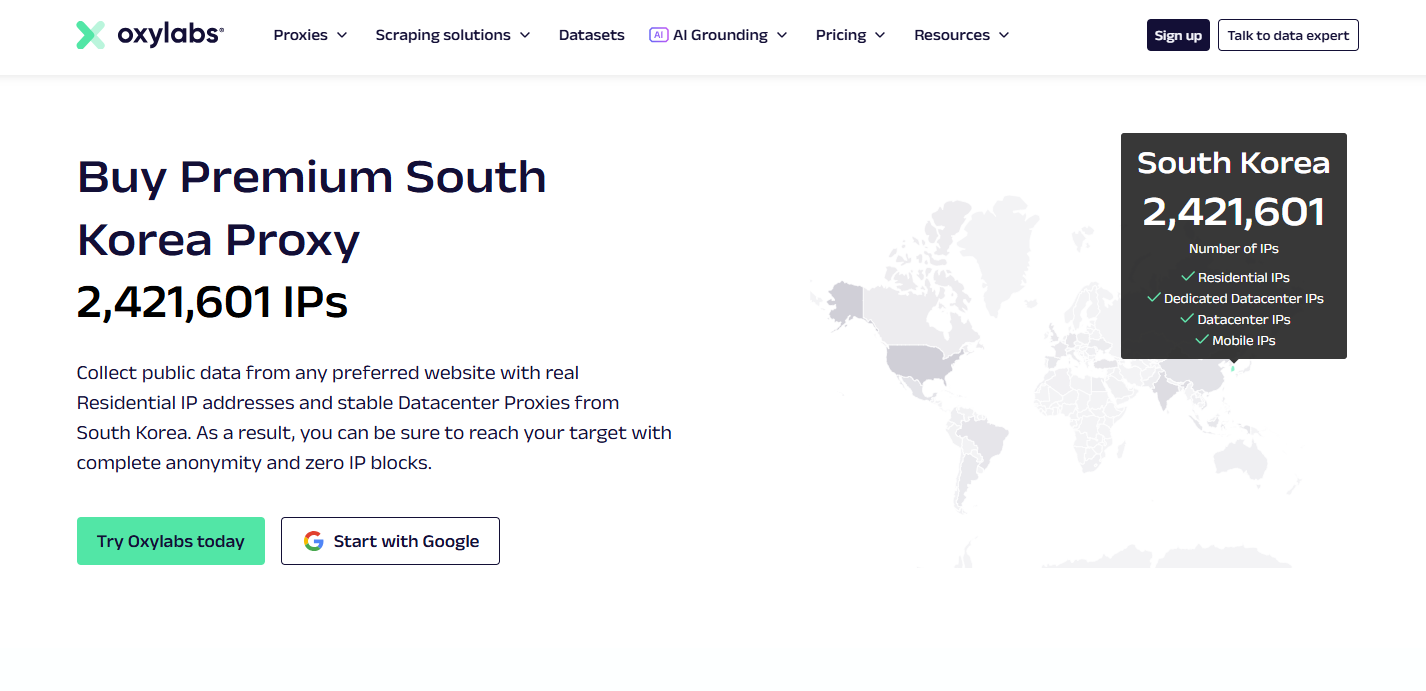
Oxylabs is one of the more prominent choices if you need a large South Korean IP pool and granular location targeting. Its dedicated South Korea proxy page publicly lists more than 2.4 million Korean IPs and supports both residential and dedicated datacenter proxies. For Korean proxy availability, Oxylabs publicly specifies:

  • Proxy types: Residential, mobile, datacenter

  • IP pool: 2,421,601 South Korean IPs listed

  • Residential pricing: From $8/GB

  • Free trial: Available for eligible customers

  • South Korea targeting: Country, state, city, ZIP code, and advanced ASN targeting

  • Notable locations: Seoul and other Korean locations

  • Best for: Large-scale data collection, advanced targeting, and enterprise use

Oxylabs stands out when targeting precision and a large Korean IP pool matter more than having the lowest possible price.

Want to explore Oxylabs or save on your purchase? Check the latest Oxylabs promo codes on IPFighter Coupons Partners.

korean proxy service - oxylabs

Oxylab’s Korean proxies

3.2. Bright Data

Bright Data offers one of the broadest selections of proxy types for South Korea. Its Korea page lists residential, mobile, ISP, and datacenter proxies, making it suitable for users who want to choose an IP type based on a specific workflow. Publicly available Korean proxy information includes:

  • Proxy types: Residential, ISP, Datacenter

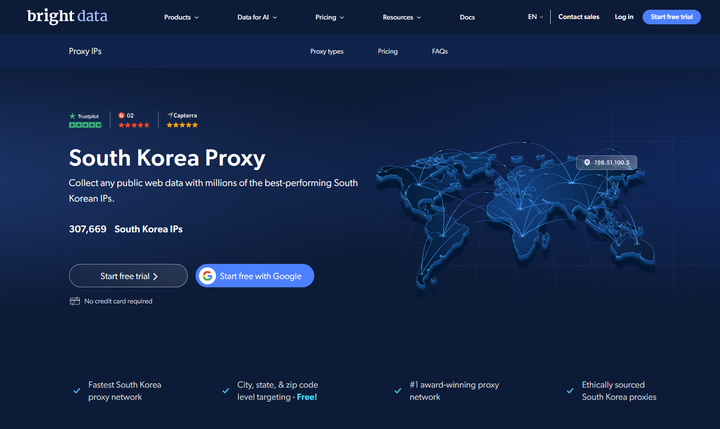
  • IP pool: 307,669 South Korea IPs listed on its Korea page

  • Residential pricing: From $4/GB residential & $1.40/IP datacenter

  • Free trial: Available, with no credit card required

  • South Korea targeting: City, state, and ZIP code targeting

  • Notable locations: South Korea locations with granular targeting options

  • Best for: Users who need multiple proxy types and flexible targeting

Bright Data is particularly useful when you are not sure which Korean proxy type you will need, because its product range covers residential, mobile, ISP, and datacenter connections.

korean proxy service - bright data

Bright Data's Korean proxies

3.3. Decodo

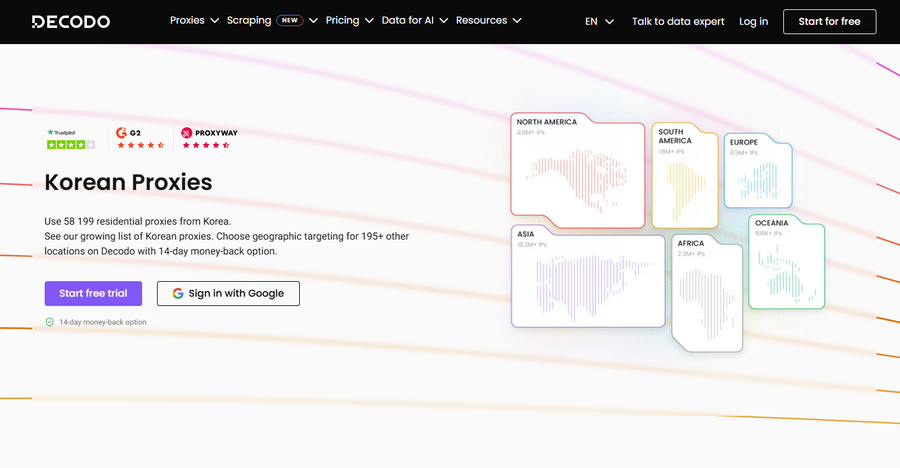
Decodo is a strong option for users looking for Korean residential proxies with relatively accessible pricing. Its dedicated South Korea page lists more than 58,000 residential IPs and supports several levels of geographic targeting. Key details include:

  • Proxy types: Residential, ISP, Mobile, Datacenter

  • IP pool: 58,199 South Korean residential proxies

  • Residential pricing: From $2.75/GB on larger plans; pay-as-you-go from $4/GB 

  • Free trial: Available

  • South Korea targeting: Country, state, city, ZIP code, and ASN

  • Notable locations: South Korea, with city-level targeting available

  • Best for: Affordable residential proxy access and location-based research

Decodo can be a good middle ground for users who want residential Korean IPs and detailed targeting without immediately moving to a more enterprise-oriented proxy plan.

korean proxy service - decodo

Decodo's Korean proxies

3.4. Proxy-Seller

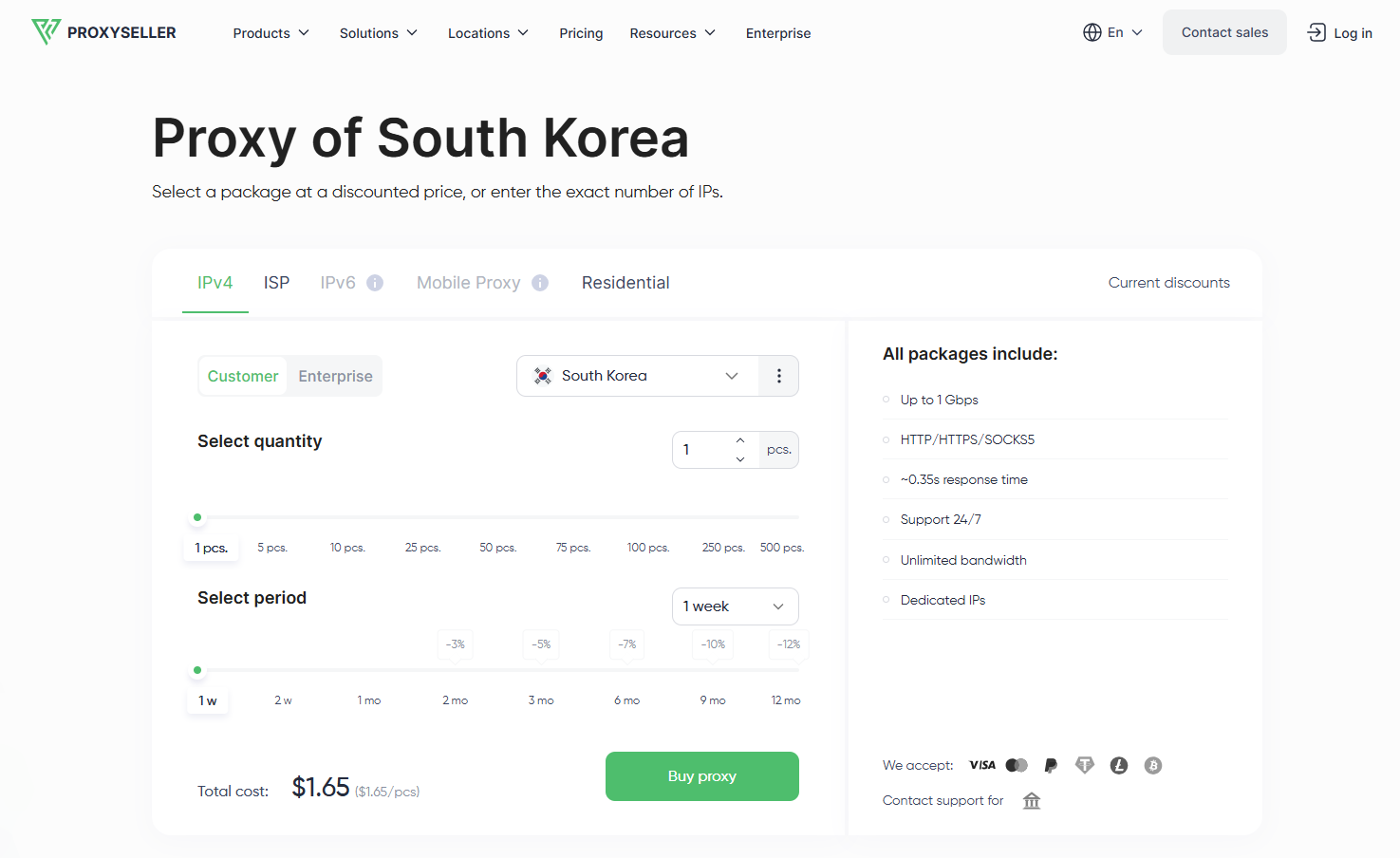
Proxy-Seller has a dedicated South Korea proxy page with several proxy formats. This makes it a flexible option for users who already know which type of Korean IP they need. Its publicly listed options include:

  • Proxy types: Residential, ISP, IPv4, 

  • IP pool: Not specified

  • Residential pricing: From$3.5/GB residential & $1.65/pcs IPv4

  • Free trial: Not specified

  • South Korea targeting: South Korea country selection; further Korea-specific targeting is not publicly specified

  • Notable locations: South Korea

  • Best for: Users who want to compare several proxy formats from one provider

Proxy-Seller's main advantage is product variety, although users looking for detailed Korean city or carrier targeting may prefer providers that publish more granular Korea-specific information.

Planning to try Proxy-Seller? Check the latest Proxy-Seller promo codes on IPFighter before purchasing.

korean proxy service - proxy-seller

Proxy-Seller’s Korean proxies

3.5. SOAX

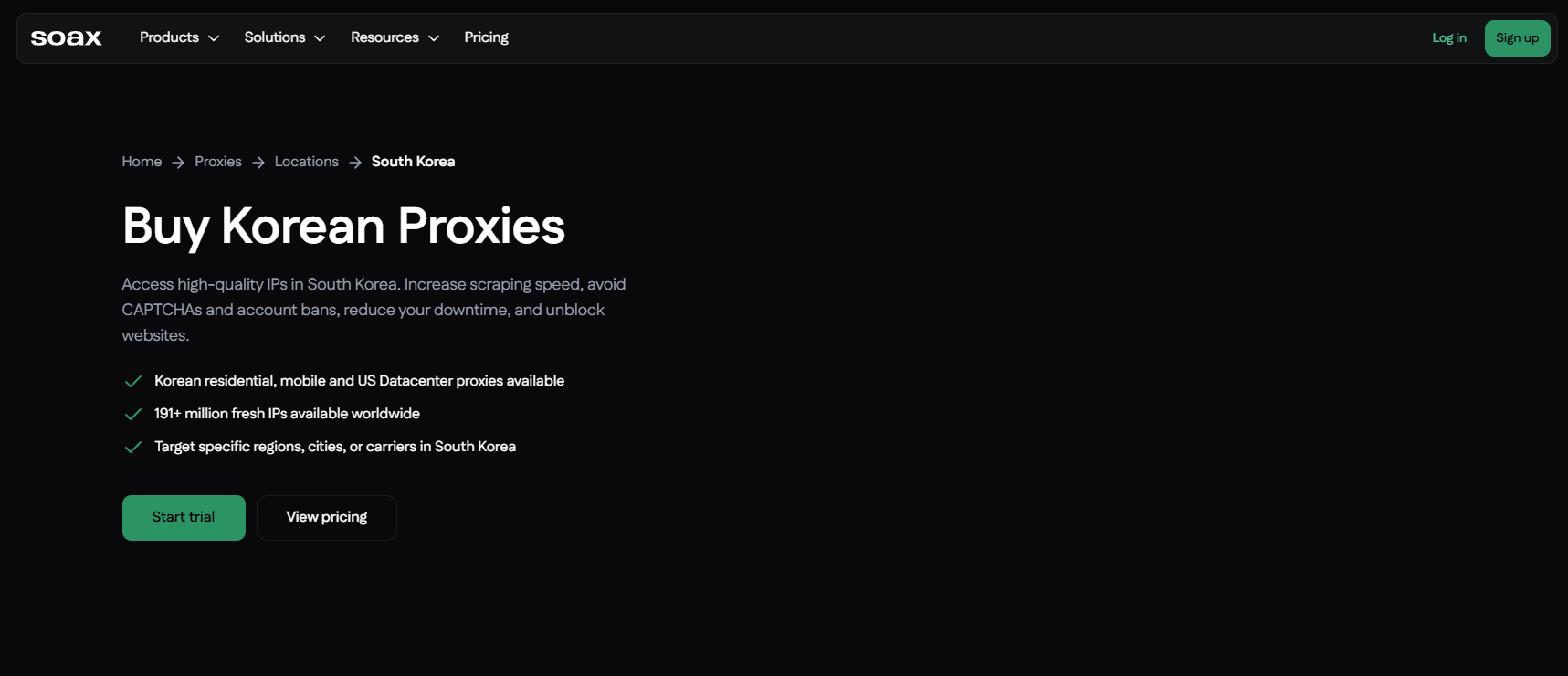
SOAX provides both residential and mobile proxies for South Korea, with a particularly detailed focus on location and network targeting. Its Korean proxy page lists more than 136,000 Korean IPs. Its publicly listed Korean coverage includes:

  • Proxy types: Residential, Mobile

  • IP pool: 136,320 Korean IPs

  • Residential pricing: From $5.00/GB

  • Free trial: They do not offer a free trial, but offers a trial package for just $1.99 for 3 days, including 400MB of data

  • South Korea targeting: Region, city, and carrier

  • Notable locations: Seoul, Busan, Incheon, Daegu, and other Korean cities

  • Carrier/network options: Includes networks such as SK Telecom, Korea Telecom, and LG Uplus

  • Best for: City- and carrier-specific Korean proxy use cases

SOAX is worth considering when your Korean proxy requirement goes beyond simply selecting the country and you need more granular location or carrier targeting.

korean proxy service - soax

SOAX’s Korean proxies

3.6. Webshare

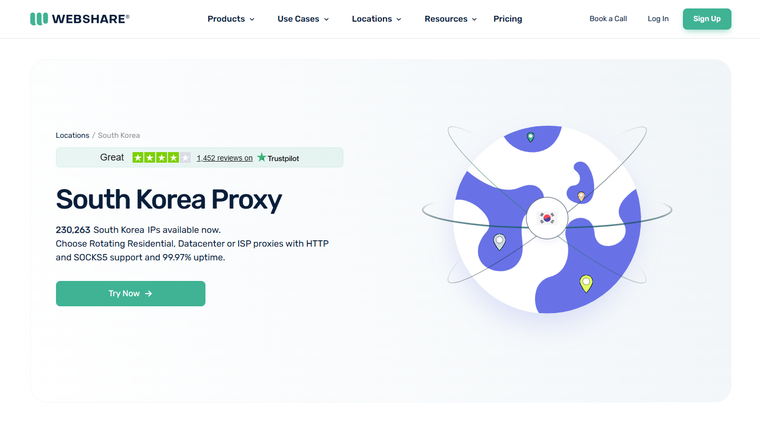
Webshare focuses on making proxy access relatively simple and affordable. Its South Korea proxy page lists more than 230,000 Korean IPs and also provides a small free proxy option for users who want to test the service. Public information includes:

  • Proxy types: Residential, Datacenter

  • IP pool: 230,263 South Korea IPs listed

  • Residential pricing: From $3.50/GB rotating residential

  • Free trial: 10 free proxies; no credit card required

  • South Korea targeting: Country-level access; more granular targeting is limited compared with some competitors

  • Notable locations: South Korea

  • Best for: Budget users and straightforward Korean proxy access

Webshare is more appealing when affordability and simplicity are priorities rather than highly granular Korean city, ISP, or carrier targeting.

korean proxy service - webshare

Webshare’s Korean proxies

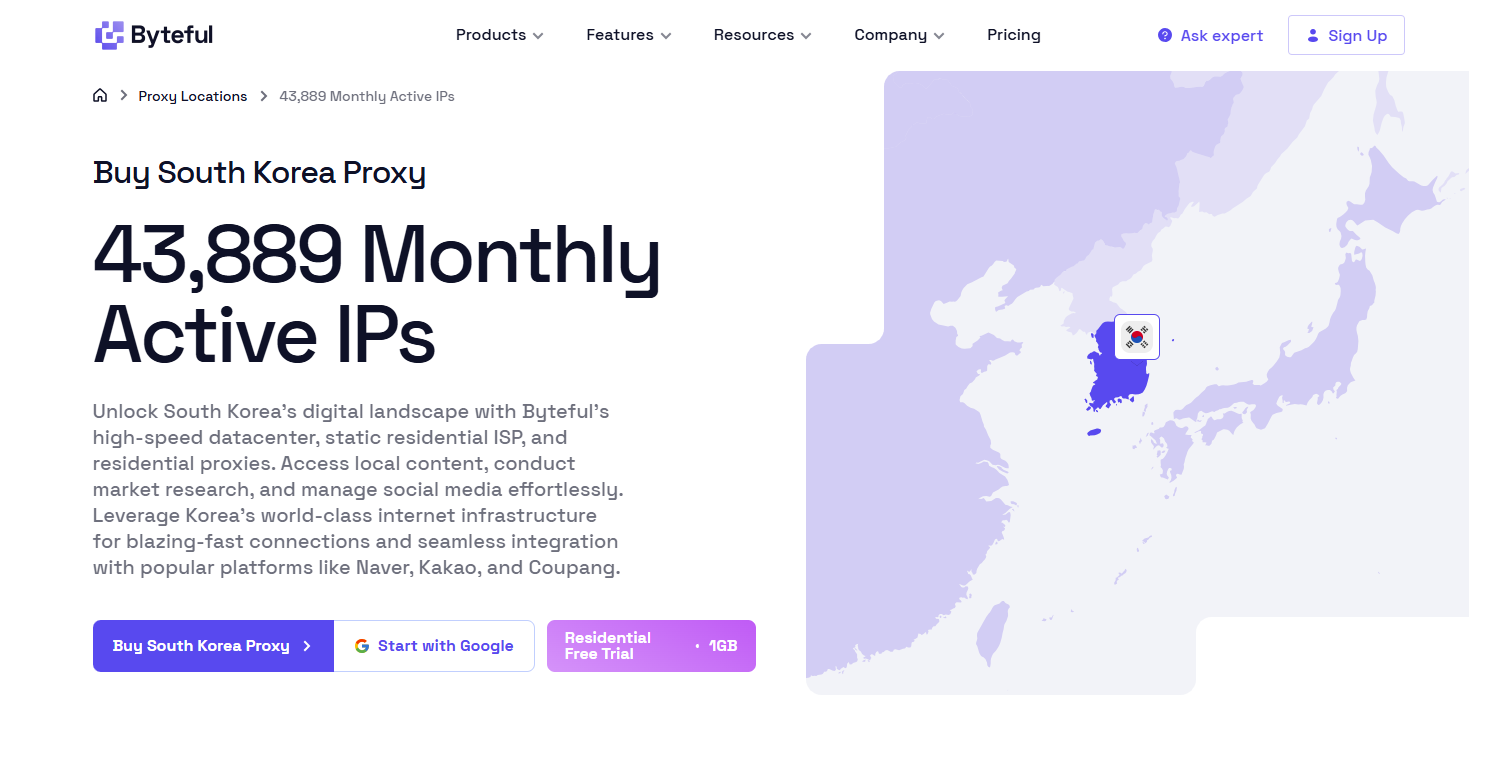
3.7. Byteful

Byteful has a dedicated South Korea proxy offering covering several proxy categories and specifically references Korean websites and use cases such as Naver, Kakao, Coupang, Gmarket, and 11Street. Publicly listed information includes:

  • Proxy types: Residential, Datacenter, ISP, Mobile

  • IP pool: 43,889 monthly active Korean IPs

  • Residential pricing: From $3.25/GB residential

  • Free trial: Available for selected ISP products after verification

  • South Korea targeting: Korea-focused targeting with ISP options

  • Notable locations: Seoul, Busan, Incheon

  • Best for: Korea-focused browsing, e-commerce research, and users needing multiple proxy types

Byteful is especially interesting for users who want Korean-specific proxy products rather than simply selecting South Korea from a global location list.

Interested in Byteful proxies? Check the latest Byteful promo codes and deals on IPFighter.

korean proxy service - byteful

Byteful’s Korean proxies

3.8. Infatica

Infatica offers residential Korean proxies with a relatively broad list of South Korean cities. Its Korea page also highlights dynamic IP rotation and a no-bot policy. Its publicly available information includes:

  • Proxy types: Residential

  • IP pool: 5,000+ IPs

  • Residential pricing: From $4/GB residential

  • Free trial: Not specified

  • South Korea targeting: City-level targeting

  • Notable locations: Seoul, Busan, Incheon, Daegu, Daejeon, Gwangju, Suwon, Goyang-si, Seongnam-si, Ulsan, Bucheon-si, and Ansan-si

  • Best for: Residential Korean IPs with city-level coverage

Infatica may be a suitable choice when your priority is accessing residential IPs across different South Korean cities rather than comparing a wide range of proxy types.

Planning to use Infatica? Check IPFighter for available Infatica promo codes and deals before purchasing.

korean proxy service - infatica

Infatica’s Korean proxies

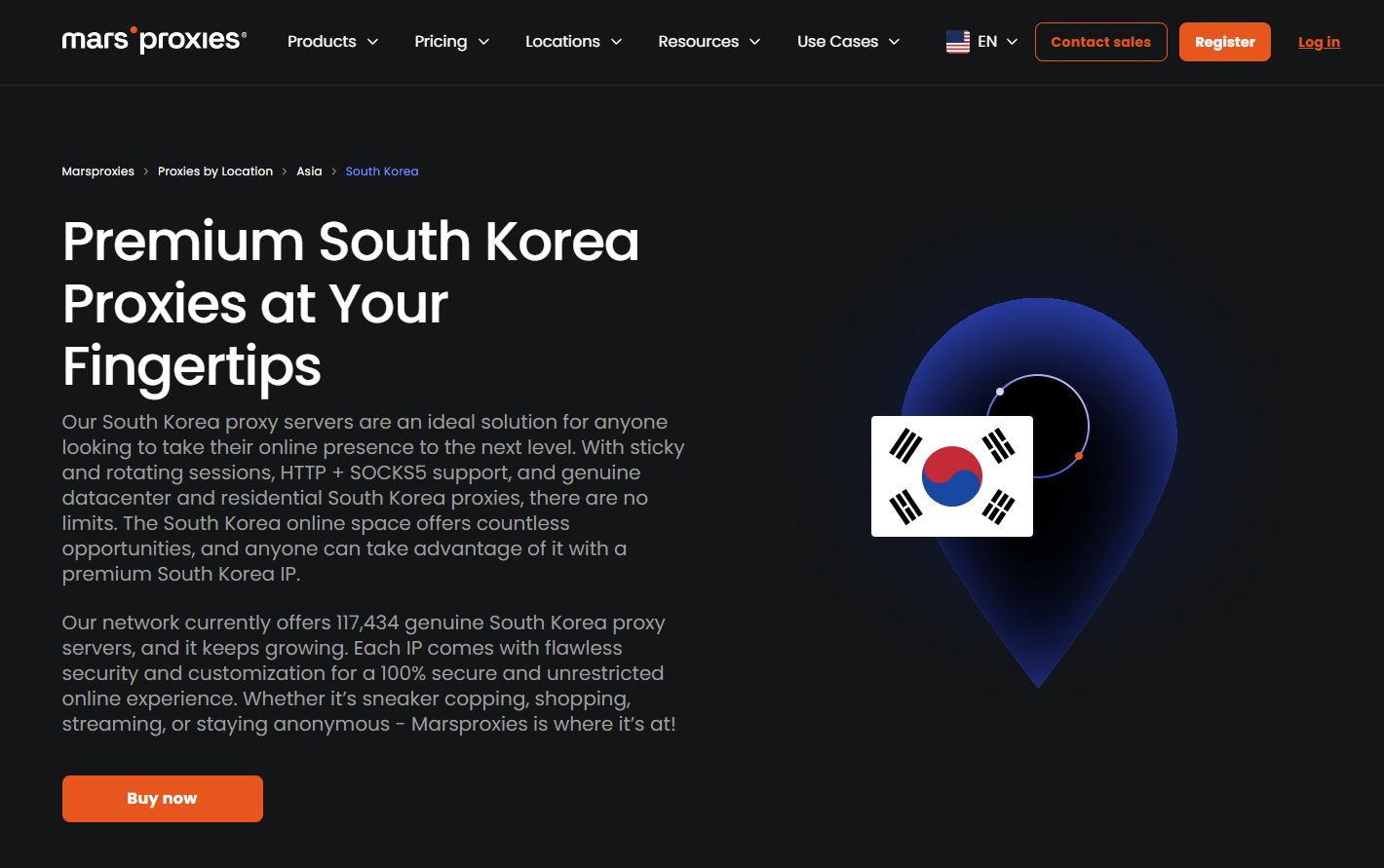
3.9. MarsProxies

MarsProxies offers several proxy categories and is listed among Korean proxy services in recent industry comparisons. Its available products cover residential, ISP, datacenter, and mobile proxies. Publicly available information indicates:

  • Proxy types: Residential, ISP, Datacenter, Mobile

  • IP pool: 117,434 genuine South Korea proxy servers

  • Residential pricing: Around $4.99/GB residential 

  • Free trial: Not specified

  • South Korea targeting: South Korea available; detailed Korea targeting is not specified

  • Notable locations: Four Korean cities are listed in available comparison data

  • Best for: Users comparing different Korean proxy types

MarsProxies can be considered when proxy type flexibility matters, although its publicly documented South Korea coverage is less detailed than providers such as Oxylabs, Bright Data, or SOAX.

korean proxy service - marproxies

MarProxie’s Korean proxies

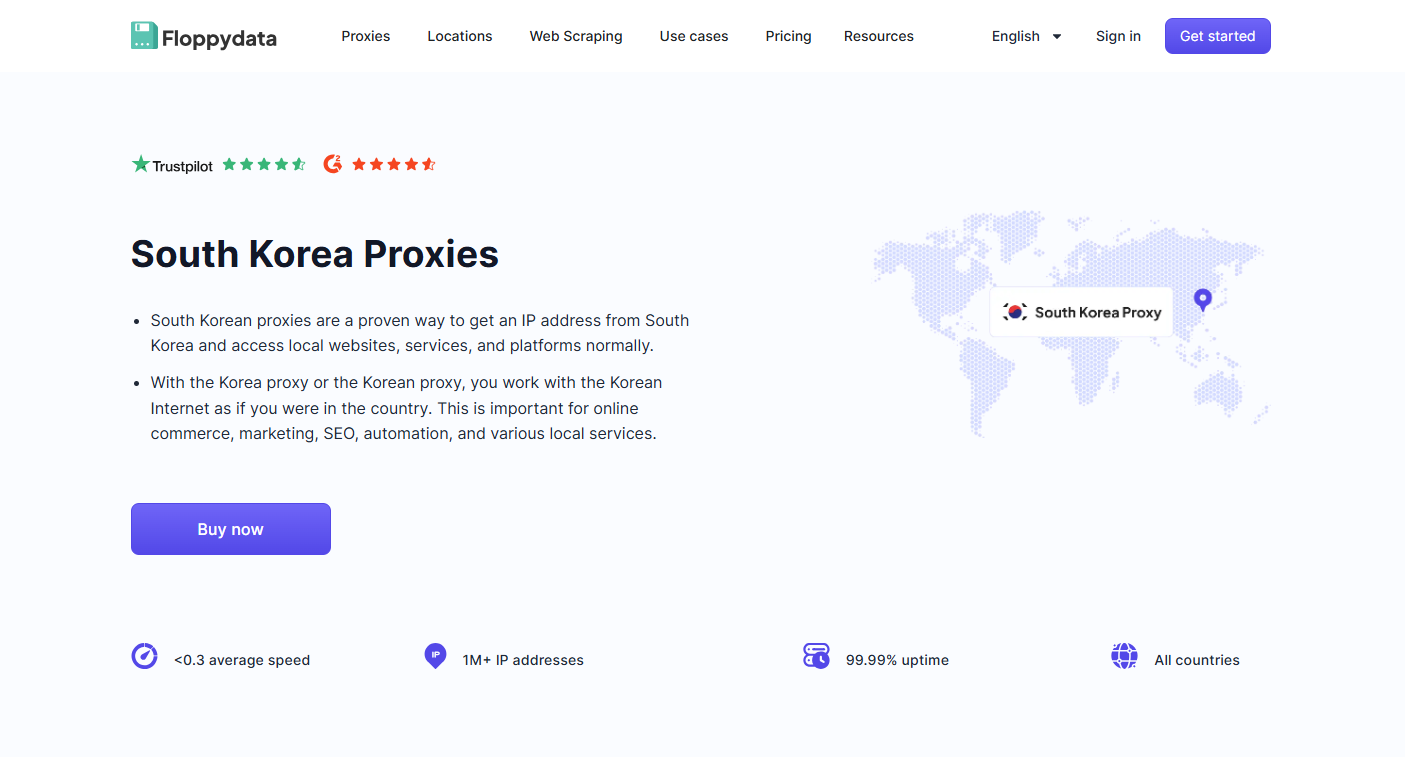
3.10. FloppyData

FloppyData provides several proxy categories on its South Korea page, including residential, ISP, mobile, and datacenter proxies. The provider also publishes relatively low starting bandwidth pricing. Its publicly listed information includes:

  • Proxy types: Residential, ISP, Mobile, Datacenter

  • IP pool: 1M+ IP addresses listed on the South Korea page

  • Residential pricing: From around $1/GB on listed plans

  • Free trial: Not specified

  • South Korea targeting: South Korea

  • Notable locations: Detailed city or carrier coverage is not specified

  • Best for: Users looking for low-cost access across several proxy types

FloppyData is worth considering if pricing and proxy-type variety are more important than highly detailed Korean city or carrier targeting.

Looking to try FloppyData? Browse the latest FloppyData promo codes on IPFighter Coupons Partners before choosing a plan.

korean proxy service - floppydata

FloppyData’s Korean proxies

4. What are Korean proxy services used for?

South Korean proxies can be useful whenever the information or service you are accessing changes according to the visitor's IP location. They can also help separate requests across different Korean IP addresses when a single connection is not suitable for a task. Common use cases include:

  • Korean website research: View websites and localized content as a South Korean visitor.

  • Market research: Compare prices, products, search results, and promotions shown to users in Korea.

  • E-commerce monitoring: Track Korean marketplaces and product availability from a Korean IP.

  • Web scraping: Collect publicly available Korean web data while distributing requests across multiple IPs.

  • Ad and SEO research: Check Korean search results, localized pages, and advertising behavior.

  • Account or website testing: Verify how a service behaves for users connecting from South Korea.

  • Location-specific automation: Run workflows that require a Korean IP address.

The right proxy type depends heavily on the website, scale, and level of location accuracy required. For example, a residential proxy may be a better starting point for localized website research, while a datacenter proxy can be more practical for high-volume tasks where residential identity is less important.

5. Which type of Korean proxy do you need?

The four main proxy types commonly available for South Korea are residential, mobile, static ISP, and datacenter proxies. They are not interchangeable, so choosing the type first can help narrow down the right provider.

Proxy type

What it offers

Best for

Main consideration

Residential

IPs associated with residential networks

Web research, localization, e-commerce

Usually more expensive than datacenter

Mobile

IPs associated with mobile networks

Mobile-focused services, stricter detection

Often more expensive and limited in supply

Static ISP

Stable IPs associated with

ISP networks

Long sessions, account workflows

Smaller pools than rotating residential

Datacenter

Data-center hosted IPs

High-volume tasks, speed, general automation

More likely to be recognized as datacenter traffic

In general, residential proxies are the safest starting point for broad Korean localization tasks, while mobile or ISP proxies can make more sense when the target website is sensitive to IP type or network origin.

6. Why avoid a free Korean proxy?

Free Korean proxies may look attractive when you only need a South Korean IP for a quick test. However, they generally provide much less information and control than a paid proxy service. Common issues include:

  • Unstable availability: Free proxies can disappear or stop responding without notice.

  • Slow connections: Shared infrastructure can make browsing or automation significantly slower.

  • Poor IP reputation: Some public IPs may already have a history of abuse or heavy use.

  • Unknown ownership: You may have little information about who operates the proxy.

  • Limited locations: Finding a working Korean IP from a specific city or network can be difficult.

  • No reliable support: Free lists typically do not provide customer support or replacement guarantees.

For quick browser-based testing, IPFighter's Free Web Proxy can also be a convenient option when you need to check a website through a proxy without committing to a paid proxy plan.

For ongoing research, automation, or business workflows, a reputable paid Korean proxy service is generally a more predictable choice.
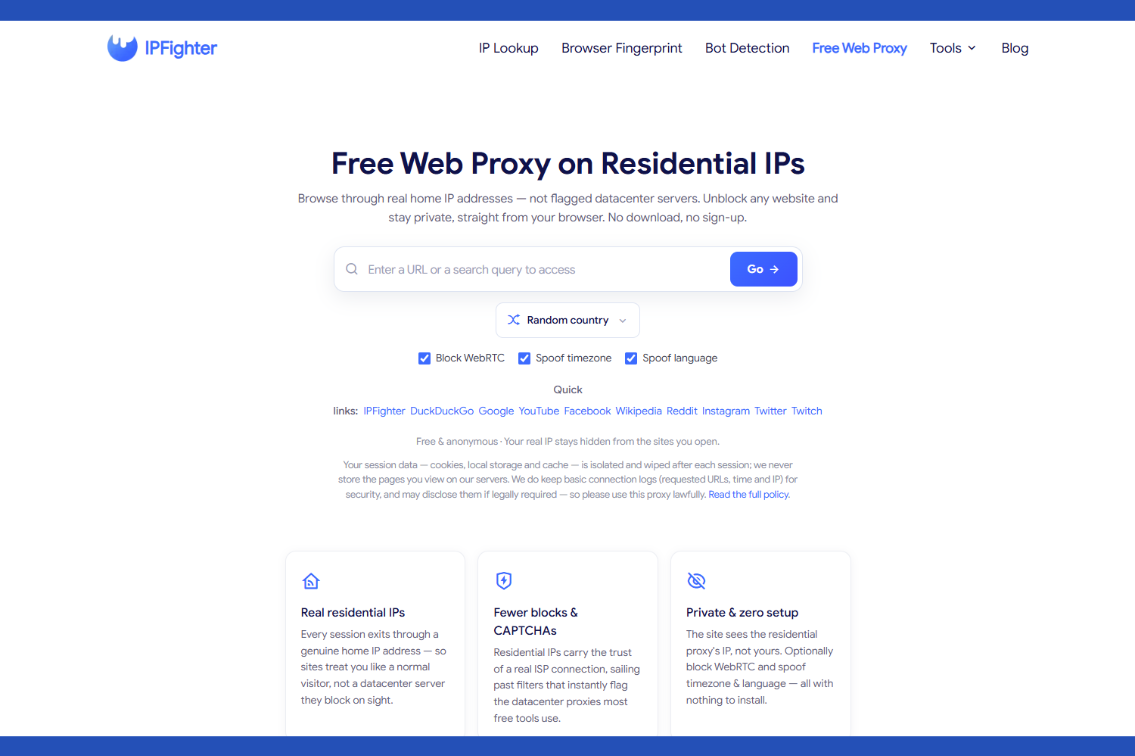
korean proxy service - free web proxy

Free Web Proxy tool on IPFighter

7. How to test a Korean proxy before you use it

A proxy being labeled “South Korea” does not automatically mean that it will work well for your target website. Before using it for a larger workflow, check both its location and its IP quality. You can use IPFighter to verify the proxy from several angles:

  • IP location: Confirm that the proxy is actually resolving to South Korea and that the detected country matches the location you selected from the provider.

  • ISP and network: Check the ISP, organization, and network information associated with the IP to understand where the proxy comes from and whether it matches the expected connection type.

  • Proxy detection: Check whether the IP is identified as a proxy, or other anonymizing connection, which can help you assess how easily the proxy may be detected by websites.

  • IP score: Review the IP Score to get a broader view of the IP's reputation and trust signals, helping you identify potentially low-quality or frequently abused IPs before use.

  • DNS and WebRTC leaks: Check for DNS or WebRTC leaks to make sure your real network information is not accidentally exposed while you are connected through the Korean proxy.

These checks are useful because a Korean IP alone does not tell you whether the proxy is clean, detectable, or suitable for your particular workflow.
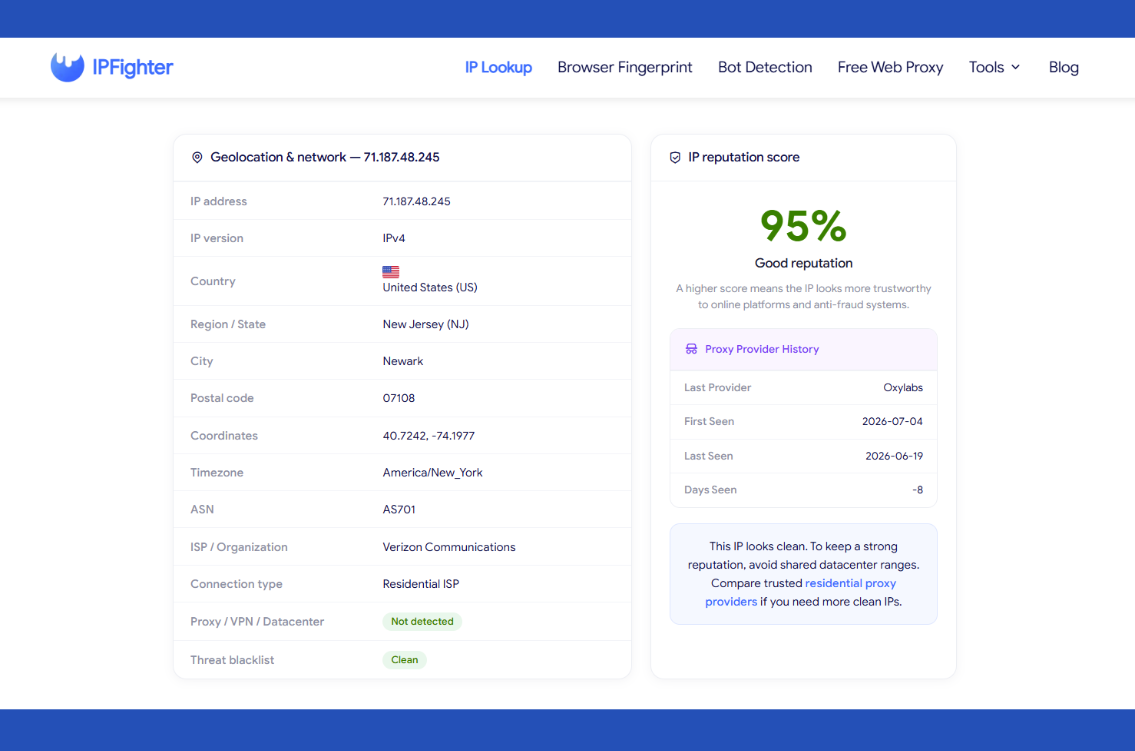
korean proxy service - check proxy on ipfighter

Check proxy on IPFighter

Read more:

Using a proxy to connect through a South Korean IP is generally not illegal by itself. However, what you do through the proxy still needs to comply with applicable laws, website terms, and the rules of the service you are accessing.

For example, using a Korean proxy to view localized content or conduct legitimate market research is different from using one to commit fraud, bypass account restrictions, or access content unlawfully.

Before using a proxy for automation or data collection, check the target website's terms and make sure your activity complies with applicable regulations.

9. Conclusion

A Korean proxy service can help with localization, market research, e-commerce monitoring, web scraping, and other tasks that require a South Korean IP. Among the providers compared, Oxylabs, Bright Data, Decodo, and SOAX offer strong Korea coverage and targeting, while Webshare, Proxy-Seller, Byteful, Infatica, MarsProxies, and FloppyData provide alternatives for different budgets and proxy requirements.

Before choosing a provider, consider the proxy type, Korean coverage, targeting options, pricing, and trial policy. You can also use IPFighter to check the proxy's location, detection status, IP reputation, and other signals before using it, and browse Coupons Partners for available provider deals and promo codes.

    
        Check your IP reputation and grab the best deals today!     
             Get started with IPFighter     

10. FAQ

What is a good proxy service for Korea?

There is no single best option. Residential proxies are a good general starting point, while mobile or ISP proxies may be better for specific targeting and detection requirements.

What is a Korean proxy service?

A Korean proxy service provides IP addresses located in South Korea, allowing websites to see your connection as coming from Korea.

Which type of Korean proxy is best?

Residential proxies are a good general choice. Mobile, ISP, or datacenter proxies may be better depending on your target website and workflow.

How do I get a South Korea IP address?

Use a proxy provider that offers South Korean IPs, then connect through its Korean proxy. You can verify the resulting IP with IPFighter.

How do I test a Korean proxy?

Check its location, ISP, proxy detection, IP score, and potential DNS or WebRTC leaks. IPFighter provides tools for these checks.

Read more

blog thumbnail

Korean proxy service: How to choose one and compare the top providers

A Korean proxy service gives you access to South Korean IP addresses, allowing websites and online platforms to see your connection as coming from South Korea. This can be useful for checking Korean websites, localized content, market data, or services that depend on IP location. However, “Korean proxy service” can also refer to Korean shopping or buying-agent services, which is a different concept. In this guide, IPFighter focuses on South Korea IP proxies and compares providers based on their publicly available proxy types, pricing, Korea coverage, targeting options, and trial policies.  Show more
Valerie Thorne avatar
Valerie Thorne
blog thumbnail

Ecommerce proxy: How online sellers use it and what to consider
Why does the same product show a different price, delivery cost, or stock level depending on where you look from? Online stores, marketplaces, and search engines often tailor what they show to the visitor's location, and many of them limit how many requests a single IP can send. An ecommerce proxy lets sellers and analysts see a store the way a buyer in another place would, and spread requests across several IPs. In this guide, IPFighter explains what an ecommerce proxy is, what it is used for, which proxy types fit different tasks, how to choose and test one, and what to know about rules and risks before you start.  Show more
Valerie Thorne avatar
Valerie Thorne
blog thumbnail

ProxyCove review: How its traffic-based proxy service works

With residential, mobile, and datacenter proxies under one network, does ProxyCove offer the flexibility users actually need, or does its performance vary behind the advertised coverage? With 195+ countries, flexible IP rotation, and traffic that does not expire, the provider offers several features that may appeal to users with different proxy requirements. In this ProxyCove review, IPFighter takes a closer look at its proxy types, pricing, key features, setup options, and network performance. We also test selected IPs to examine their quality, connection speed, and location consistency in real-world use.  Show more
Valerie Thorne avatar
Valerie Thorne
blog thumbnail

Best Chinese proxy providers: Compare China proxies

Finding a reliable Chinese proxy is not simply about choosing a provider that lists China as an available location. The type of Chinese IP, city and ISP targeting, IP pool, pricing, and session options can all affect whether a proxy works well for scraping, ecommerce research, localization testing, or other China-focused tasks. This guide, IPFighter compares 9 Chinese proxy providers by network coverage, proxy types, pricing, and China targeting options, helping you choose a reliable option for your specific use case.  Show more
Valerie Thorne avatar
Valerie Thorne
blog thumbnail

Social media proxy: What it is and how to choose one

If you manage social media accounts, research audiences, test content from different locations, or work with several platforms, a social media proxy can route your connection through a different IP address. The right proxy gives you more flexibility over the network identity and location that a social platform sees. In this guide, IPFighter explains what a social media proxy is, how it works, what it is used for, which proxy types and providers to consider, how to unblock Facebook, and what to know about risks and rules.  Show more
Valerie Thorne avatar
Valerie Thorne
blog thumbnail

Proxy for trading: Can it improve your connection and privacy?

A proxy for trading routes your connection through an intermediary server before it reaches a trading platform. It can change the IP address and network route visible to the platform, but it does not automatically make trading faster or more secure. In this guide, IPFighter explains how trading proxies work, what they can be used for, which proxy types fit different needs, and which providers to consider. It covers network proxies, not "proxy trading" as a market strategy, where a trader uses a related instrument to express a view on another asset. This guide is general information, not financial or legal advice.  Show more
Valerie Thorne avatar
Valerie Thorne