


All articles by Julian Vance

Why do I keep getting CAPTCHA? Here's what may be triggering it
Stuck in an endless loop of clicking traffic lights and crosswalks just to access basic websites? Endless CAPTCHAs do not mean your device is infected - instead, security algorithms are flagging your connection parameters, shared network traffic, or proxy configuration as potentially suspicious.
In this article, IPFighter explores why websites repeatedly demand human verification and how your IP reputation, VPN settings, and browser cookies impact these security checks. More importantly, you will learn practical troubleshooting steps to prevent these triggers and restore a seamless browsing experience Show more
What is a CAPTCHA? The check that separates people from bots
Whether it is selecting traffic lights in an image grid or simply clicking "I'm not a robot", CAPTCHAs are the ultimate digital security checkpoints standing between users and automated bots. Designed to analyze browser signals and distinguish human behavior from scripts, these verification challenges help platforms block spam, protect login gateways, and mitigate automated abuse.
In this article, IPFighter explores the mechanics behind CAPTCHA technology, the primary reasons websites enforce extra verification steps, and how different CAPTCHA variants function. We also share actionable methods to complete challenges efficiently and troubleshoot persistent verification loops. Show more
What is a mesh network and when should you use one?
Have you ever wondered why traditional WiFi routers struggle to cover every corner of your home, leaving you with frustrating dead zones? That is precisely where a mesh network comes in - connecting multiple nodes to create a seamless, resilient network that eliminates coverage gaps without relying on a single central hub.
In this guide, IPFighter explains what a mesh network does, how it works, its main types and applications, key benefits, potential limitations, and how mesh WiFi compares to a traditional router or WiFi extender. Show more
What is anonymous browsing and how does it work?
Could you really browse the internet without revealing who you are? With websites, advertisers, and network providers able to collect information about your IP address, browser, and online activity, staying anonymous online is not as simple as opening an Incognito window.
In this article, IPFighter explains what anonymous browsing means, how VPNs, Tor, privacy-focused browsers, and web proxies can help, and what these tools cannot hide. You’ll also learn how to reduce online tracking and identify the information your browser and network may still expose. Show more
Is Pixelscan any good? A full review and alternative
Pixelscan enables quick checks of browser fingerprints, IP addresses, proxies, VPNs, DNS, and WebRTC, helping to detect inconsistencies that could expose your environment. But is this tool sufficient for a comprehensive browser and proxy testing workflow?
In this review, we analyze Pixelscan and its key features, and compare it with IPFighter to help you choose the right solution for your testing needs. Show more
What is an IP2 network? How it works, uses, and benefits
If you search for IP2 network, you may find different explanations. Some describe it as a decentralized, privacy-focused network, while others use “IP2” to refer to unrelated IP services or live-streaming communities. In technical contexts, however, the term is often associated with I2P (Invisible Internet Project), a decentralized and encrypted peer-to-peer network designed for private communication and services.
In this guide, IPFighter explains what an IP2 network can mean, why it is often linked to I2P, how I2P works, its main use cases, benefits and limitations, and how it compares with privacy technologies such as VPNs and Tor. Show more
Explaining how to know if you have a DNS leak
Running a DNS leak test and seeing a table full of server addresses can be hard to make sense of without knowing what to compare it against. This guide walks you through how to know if you have a DNS leak by reading IPFighter's DNS leak test results in detail, and what to do depending on what you find. Show more

How to know if you have a WebRTC leak: Reading your results
Running a WebRTC leak test and seeing a wall of server names and IP addresses can be confusing if you don't know what you're looking at. This guide walks you through exactly how to know if you have a WebRTC leak by reading IPFighter's test results in detail, and what to do depending on what you find. Show more
How to check browser fingerprint for spoofing signs with IPFighter
Running a browser fingerprint test and seeing a score, a few labels, and a long list of technical fields can be a lot to take in at once. This guide walks you through how to check browser fingerprint results in detail, how to spot signs of spoofing or automation, and what to do depending on what you find. Show more
How to pass bot detection test and avoid getting flagged
Running the Bot Detection Test and seeing a number of flagged checks can be confusing if you don't know what each category actually means. This guide walks you through how to read your results in detail, what each group of checks is testing for, and what to do depending on which parts of your browser are getting flagged. Show more
How to improve IP score: A complete guide
If your IP score on IPFighter shows anything below "Good", it's easy to see the number and not know what to do with it. This guide walks you through exactly what your IP Score results mean from the overall percentage to the platform-by-platform breakdown and what steps to take depending on what's actually causing your score to be low. Show more
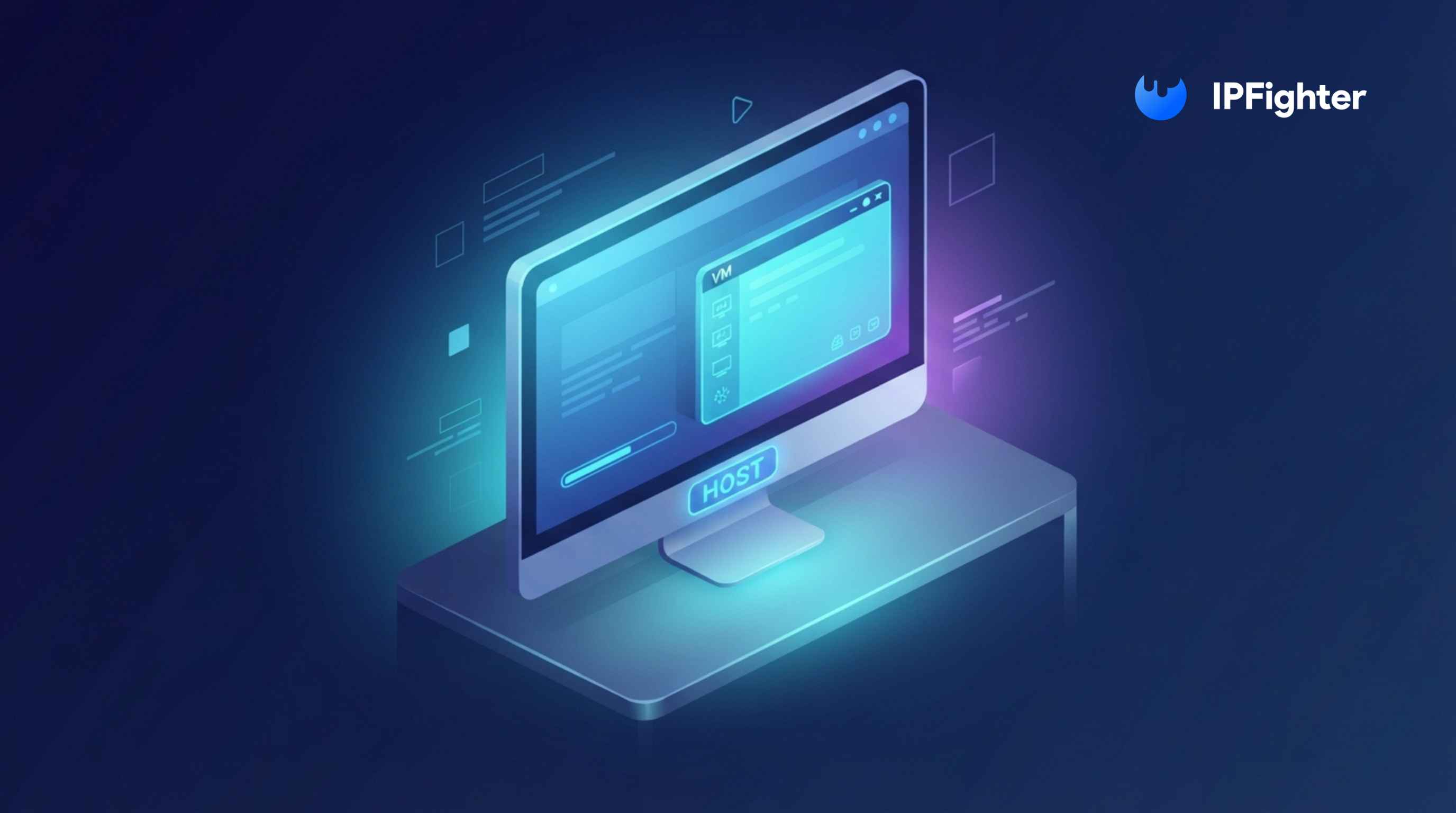
What is a virtual machine? How it works and when to use one
Nowadays, virtual machines are widely used for software testing, cybersecurity, cloud computing, and even multi-account management. But can a virtual machine really replace an antidetect browser, and is it enough to protect your online identity?
In this guide, IPFighter explains what a virtual machine is, how it works, its pros and cons, and when a VM is the right choice. You'll also learn how virtual machines compare with antidetect browsers for account management and privacy. Show more
What is a spoofer? How identity masking actually works
Are you wondering what a spoofer is and how it changes the identifier parameter? In this guide, IPFighter explains what a spoofer is, how spoofing works, the most common types of spoofers, and the differences between spoofers, VPNs, and proxies. You'll also learn when spoofing is legitimate, what risks to be aware of, and how to verify that your spoofed environment appears consistent. Show more
What is an IP fraud score? Reading the 0-100 scale
Are you wondering what the ip fraud score is and how to read it? In this guide, IPFighter explains what an IP fraud score is, the factors that influence it, how to interpret different score ranges, why it matters for online activities, and how to reduce the risk associated with your IP address. You'll also learn where to check IP fraud score before using an IP for sensitive tasks such as account creation, automation, or web scraping. Show more
Browser fingerprint testing tools: Which one should you use?
Not every browser fingerprint testing tool looks at the same things or presents results the same way. This guide rounds up the top browser fingerprint testing tools available today so you can pick the one that actually fits your use case, whether that's a quick sanity check or a deep technical audit.
In this guide, IPFighter compares each tool's strengths and limitations so you can choose the right one for your workflow. Show more