

Web scraping can help collect large amounts of public web data, but sending too many requests from a single IP can create performance and access issues. A web scraping proxy routes requests through an intermediary IP, giving scrapers more flexibility when collecting data from different websites and locations.
In this article, IPFighter explains how a scraping proxy works, what it is used for, which proxy types suit different scraping tasks, and what to consider before choosing a proxy.
1. What is a web scraping proxy?
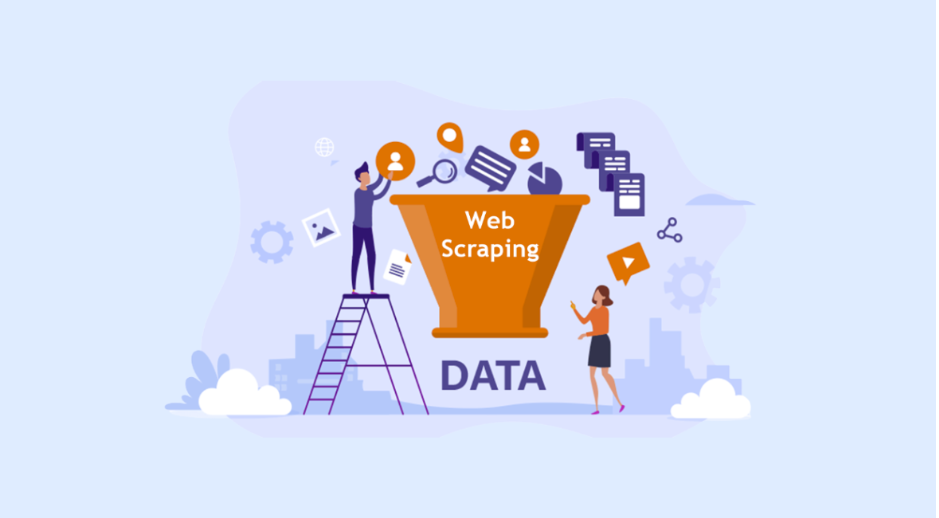
A web scraping proxy is an intermediary server that forwards requests from a scraper to a target website through a different IP address. Instead of sending every request directly from the scraper's original IP, the proxy handles the connection between the scraper and the website.
The terms scraping proxy and proxy for scraping are often used interchangeably, with the latter simply emphasizing the proxy's purpose. If you want to learn more about proxy technology in general, see our guide on what is a proxy.
Definition of web scraping proxy
Discover more:
-
Proxy server for streaming: Can it improve your experience?
-
Can a gaming proxy improve your gaming experience? What to know
-
Proxies for market research: How to collect better market data
2. How does a web scraping proxy work?
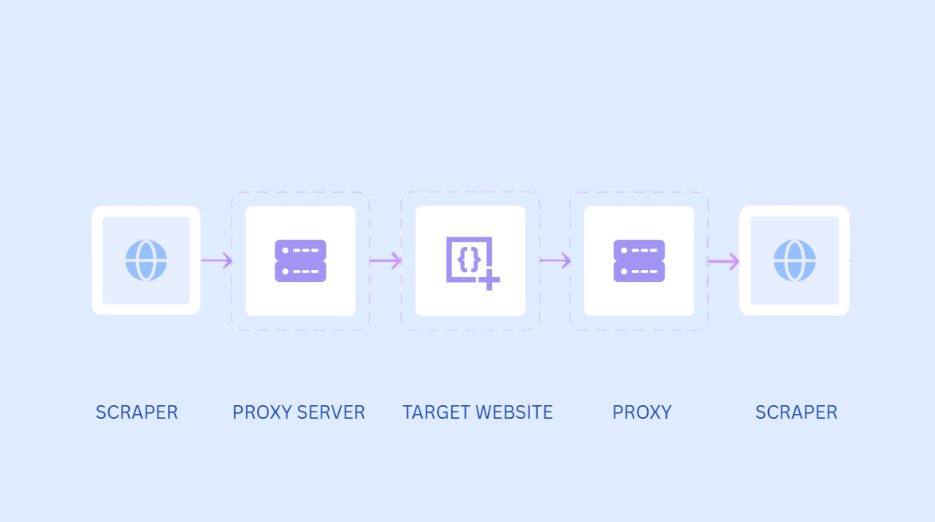
A web scraping proxy sits between the scraper and the target website, forwarding requests and returning the website's responses.
The basic flow looks like this:
Scraper → Proxy server → Target website → Proxy → Scraper
With rotating proxies, requests can also be distributed across different IP addresses instead of relying on a single IP. This can be useful when a scraping workflow needs multiple locations or a larger IP pool.
Web scraping proxy works
3. What is a scrape proxy used for?
A scrape proxy can support different types of web data collection, from simple research to larger-scale scraping projects. Common uses include:
-
Collecting public web data: Gather product information, reviews, search results, prices, and other publicly available content.
-
Market research: Monitor competitors, market trends, and publicly available industry data.
-
Price monitoring: Track product prices and availability across websites or locations.
-
Geo-specific data collection: Access location-dependent content to compare how websites appear in different regions.
-
Large-scale scraping: Distribute requests across multiple IPs when collecting larger volumes of data.
A proxy is only one part of a scraping workflow, however. It does not guarantee that a website will allow automated access or return the data you need.
4. Why use proxies for web scraping?
Proxies can provide several technical benefits for scraping workflows, particularly when requests need to be distributed across different IPs or locations.
-
IP distribution: Spread requests across multiple IP addresses.
-
Location targeting: Collect location-specific web data.
-
Session management: Maintain a consistent IP when a workflow requires one.
-
Scalability: Support larger scraping operations with a broader IP pool.
-
Reduced IP-based limits: Reduce the number of requests sent from a single IP.
However, proxies are not a universal solution for access restrictions. Websites can also consider request frequency, browser characteristics, account behavior, and other signals when evaluating automated traffic.
5. Which proxies are best for web scraping?
There is no single proxy type that works best for every scraping project. The right option depends on factors such as the target website, scraping volume, required locations, speed, and access restrictions.
5.1. Residential proxies
Residential proxies use IP addresses associated with residential internet connections. They can be useful for targets that are more sensitive to IP reputation or require specific geographic locations, although they generally cost more than datacenter proxies.
5.2. Datacenter proxies
Datacenter proxies use IP addresses associated with hosting or cloud infrastructure. They typically offer high speed, bandwidth, and scalability, making them suitable for high-volume scraping on targets with fewer access restrictions.
However, their hosting-provider IP ranges can be easier for websites to identify than residential IPs.
Datacenter proxies are among the best proxies for web scraping
5.3. ISP proxies
ISP proxies use IP addresses registered with internet service providers while the proxy infrastructure is hosted in a datacenter. They can provide a combination of stable IPs, high performance, and an ISP-associated IP identity.
This makes them useful for workflows that need a consistent IP while still requiring good connection performance.
Overall, the best proxy depends on the project's requirements rather than the proxy category alone. Speed, stability, IP quality, location, and the target website should all be considered.
6. How can you choose a proxy for web scraping?
Choosing a proxy depends on the target website, scraping volume, required locations, and how consistent the connection needs to be. Instead of choosing based only on proxy type, consider how each option fits your specific scraping workflow.
-
Low-restriction target → Datacenter proxies may offer enough speed and bandwidth for basic or large-scale scraping.
-
More restrictive target → Residential proxies may be more suitable when IP reputation and location are important.
-
Need a stable IP → Static or ISP proxies can work well for sessions that require consistent IPs.
-
Large-scale request distribution → Rotating proxies can distribute requests across multiple IPs.
-
Location-specific data → Choose a proxy with coverage in the countries or cities you need.
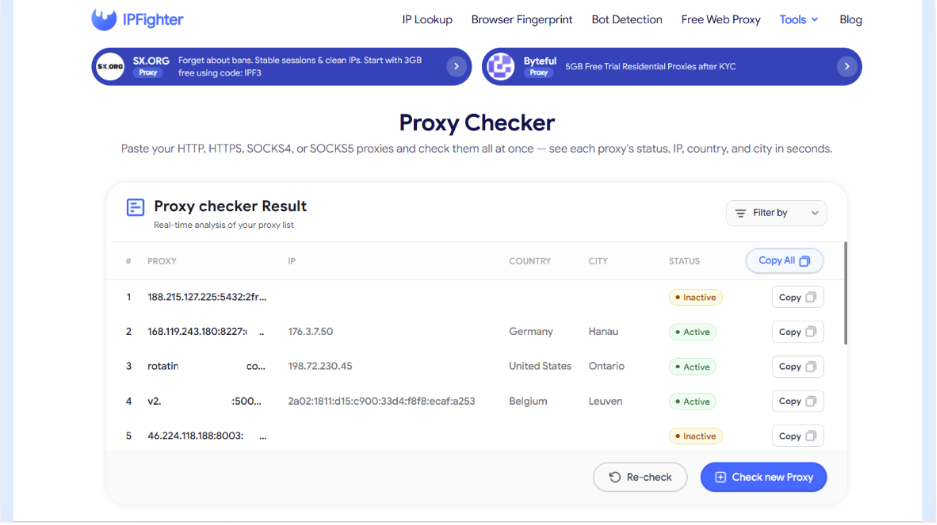
If you're comparing a web scraping proxy service, also consider IP quality, location coverage, rotation options, speed, and stability. Before adding a proxy to your scraper, you can use the IP Lookup tool on IPFighter to check IP details, location, proxy status, and IP reputation.
Check the proxy using IPfighter's proxy checker
Read more:
-
How to check if a proxy is working and read your results
-
How to use web proxy safely: A practical guide
7. Is web scraping illegal?
Web scraping is not automatically legal or illegal in every situation. The legal considerations can depend on your jurisdiction, the website's terms, the type of data collected, how it is accessed, and how the data is used. A few factors are particularly important:
-
Public data: Publicly accessible information is not automatically free from all legal or contractual restrictions.
-
Robots.txt: Websites can use robots.txt to provide instructions for automated crawlers, although the Robots Exclusion Protocol states that these rules are not a form of access authorization.
-
Terms of Service: A website may establish its own rules regarding automated access and data collection.
-
Data and copyright: Personal information, copyrighted material, and the way scraped data is reused can create additional legal considerations.
Court decisions can also depend heavily on the specific circumstances. For example, the Ninth Circuit's hiQ v. LinkedIn litigation addressed automated access to publicly available LinkedIn profiles under the U.S. Computer Fraud and Abuse Act, but it does not establish a universal rule that all web scraping is lawful. Laws vary by country and individual circumstances, so this article should not be treated as legal advice.
8. How can you scrape websites responsibly?
Responsible scraping focuses on collecting data without unnecessarily disrupting the target website or violating applicable rules. A practical approach includes:
-
Check robots.txt: Review the site's crawler instructions before scraping.
-
Follow Terms of Service: Check whether automated access or data collection is restricted.
-
Use reasonable request rates: Avoid sending excessive traffic in short periods.
-
Limit server load: Request only the pages and data you actually need.
-
Respect data restrictions: Collect and use information only where you have a legitimate basis to do so.
-
Protect sensitive data: Handle personal or sensitive information carefully and securely.
Following these practices can make a scraping workflow more sustainable while reducing unnecessary technical and compliance risks.
9. Conclusion
A web scraping proxy routes scraper requests through an intermediary IP and can support IP distribution, location targeting, scalability, and stable sessions. However, there is no single proxy type that fits every scraping project.
When choosing scraping proxies, consider IP quality, rotation, location, speed, stability, and the restrictions of your target websites. Responsible scraping also means following applicable laws, website terms, and crawler instructions.
Before using a proxy for data scraping, check the IP information, location, and proxy status using IPFighter to gain a better understanding of the connection you are using.
10. FAQ
What is the difference between a scraping proxy and a regular proxy?
A scraping proxy is simply a proxy used specifically for web data collection. Compared with a general-purpose proxy, it is typically selected based on factors such as IP pool size, rotation, location coverage, stability, and scalability.
Can I use free proxies for web scraping?
You can, but free proxies often have limited availability, inconsistent performance, and smaller IP pools. They may be suitable for basic testing but are generally less practical for larger scraping workflows.
How many proxies do I need for web scraping?
There is no fixed number. Your requirements depend on request volume, target restrictions, rotation frequency, session length, and the number of locations you need.
Do web scraping proxies hide my IP address?
Yes. A proxy forwards requests through its own IP, so the target website generally sees the proxy IP instead of your original public IP. However, this does not make a scraper invisible to other detection methods.
Can web scraping proxies bypass CAPTCHAs?
Not necessarily. A proxy can change the IP associated with a request, but CAPTCHA systems may also evaluate factors such as request patterns, browser signals, cookies, and other behavioral indicators.
Read more
Web scraping proxy: How to collect web data more efficiently


Can a gaming proxy improve your gaming experience? What to know
Proxy server for streaming: Can it improve your experience?
Rapidproxy review: A closer look at its residential proxy network
Coronium review: How do its dedicated 4G/5G proxies perform?
ProxyEmpire review: What do its proxy services offer?