

Success in proxy-dependent tasks relies on balancing IP authority, network speed, and pricing rather than raw pool size alone. CatProxies addresses these varying requirements by offering residential, mobile, ISP, and datacenter proxy solutions with flexible session controls.
In this CatProxies review, IPFighter examines the provider's proxy offerings, key features, pricing, and setup workflow. We also perform hands-on tests across its Standard and Premium Residential networks to evaluate IP quality, speed, and location accuracy in real-world scenarios.
1. General information
CatProxies provides several proxy products designed for different workloads, including rotating residential IPs, mobile connections, datacenter proxies, IPv6 addresses, and static ISP options. Its website also separates some products into plans with different IP pools, session controls, and billing structures. The information below summarizes the provider's main offerings and published specifications.
|
Website |
|
|
Founded |
N/A |
|
Proxy types |
Residential / Mobile / Datacenter / IPv6 / ISP |
|
IP pool |
20M+ residential IPs, 5M+ mobile IPs, 15,000+ datacenter IPs, and 680,000+ static ISP IPs across 62 countries. IPv6 is advertised as a very large address pool. |
|
Protocol |
HTTP / HTTPS / SOCKS5, depending on the product; some products also support UDP |
|
Pricing model |
Per-GB residential and mobile plans; time- or bandwidth-based datacenter and IPv6 plans; per-IP ISP plans |
|
Payment |
Visa, Mastercard, Apple Pay, Google Pay, Bitcoin, Ethereum, SBP, Pix, and other listed options |
|
Trial |
Free trial advertised for residential and selected unlimited-bandwidth plans; eligibility depends on the product |
|
Refund |
Conditional refunds for eligible residential and mobile purchases; several other products are explicitly non-refundable under the published policy |
|
Best for |
Web scraping, location-based research, social media workflows, data collection, and account management requiring different proxy types |
Discover more:
-
Best proxy providers in 2026: Compare top 6 services
-
What is a residential proxy? Why websites trust these IPs
-
Datacenter proxy: Best solutions for scaling operations
2. Proxy types available at CatProxies
CatProxies offers five main proxy categories, with several product variations within some categories. These options differ in how IP addresses are sourced, how long sessions can remain active, and whether users pay for traffic, time, or individual IPs.
2.1. Residential proxies
CatProxies' residential lineup includes standard residential and premium residential. Both are bandwidth-based products, but they use different pools and connection configuration methods. The provider advertises more than 20 million residential IPs across its network, with country and more granular location targeting.
-
Advertised proxy pool: 20M+ & 100M+ residential IPs
-
Standard residential: Designed for users who need access to a broad residential IP pool at a relatively low starting price. The provider supports rotating connections and sticky sessions, with targeting options that include country, US state, city, and ISP/ASN where available.
-
Premium residential: Positioned as a cleaner residential pool for websites that may block or challenge more frequently. It supports location and session controls, along with optional quality filtering according to the provider's documentation.
-
Coverage: 194 countries & 196 countries
-
Rotation: Rotating IPs and sticky sessions up to 24 hours
-
Protocols: HTTP, HTTPS, SOCKS5
Residential proxies can be useful when a task requires IP addresses associated with consumer internet connections. Standard Residential may appeal to users prioritizing cost and broad access, while Premium Residential is worth considering when IP quality is a greater concern. However, a premium label does not guarantee that every IP will avoid detection or deliver the same performance.
2.2. Mobile proxies
CatProxies offers mobile proxies using IP addresses assigned by cellular carriers. Its website advertises more than five million mobile IPs across 150+ countries, with 3G, 4G, LTE, and 5G connections represented in its product information.
-
Advertised proxy pool: 5M+ IP addresses
-
Coverage: 150+ countries
-
Filtering: Country, region or state, and carrier targeting where available.
-
Rotation: Rotating and sticky sessions
-
Protocols: HTTP, HTTPS, SOCKS5
Mobile proxies can be relevant for mobile ad verification, social media workflows, app testing, and websites that treat cellular IPs differently from residential or datacenter ranges. The trade-off is that mobile plans can cost more per gigabyte than standard residential options, so users should consider both their target requirements and expected traffic volume.
2.3. Datacenter proxies
CatProxies' datacenter products use IPs hosted on commercial server infrastructure. The provider offers customizable plans where users select the number of IPs and allocate them across available countries. It advertises a 10 Gbps network and a pool of more than 15,000 IPs across five countries.
-
Advertised proxy pool: 15,000+ IPs
-
IP allocation: Users can choose the number of IPs required and distribute them across supported locations.
-
Bandwidth: Plans can include a traffic allowance or unlimited bandwidth, depending on the package.
-
Rotation: Rotating connections are available, with static or dedicated options depending on the plan.
-
Protocols: HTTP, HTTPS, SOCKS5
Datacenter proxies are often a practical option for large-scale data collection, price monitoring, and other tasks where speed and cost efficiency matter more than a residential IP origin. However, datacenter ranges may be easier for some websites to identify, so they are not always the best fit for targets with strict proxy filtering.
2.4. IPv6 proxies
CatProxies also provides IPv6 proxies for applications and websites that support IPv6 connections. The service offers bandwidth-based and unlimited plans, with the unlimited option tied to a selected connection speed.
-
Advertised proxy pool: Octillions of IPv6 addresses across 14 /32 subnets in 4 countries
-
Address type: Native IPv6 proxy connections.
-
Location options: The provider lists worldwide access and gateways for the US, UK, Germany, and the Netherlands.
-
Rotation: Rotating connections are available, with static-session options described in the product documentation.
-
Protocols: HTTP, HTTPS, SOCKS5
IPv6 proxies can be useful for high-volume tasks where the target supports IPv6 and a large pool of addresses is advantageous. However, IPv6 compatibility should be checked before purchase because not every website, application, or proxy workflow accepts IPv6 connections in the same way as IPv4.
2.5. ISP proxies
CatProxies' ISP lineup includes static ISP products and dedicated ISP plans. These use ISP-registered IP addresses hosted on server infrastructure, combining the potential advantages of a stable IP with infrastructure that differs from a typical consumer residential connection.
-
Advertised proxy pool: 680,000+ dedicated IPs in 62 countries
-
Static ISP: Users can select a country and city, and optionally a carrier where available. Plans are offered for different rental periods and advertise unlimited bandwidth.
-
Dedicated ISP: These plans are tailored to specific use cases, such as retail, sneaker releases, ticketing, and social media workflows. The available countries and IP packages depend on the product.
-
Session behavior: IPs are intended to remain stable during the plan period rather than rotating on every request.
-
Protocols: HTTP, HTTPS, SOCKS5
ISP proxies can suit workflows that require longer sessions, repeated access from the same address, or an IP tied to a particular location or carrier. Dedicated ISP products are more specialized, so buyers should check the supported target websites and replacement terms before choosing a plan.
Overall, CatProxies' range covers several distinct needs rather than relying on one universal proxy product. The key is to choose based on the target website, required IP origin, session duration, location options, and traffic budget.
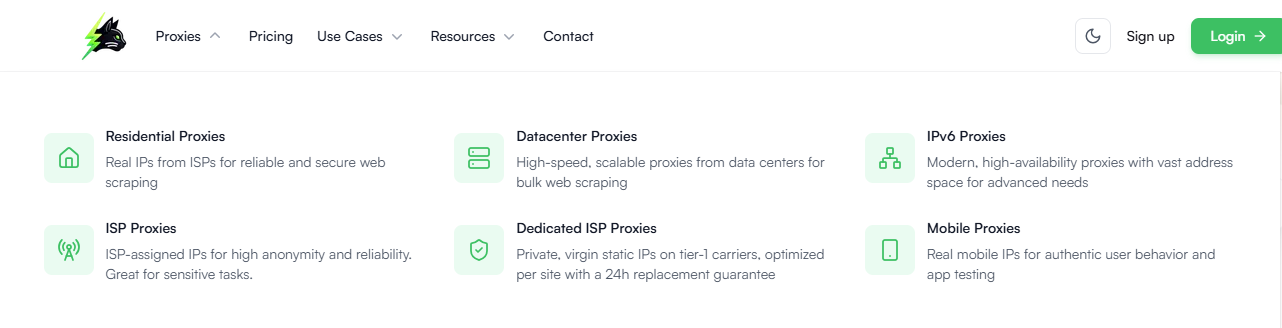
Proxy types available at CatProxies
3. Key features of CatProxies proxies
Beyond its range of proxy types, CatProxies advertises several features intended to make its plans adaptable to different workloads.
-
Location targeting: Depending on the product, users can select a country, region or state, city, ISP, or carrier. This is useful for localized search checks, ad verification, and market research. Not every targeting level is available across all products or locations.
-
Rotation: Residential and mobile plans offer session options for different workflows. Rotating sessions can help distribute requests across IPs, while sticky sessions keep a connection on the same IP for a period of time. The exact session limits vary by product.
-
Multiple billing structures: CatProxies offers per-GB residential and mobile plans, datacenter plans with IP and bandwidth configurations, IPv6 options, and per-IP ISP products. This gives users flexibility, although comparing costs requires looking at the complete plan rather than just the advertised starting price.
-
Protocol support: HTTP/HTTPS and SOCKS5 are available across much of the catalog, while UDP support is listed for selected products. Authentication methods vary: for example, residential and mobile plans use username/password authentication, while datacenter plans may support IP binding.
-
Traffic top-ups and plan extensions: The provider documents options to add traffic to eligible bandwidth-based plans and extend certain products. This can help users continue using an existing configuration without purchasing an entirely new plan, though unused traffic and remaining plan time are handled according to each product's rules.
-
Customizable datacenter and ISP plans: Users can select IP quantities, allocate datacenter IPs across supported countries, or configure certain ISP plans around city and carrier requirements. This may be useful for projects that need more control over IP inventory.
These features make CatProxies flexible, especially for users who work across several proxy types. Still, the breadth of the catalog means it is important to check the specific plan's protocol, authentication, targeting, session, and refund terms before purchasing.
4. CatProxies pricing overview
CatProxies uses different pricing models depending on the proxy type. Residential and mobile plans are mainly traffic-based, datacenter plans depend on IP quantity and plan duration, IPv6 offers both bandwidth and unlimited options, and ISP products are priced per IP.
The following table summarizes the starting prices advertised on the provider's pricing pages. These are entry points rather than direct equivalents between products.
|
Proxy type |
Advertised starting price |
Pricing model |
|
Standard Residential |
$2.50/GB |
Per GB; larger packages reduce the price per GB |
|
Premium Residential |
$4.00/Gb |
Per GB; larger packages reduce the price per GB |
|
Mobile |
$4.50/GB |
Per GB; larger packages reduce the price per GB |
|
Datacenter |
$4/day on the main pricing overview |
Time-based plans with selectable IP quantities and bandwidth; prices vary by configuration |
|
IPv6 |
$10/day on the main pricing overview |
Unlimited plans with speed limits or bandwidth-based options |
|
Static ISP |
$4/IP |
Per IP, with rental periods from one day to several months |
|
Dedicated ISP |
$5/IP |
Per IP, with pricing varying by plan type and package size |
Prices are based on CatProxies' published pricing pages and may vary by package, location, configuration, and current availability. The provider displays prices before VAT; confirm the final amount at checkout.
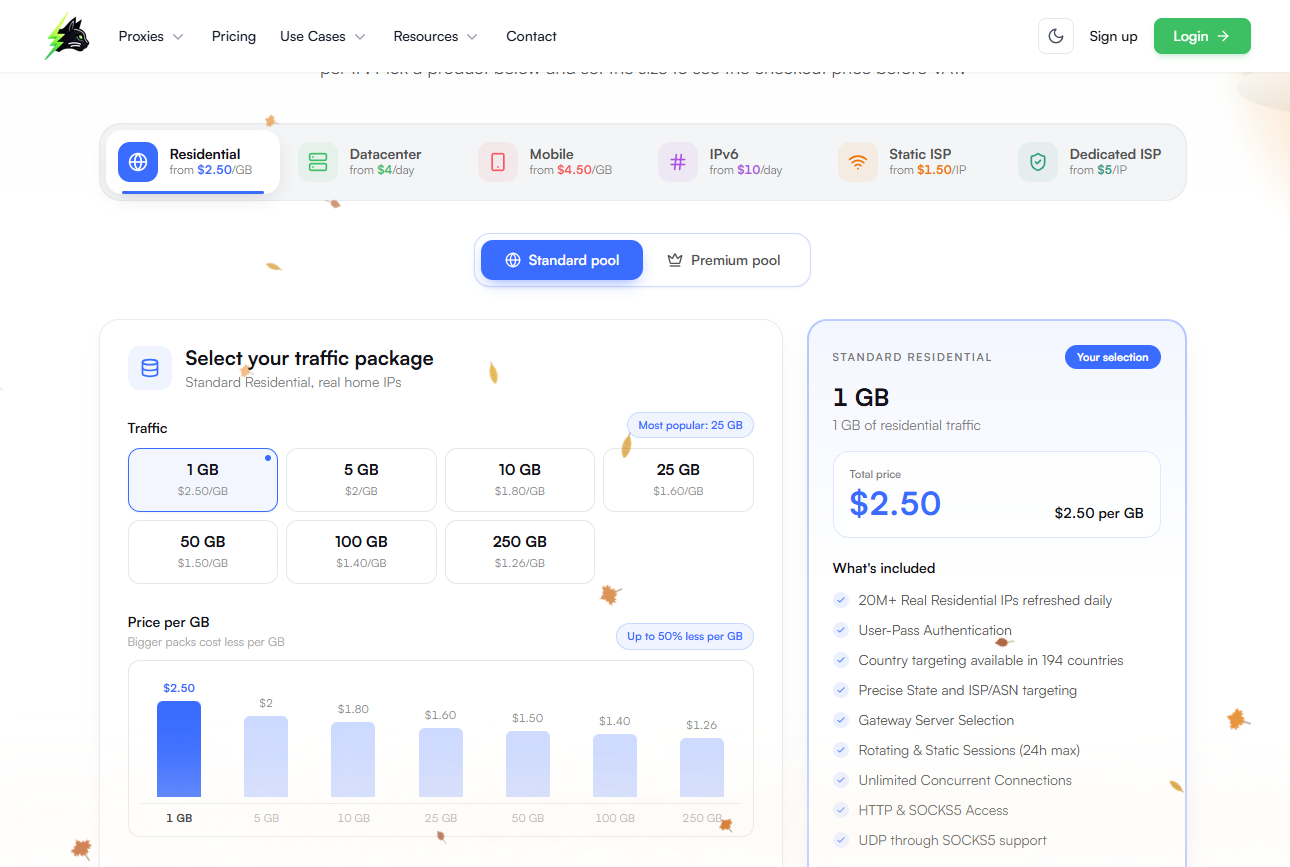
Prices for proxies plan at CatProxies
If you're planning to purchase proxies from CatProxies, don't miss the CatProxies promo code available on IPFighter. You can save on your proxy purchase with exclusive discounts while choosing the plan that best suits your needs.
5. Performance test
CatProxies offers a variety of proxy types; however, the findings in this review focus specifically on their residential proxy products. We evaluated the selected IP addresses using IPFighter, speed tests, and Google search to assess IP quality, connection performance, and geographical consistency. These results reflect only the specific IP addresses tested and do not necessarily represent CatProxies' entire network.
5.1. Preparation
Before evaluating the proxy, we first added it to our browser using the IPFighter Proxy Manager extension. This extension makes it easy to import, manage, and switch between multiple proxies directly within your browser, eliminating the need for manual proxy configuration.
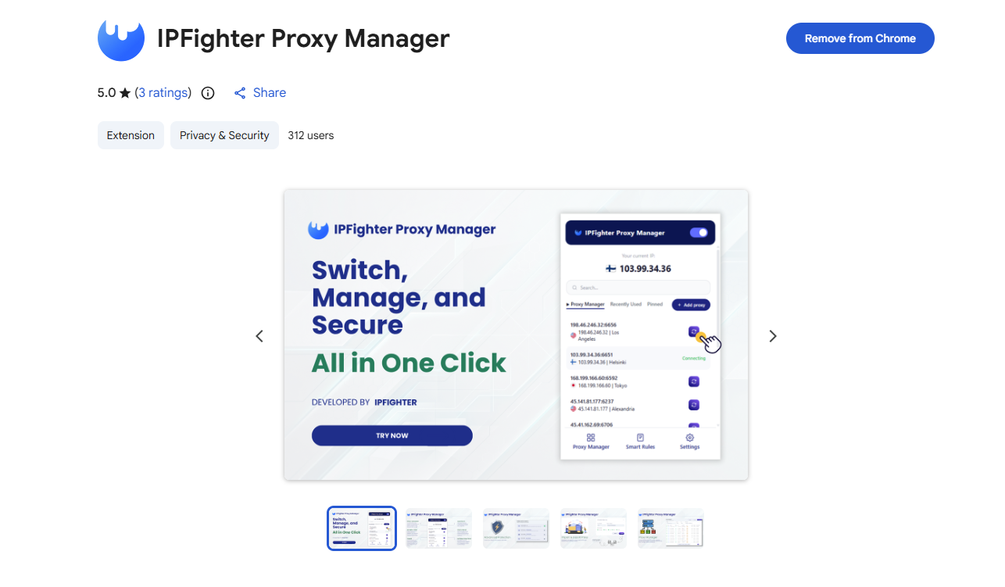
IPFighter Proxy Manager extension on Chrome
If you'd like to learn how to set it up, check out our detailed guide: A complete guide to the IPFighter Proxy Manager extension.
5.2. Test results
The table below summarizes the results for all 10 residential IPs, split between Standard Residential and Premium Residential. The overall assessments consider IP quality, proxy detection, connection speed, latency, and location consistency together rather than treating any single metric as conclusive.
|
Proxy type |
Proxy location |
IPFighter |
Speedtest |
Google Search |
Overall assessment |
|
|
Standard Residential |
IP1 |
Alaska, US |
Score: 90%; Proxy: Not detected; Blacklist: Clean; detected location: Alaska, US |
Download: 4.49 Mbps; Upload: 4.34 Mbps; Latency: 413 ms. |
Detected: Alaska, US; Target: Alaska, US |
High-quality, clean IP with consistent location detection, but slow speeds and high latency may limit performance-sensitive tasks |
|
IP2 |
Brittany, France |
Score: 90%; Proxy: Not detected; Blacklist: Clean; detected location: Brittany, France |
Download: 16.78 Mbps; Upload: 18.84 Mbps; Ping: 270 ms |
Detected: Paimpol, France; Target: Brittany, France |
High-quality, clean IP with reasonable speeds and regional location consistency, although latency remains relatively high. |
|
|
IP3 |
Daegu, South Korea |
Score: 90%; Proxy: Not detected; Blacklist: Clean; detected location: Daegu, South Korea |
Download: 47.64 Mbps; Upload: 16.31 Mbps; Ping: 490 ms |
Detected: Gyeonggi-do, South Korea; Target: Daegu, South Korea |
High-quality, clean IP with strong download speed, but high latency and a detected region different from the target city. |
|
|
IP4 |
Wales, UK |
Score: 85%; Proxy: Not detected; Blacklist: Clean; detected location: Wales, UK |
Download: 533 kbps; Upload: 526 kbps; Ping: 314 ms; Jitter: 72.4 ms |
Detected: Llanelli, UK; Target: Wales, UK |
Clean IP with consistent regional location, but extremely slow speeds and noticeable jitter may significantly limit usability. |
|
|
IP5 |
Kowloon, Hong Kong |
Score: 65%; Proxy: Detected as datacenter; Blacklist: Clean; detected location: Kowloon, Hong Kong |
Download: 35.80 Mbps; Upload: 4.26 Mbps; Ping: 268 ms |
Detected: Texas, US; Target: Kowloon, Hong Kong |
Moderate-quality IP with clean blacklist status and reasonable download speed, but datacenter detection and a major location mismatch are notable drawbacks. |
|
|
Premium Residential |
IP1 |
Aachen, Germany |
Score: 85%; Proxy: Not detected; Blacklist: Clean; detected location: North Rhine-Westphalia, Germany |
Download: 20.56 Mbps; Upload: 20.78 Mbps; Ping: 309 ms |
Detected: Hückelhoven, Germany; Target: Aachen, Germany |
High-quality, clean IP with country-level location consistency and balanced speeds, although the detected town differs from the target city. |
|
IP2 |
India |
Score: 85%; Proxy: Not detected; Blacklist: Clean; detected location: Telangana, India; DNS server detected in Singapore |
Download: 217.11 Mbps; Upload: 28.99 Mbps; Ping: 111 ms |
Detected: Telangana, India; Target: India |
High-quality, clean IP with excellent speeds, low latency, and consistent country-level location. The DNS location discrepancy warrants context but does not by itself confirm a leak. |
|
|
IP3 |
Canada |
Score: 85%; Proxy: Not detected; Blacklist: Clean; detected location: Ontario, Canada; DNS server detected in the US |
Download: 41.96 Mbps; Upload: 7.32 Mbps; Ping: 330 ms |
Detected: Cottam, Kingsville, Ontario, Canada; Target: Canada |
High-quality, clean IP with good download speed and country-level location consistency, though latency is relatively high and upload speed is more modest. |
|
|
IP4 |
Hanoi, Vietnam |
Score: 80%; Proxy: Not detected; Blacklist: Clean; detected location: Hanoi, Vietnam; DNS server detected in Singapore |
Download: 180 Mbps; Upload: 42 Mbps; Latency: 124-215 ms |
Detected: Hai Phong, Vietnam; Target: Hanoi, Vietnam |
Good-quality, clean IP with excellent speeds, but Google Search detected a different city. The DNS location discrepancy alone is not proof of a leak. |
|
|
IP5 |
US |
Score: 90%; Proxy: Not detected; Blacklist: Clean; detected location: New Mexico, US |
Download: 43 Mbps; Upload: 8.8 Mbps; Latency: 245-365 ms |
Detected: Chamiza, Rio Rancho, New Mexico; Target: US |
High-quality, clean IP with good download speed and consistent country-level location, although latency varies and upload speed is moderate. |
|
5.3. Overall performance findings
Across the 10 residential IPs tested, nine received IPFighter scores of 80% or higher, with proxy detection returning “Not detected” and blacklist status marked “Clean.” The exception was Standard Residential IP 5 in Hong Kong, which received a lower score and was identified as a datacenter proxy. Google Search also returned a US location instead of the configured Hong Kong target, making this IP the clearest outlier in the sample.
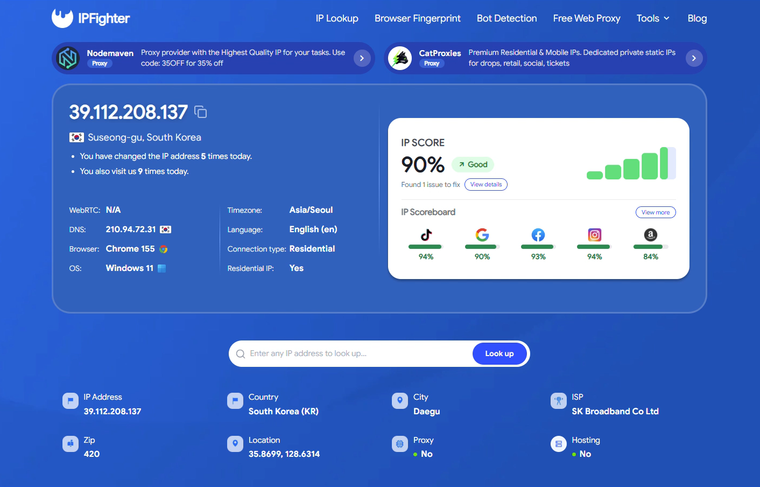
South Korea standard residential IP test results
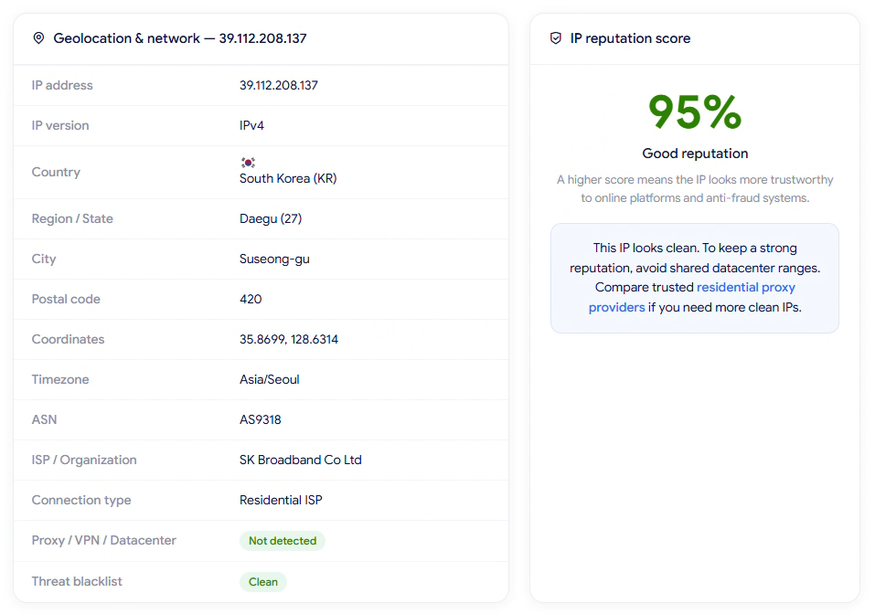
IP Lookup results on IPFighter
Connection performance varied considerably between individual IPs. Some Premium Residential addresses delivered strong download and upload speeds, while the Standard Residential IP in Wales was much slower. Latency was also inconsistent: the India Premium Residential IP recorded the lowest ping in this sample, while several other addresses had considerably higher latency. This suggests that performance should be evaluated at the IP and location level rather than assumed to be uniform across either plan.
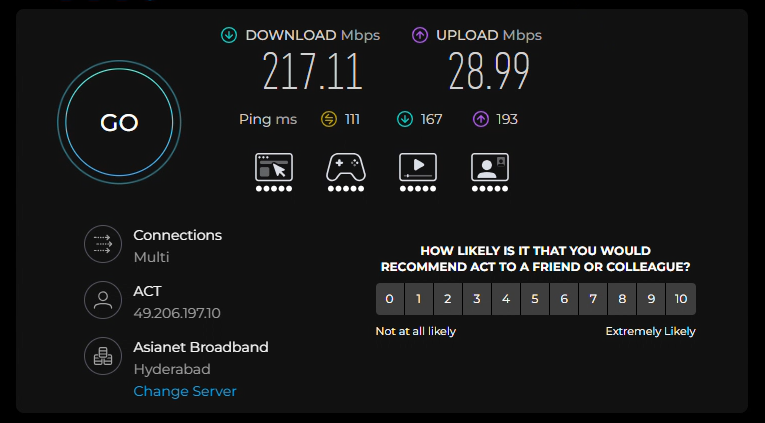
Results of residential IP speed tests in India on Speedtest
Location consistency was generally better at the country or region level than at the exact city level. For example, the Daegu IP was detected in another South Korean region, while the Vietnam IP configured for Hanoi was detected in Hai Phong. Such discrepancies can occur because IP geolocation databases do not always map a proxy address to the exact requested city. Users who need precise city-level targeting should verify the returned location against their own requirements.
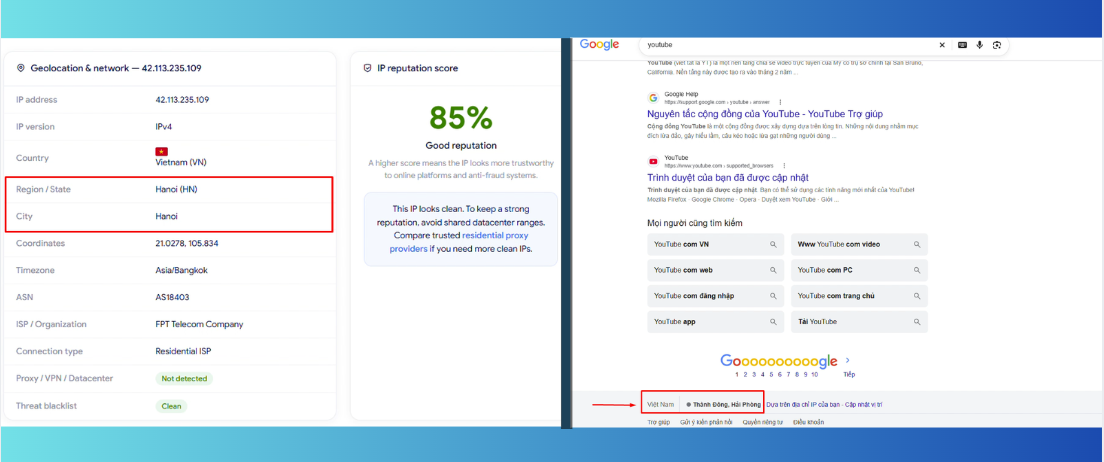
Results of the residential IP location check in Vietnam
Three Premium Residential IPs also showed DNS servers located in a country different from the proxy target. This observation should not automatically be treated as a confirmed DNS leak. DNS queries can be routed through distributed resolver infrastructure, and geolocation databases may not accurately reflect the physical location of a DNS server. The key concern is whether a test exposes the user's real IP address or actual ISP information; the DNS location alone is not sufficient to establish that.
During browsing tests, both Standard and Premium Residential proxies were also usable for searching social media platforms, watching YouTube, and browsing Reddit. These activities generally ran smoothly, without notable stuttering, frequent disconnections, or timeouts during the observed sessions. This is a positive practical sign for CatProxies' residential products, although it does not override the speed and latency differences recorded for individual IPs.
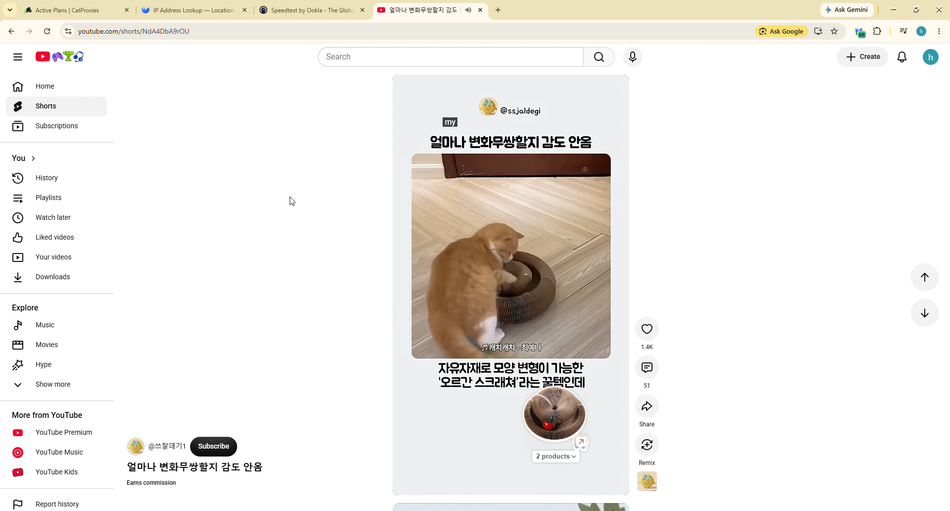
Access YouTube using an IP from a CatProxies residential plan
Overall, the residential sample showed generally good IP reputation and usable everyday browsing, particularly across the Premium Residential tests. However, speed, latency, and exact geolocation varied, and one Standard Residential IP showed clear proxy-type and location discrepancies. These findings apply only to the residential products and IPs tested at a specific time; actual performance may differ by location, IP assignment, network conditions, and target website. They should not be interpreted as a test of CatProxies' mobile, datacenter, IPv6, or ISP products.
Read more:
-
How to use web proxy safely: A practical guide
-
How to check browser fingerprint for spoofing signs with IPFighter
-
Explaining how to know if you have a DNS leak
6. How to get proxy from CatProxies
Getting started with CatProxies is relatively straightforward: create an account, choose a proxy plan, configure the required targeting and session settings, and generate the proxy credentials.
Step 1. Create or log in to your account
Go to the CatProxies dashboard and create an account or log in. After activation, you can access the available proxy plans and trial options.
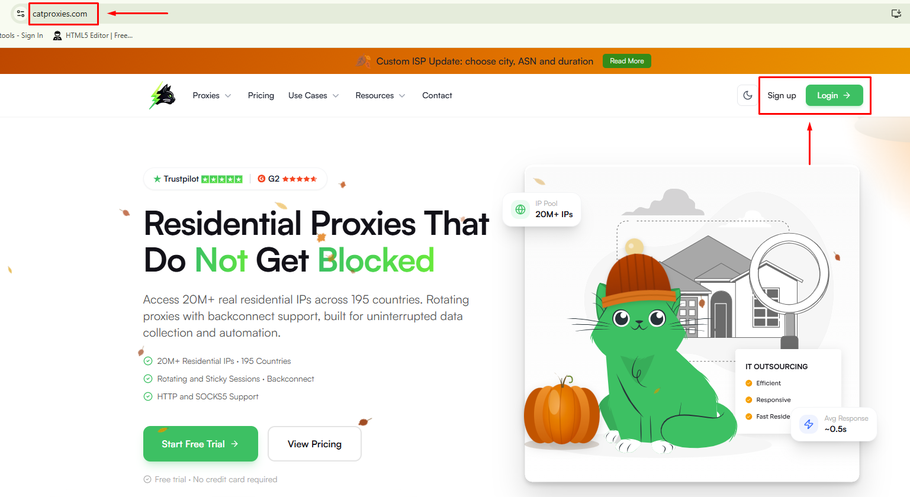
Create or log in to your account
Step 2. Purchase a proxy plan
Select the product that fits your workflow, such as Standard Residential, Premium Residential, Mobile, Datacenter, IPv6, or ISP. Check the billing model, location options, and included traffic or rental period.
Before completing your purchase, don't forget to check for CatProxies promotional codes with a 15% OFF coupon code on IPFighter. Applying an existing discount code can significantly reduce your costs.
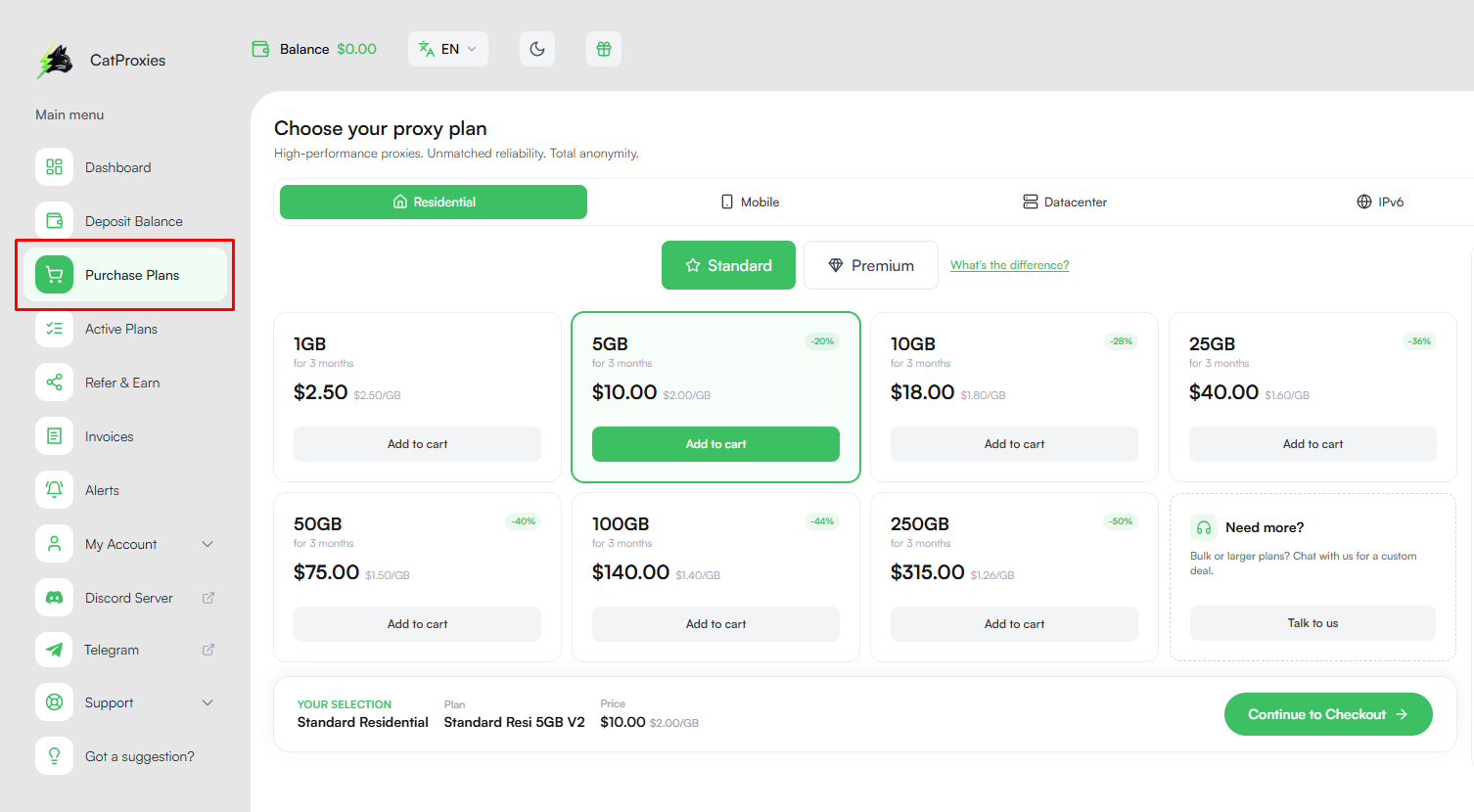
Purchase a proxy plan
Step 3. Configure your proxy
After purchasing traffic, open the Active Plans section in the dashboard. You can configure the country, state, optional filters, session type, protocol and format, depending on the proxy type and your requirements.
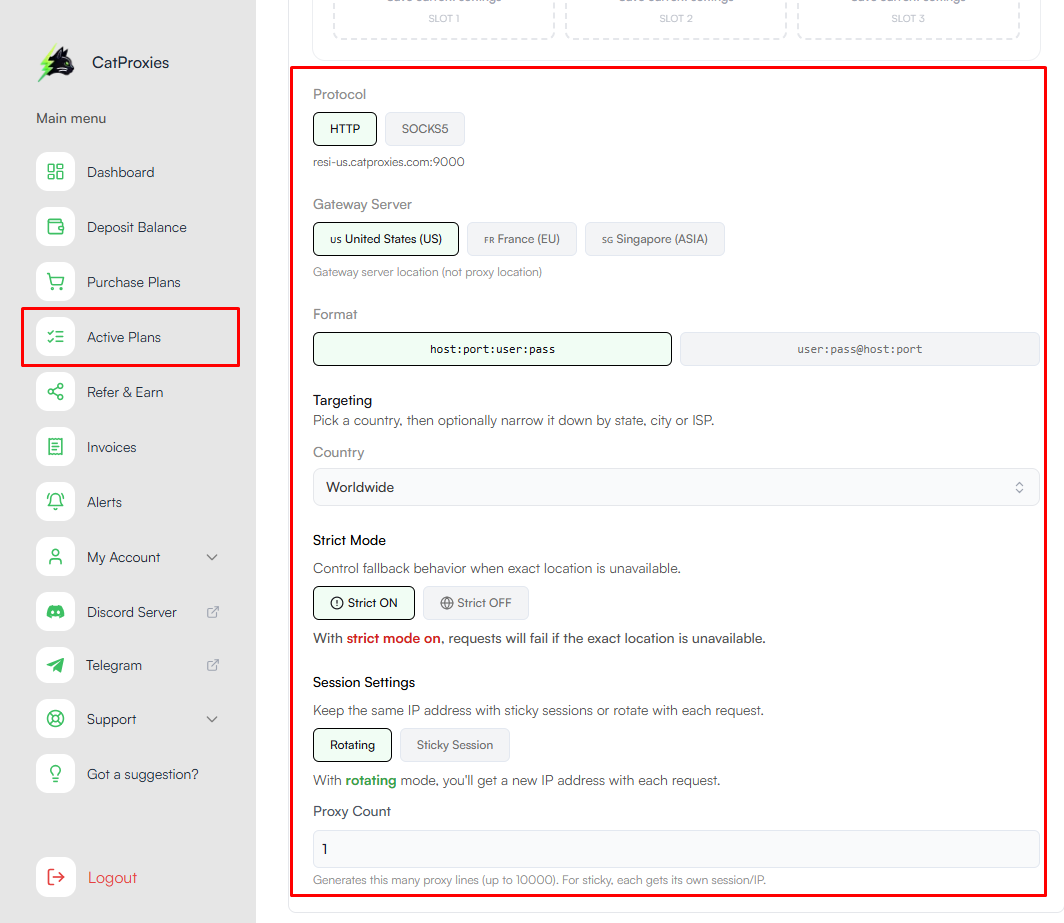
Configure your proxy
Step 4. Generate and copy your proxy
Once the configuration is complete, CatProxies generates a proxy list based on your selected settings. You can specify the number of proxies, copy the list directly, or download before using it with your preferred browser, software, or automation tool.
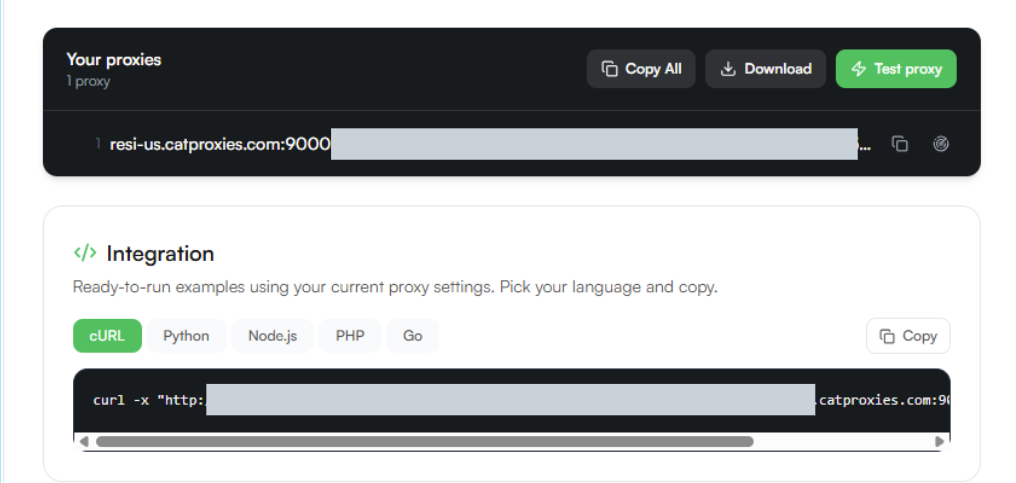
Generate and copy your proxy
7. Alternatives
Besides CatProxies, you can also consider other providers offering similar residential proxy services.
-
WhiteCloakProxy: Focuses on dedicated 5G mobile proxies with unlimited bandwidth and flexible IP rotation, making it worth considering for mobile-specific workflows.
-
Geonix: Offers residential and other proxy solutions for users who need IPs across different locations, making it an option to compare for web scraping and location-sensitive workflows.
-
NodeMaven: Provides residential and ISP proxies with a focus on IP quality, making it an alternative for users who prioritize reliable IPs for account management and other location-sensitive tasks.
You can also check out reviews of our other partners here:
-
Floppydata review: A closer look at its proxy network
-
ProxyCove review: How its traffic-based proxy service works
-
Sx.org review: A closer look at its global proxy network
-
ProxyOmega review - Should you make it your trusted proxy provider?
8. Conclusion
CatProxies offers a versatile lineup of proxy solutions under one roof, spanning residential, mobile, ISP, datacenter, and IPv6 proxies with flexible billing models. Our hands-on testing of its residential network revealed generally strong IP trust scores, clean blacklist status, and smooth everyday browsing performance, with the Premium Residential plan standing out for higher reliability. However, speeds, latency, exact city-level geolocation, and DNS routing varied across individual IPs, with occasional outliers identified as datacenter connections.
These findings reflect only the randomly selected IPs tested at a specific time; performance and IP reputation may vary depending on the location, IP assignment, and target platform. Before deploying any proxy into active workflows, always verify its IP quality, reputation, location accuracy, and security leaks with IPFighter.
If you're planning to try CatProxies, check out the CatProxies promo code on the IPFighter page to get up to 15% off your purchase.
9. FAQ
What proxy types does CatProxies offer?
CatProxies offers residential, mobile, datacenter, IPv6, and ISP proxies. Residential products include Standard and Premium plans, while the ISP category includes static and dedicated options with different configurations.
What is the difference between Standard and Premium Residential proxies?
Both are bandwidth-based residential proxy products, but CatProxies positions Premium Residential as a cleaner pool for websites that may block or challenge IPs more frequently. The plans also use different connection configuration methods. Neither option guarantees that every IP will avoid detection.
Does CatProxies offer a free trial?
CatProxies advertises a free trial for residential and selected unlimited-bandwidth plans. Availability depends on the product and current trial conditions, so check the pricing page before signing up.
Are CatProxies residential proxies suitable for social media and browsing?
In our sample test, both Standard and Premium Residential proxies were generally usable for social media searches, YouTube, and Reddit without notable stuttering or frequent connection drops. However, performance varied between IPs, so results may differ by location, time, and target website.
Does CatProxies provide refunds?
Refund eligibility depends on the product. The published policy allows conditional refunds for certain per-GB residential and mobile purchases when specific usage, functionality, and request-time requirements are met. Datacenter, ISP, unlimited residential, and IPv6 products are listed as non-refundable under the policy. Review the current terms before purchasing.
Read more

CatProxies review: What do its five proxy types offer?

Hidemyacc review 2026: Features, pricing and real fingerprint test results

Whitecloakproxy review: What to know before you buy

Geonix review: What makes its proxy services stand out?
Floppydata review: A closer look at its proxy network

Japan proxy: Find the right provider for Japanese IPs