

Choosing a proxy provider involves more than checking its IP pool size. IP reputation, location accuracy, connection speed, session control, and pricing can all affect whether a proxy is suitable for a particular workflow.
In this Aproxy review, IPFighter examines all five proxy products offered by Aproxy, from rotating Residential proxies to Static Data Center proxies. We also test two selected product lines - Residential and Long Acting ISP - across five countries to see how their IP quality, location results, and connection performance compare in practice.
1. General information
Before diving into the details, here's a quick overview of Aproxy and its core specifications.
|
Website |
|
|
Founded |
2018 |
|
Proxy types |
Residential, Unlimited Residential, Long Acting ISP, Static Residential, Static Data Center |
|
IP pool |
70M+ residential IPs in 195 countries |
|
Protocol |
HTTP and SOCKS5 |
|
Pricing model |
Per GB / per IP |
|
Payment |
My Wallet / Alipay / Cryptocurrency / Credit Card / Local Payment |
|
Trial |
Trial eligibility varies by product; Residential has a published 500 MB trial option |
|
Refund |
Conditional refund policy for qualifying cases; restrictions apply |
|
Best for |
Web scraping, SEO research, market research, e-commerce monitoring, ad verification, and location-sensitive data collection |
Aproxy's main distinction is its choice of billing and session models. Users can select rotating residential access for general data collection, a traffic-unlimited residential plan for high-volume work, or static products when maintaining the same IP is more important. The provider also offers documentation for proxy tools, browsers, operating systems, and antidetect browsers.
Discover more:
-
Best proxy providers in 2026: Compare top 6 services
-
What are static residential proxies? Features, benefits, and providers
-
What is an ISP proxy? How it works and where to buy
2. Proxy types available at Aproxy
Aproxy lists five proxy products, each designed around a different balance of IP type, rotation, bandwidth, and session stability. The following overview summarizes their intended roles and the details published on the official product pages.
2.1. Residential proxies
Aproxy Residential proxies use IP addresses associated with residential devices. This product is designed for users who need geographically distributed IPs for web data collection and other tasks that benefit from residential connections.
-
Advertised proxy pool: 70 million+ residential IPs.
-
Coverage: 195+ countries
-
Filtering: Country, state, city, ASN and proxy region
-
Rotation: Rotation IP or sticky sessions up to 120 minutes.
-
Protocols: HTTP and SOCKS5.
Residential uses traffic-based billing, which can suit projects with moderate or variable bandwidth requirements. Actual IP reputation and location accuracy can differ between individual IPs, so testing the intended target locations is advisable before scaling up.
2.2. Unlimited Residential proxies
Unlimited Residential is designed for traffic-intensive workloads that would otherwise consume a large amount of per-GB residential bandwidth. It provides access to dynamic residential IPs with unlimited traffic and IP usage within the purchased plan's time period.
-
Unlimited residential proxies: Used for collecting data to train LLMs
-
Coverage: More than 50 regions are advertised for this plan.
-
Bandwidth: Unlimited traffic under the plan
-
Location selection: Country selection is not available; the provider describes the country as random.
-
Protocols: HTTP and SOCKS5.
The main advantage is the time-based, traffic-unlimited model. However, users who need a particular country or city should consider a different product because Unlimited Residential does not provide country selection according to its FAQ.
2.3. Long Acting ISP proxies
Long Acting ISP combines a data center-based operating model with ISP-related IP resources. Unlike a static proxy, it supports IP changes according to the configured session and extraction behavior, while billing is based on traffic.
-
Filtering: Country and proxy region
-
Rotation: Rotation IP or sticky sessions up to 120 minutes.
-
Concurrency: Unlimited connections and threads
-
Protocols: HTTP and SOCKS5.
Long Acting ISP may suit users who need more session continuity than short-rotation setups while retaining a traffic-based pricing model. However, the name should not be taken to mean that every IP is a conventional residential IP: IPFighter detected four of the five tested samples as data center proxies.
2.4. Static Residential proxies
Static Residential proxies are intended for users who need to retain the same residential IP instead of rotating through a pool. Aproxy advertises dedicated residential IPs hosted on data center servers but carrying residential IP addresses assigned by ISPs.
-
Advertised proxy pool: 70 million+ real residential IPs
-
IP behavior: The IP does not rotate automatically during the usage period unless manually replaced or the subscription expires
-
Bandwidth: Unlimited, subject to fair-use conditions
-
Protocols: HTTP and SOCKS5.
-
Additional options: Free ASN selection
The fixed-IP model can be useful when a task depends on session continuity. However, static IP behavior does not guarantee that every website will trust or accept the IP, so reputation checks remain important.
2.5.Static Data Center proxies
Static Data Center proxies provide fixed IP addresses hosted on data center infrastructure. Aproxy positions this product around high-speed connections and stable sessions rather than residential IP characteristics.
-
IP behavior: Static during the selected usage period.
-
Bandwidth: Unlimited, subject to fair-use conditions.
-
Session duration: Unlimited session duration
-
Protocols: HTTP and SOCKS5.
-
Additional options: Free ASN selection
Static Data Center may be worth considering for applications that benefit from a consistent endpoint and predictable session behavior. However, data center IPs may be identified as such by websites, so users should assess whether that IP type fits the target platform before purchasing.
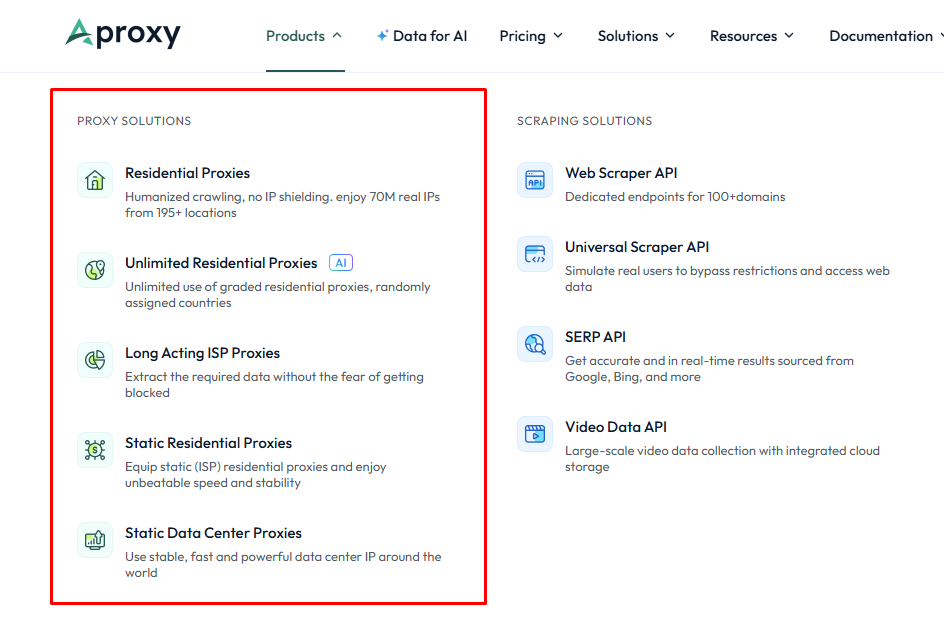
Proxy types available at Aproxy
3. Key features of Aproxy proxies
Across its five proxy products, Aproxy provides several features intended to support data collection and proxy management. Availability and configuration can differ between plans.
-
Geographic targeting: Aproxy supports precise targeting by country, state, city, ASN, and proxy region. This can help with localized search results, price comparisons, and regional data collection, although the actual IP location should be verified after connection.
-
Different rotation and session models: Residential and Long Acting ISP support dynamic IP behavior, while Static Residential and Static Data Center are designed to retain an IP. Unlimited Residential emphasizes traffic volume rather than precise country selection.
-
HTTP and SOCKS5 support: Both protocols are listed for the main proxy products, making them compatible with many browsers, proxy managers, and automation tools.
-
Unlimited concurrency: Aproxy advertises unlimited concurrent connections for several products. This is a provider claim, and actual performance may still depend on the plan configuration, target website, and network conditions.
-
Dashboard and usage management: The provider offers usage statistics, sub-user management, and IP whitelisting, helping users organize access and monitor traffic.
-
API and software integrations: Aproxy provides integration guides for third-party proxy tools, browsers, and antidetect browsers. Its wider product lineup also includes web scraping and search-result APIs.
These features give users several ways to match the proxy type to their workload. The key decision is whether a task requires residential IP characteristics, unlimited traffic, longer rotating sessions, or a fixed endpoint.
4. Aproxy pricing overview
Aproxy uses different billing structures across its five proxy products. The table below summarizes the published starting prices and representative plans available on its official pages. Prices may change, and the final cost can depend on duration, traffic volume, concurrency, bandwidth, and location.
|
Proxy type |
Published starting price |
Pricing model |
|
Residential |
$0.90 /GB (10GB plan) |
Traffic-based |
|
Unlimited Residential |
$84.39/day (30-day plan) |
Time-based; configuration-dependent |
|
Long Acting ISP |
$0.80 /GB (10GB plan) |
Traffic-based |
|
Static Residential |
$5/IP (for 10 days) |
Per IP and duration |
|
Static Data Center |
$3/IP (for 10 days) |
Per IP and duration |
Overall, Aproxy's Residential, Long Acting ISP, Static Residential, and Static Data Center plans offer relatively accessible entry-level pricing. Unlimited Residential is the exception, as it uses a time- or bandwidth-based pricing model rather than charging by traffic volume, which generally results in a higher upfront cost. This makes Aproxy's other proxy types easier to consider for users with smaller budgets or more specific usage needs.
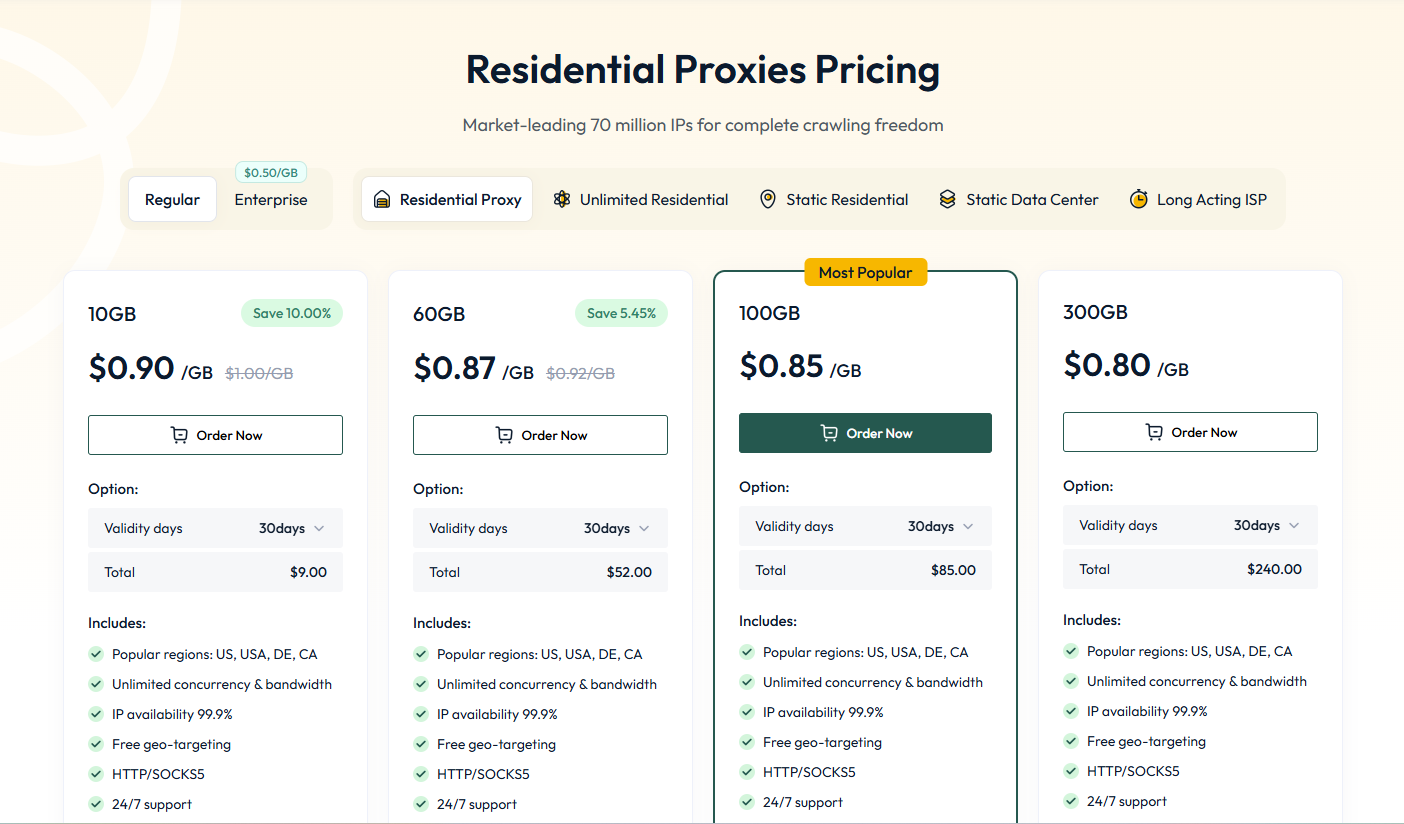
Prices for residential proxies plan at Aproxy
If you're planning to purchase proxies from Aproxy, don't miss the Aproxy promo code available on IPFighter. You can save on your proxy purchase with exclusive discounts while choosing the plan that best suits your needs.
5. Performance test
Aproxy's product range offers different approaches to IP rotation, traffic usage, and session duration. To provide a practical reference, IPFighter tested selected IPs from two of these product lines: Residential and Long Acting ISP. The tests focus on the samples provided and do not represent every product or the provider's entire network.
5.1. Preparation
Before evaluating the proxy, we first added it to our browser using the IPFighter Proxy Manager extension. This extension makes it easy to import, manage, and switch between multiple proxies directly within your browser, eliminating the need for manual proxy configuration.
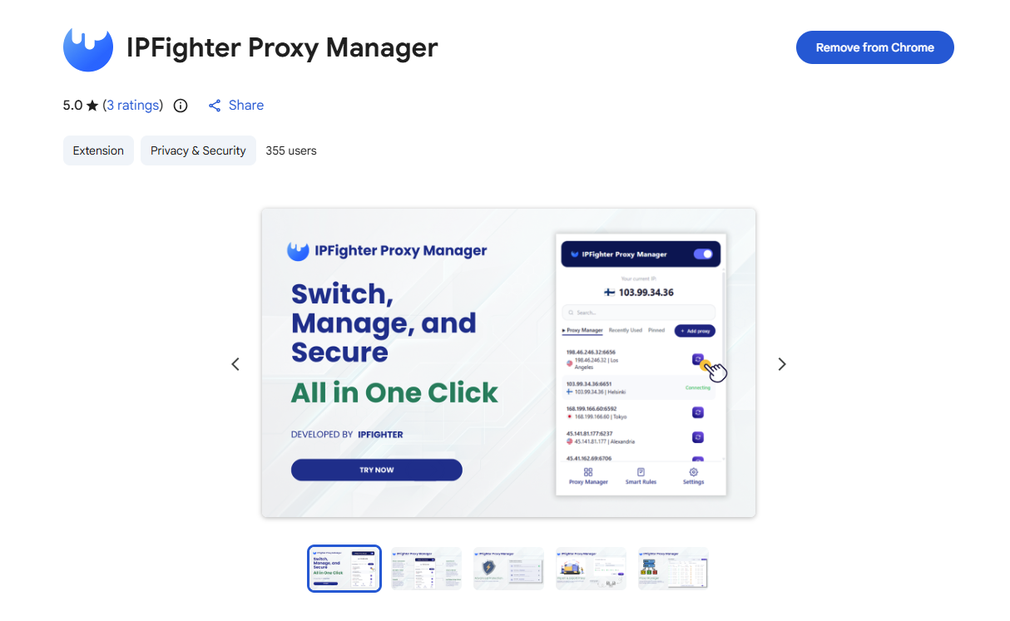
IPFighter Proxy Manager extension on Chrome
If you'd like to learn how to set it up, check out our detailed guide: A complete guide to the IPFighter Proxy Manager extension.
5.2. Test results
The table below summarizes the Residential and Long Acting ISP proxy test results across five target markets: the US, Japan, Spain, Taiwan, and Thailand. It covers IPFighter scores and detection results, speed test performance, and Google Search location accuracy to provide an overall view of how the two proxy types performed across these locations.
|
Target |
Proxy type |
IPFighter results |
Speed test |
Google Search result |
Overall assessment |
|
US |
Residential |
Score: 80-90%; proxy not detected; blacklist clean |
Download: 36.85 Mbps; upload: 13.02 Mbps; ping: 431 ms |
All tested IPs returned locations consistent with the original target. |
The tested Residential IPs showed consistently good scores, with no proxy detection or blacklist listings. Google Search location results also aligned with the target. |
|
Long Acting ISP |
Score: 80%; detected as datacenter; blacklist clean |
Download: 155.77 Mbps; upload: 31.62 Mbps; ping: 399 ms |
All tested IPs returned locations consistent with the original target. |
The tested IPs were clean of blacklist listings and matched the target location in Google Search. However, IPFighter classified them as datacenter proxies, which may affect suitability for workflows requiring residential-looking connections. |
|
|
Japan |
Residential |
Score: 40-90%; proxy not detected; most IPs were clean of blacklists, but one appeared on the Thread Intelligence Blocklist |
Download: 123.01 Mbps; upload: 56.51 Mbps; ping: 179 ms |
All tested IPs returned locations consistent with the original target. |
Most tested IPs showed high scores and no proxy detection. However, the results were less consistent than in other markets, with one low-scoring IP also appearing on a blacklist. This suggests that IP quality may vary within the rotating pool. |
|
Long Acting ISP |
Score: 80-90%; some IPs detected as datacenter, while others were not; blacklist clean |
Download: 156.15 Mbps; upload: 91.99 Mbps; ping: 346 ms |
Most results matched the target, but some returned a location in China instead of Japan. |
IPFighter scores were generally high and no blacklist listings were found. However, proxy detection varied between IPs, and some Google Search results showed a country-level location mismatch. |
|
|
Spain |
Residential |
Score: 85-90%; proxy not detected; blacklist clean |
Download: 173.83 Mbps; upload: 32.55 Mbps; ping: 302 ms |
All tested IPs returned locations consistent with the original target. |
The tested IPs showed consistently high scores, no proxy detection, and clean blacklist results. Google Search location results also matched the intended target. |
|
Long Acting ISP |
Score: 75-80%; detected as datacenter; blacklist clean |
Download: 105.37 Mbps; upload: 11.75 Mbps; ping: 384 ms |
All tested IPs returned locations consistent with the original target. |
The tested IPs were clean of blacklist listings and returned location results consistent with the target. However, their lower scores and datacenter classifications may make them less suitable for use cases that require residential IP characteristics. |
|
|
Taiwan |
Residential |
Score: 90%; proxy not detected; blacklist clean |
Download: 13 Mbps; upload: 22 Mbps; ping: 140 ms-2.1 s |
All tested IPs returned locations consistent with the original target. |
The tested IPs showed strong trust scores, no proxy detection, and clean blacklist results. Location accuracy was consistent, although latency varied considerably during testing. |
|
Long Acting ISP |
Score: 80-90%; most IPs were not detected as proxies, though some were detected as datacenter; blacklist clean |
Download: 200 Mbps; upload: 68 Mbps; ping: 350-365 ms |
All tested IPs returned locations consistent with the original target. |
The tested IPs generally showed high scores and clean blacklist results, with most avoiding proxy detection. However, some were classified as datacenter proxies, so detection results were not uniform across the tested IPs. |
|
|
Thailand |
Residential |
Score: 80-90%; proxy not detected; blacklist clean |
Download: 57 Mbps; upload: 52 Mbps; ping: 139-700 ms |
All tested IPs returned locations consistent with the original target. |
The tested IPs generally showed good scores, no proxy detection, and clean blacklist results. Google Search location results matched the target, although latency fluctuated across tests. |
|
Long Acting ISP |
Score: 75%; detected as datacenter; blacklist clean; DNS server reported in Singapore |
Download: 56 Mbps; upload: 94 Mbps; ping: 413-431 ms |
All tested IPs returned locations consistent with the original target. |
The tested IPs were clean of blacklist listings and returned location results consistent with Thailand. However, they received lower scores than the Residential samples and were classified as datacenter proxies. DNS servers were consistently reported in Singapore, indicating a DNS location mismatch that warrants separate consideration. |
5.3. Overall performance findings
The results show different strengths and weaknesses across the two tested product lines. Residential generally performed better on IPFighter score and proxy-detection checks, while Long Acting ISP delivered higher throughput in several countries. Neither product produced uniformly stronger results across all five targets.
IP quality and proxy detection
Across the five target markets, the Residential proxies generally showed stronger results in IPFighter, with most tested IPs receiving high scores, avoiding proxy detection, and returning clean blacklist results. Japan was the main exception: although many tested IPs scored highly, the overall range extended down to 40%, and one IP appeared on the Thread Intelligence Blocklist.
This variation may reflect the nature of a rotating residential pool. While many available IPs may have good trust signals, rotation can also assign an IP with a weaker reputation, potentially due to previous abusive activity or spam-related listings. The test results do not establish the exact cause of the low score, but they show that IP quality may vary between assigned addresses.
The Long Acting ISP results were more mixed. Scores generally ranged from 75% to 90%, and blacklist results remained clean across the tested markets. However, IPFighter classified many of these IPs as datacenter proxies, particularly in the US, Spain, and Thailand. Japan and Taiwan showed more variation, with some IPs avoiding detection. This suggests that Long Acting ISP may offer good trust and blacklist results, but its IP classification is not consistent across all locations or assigned IPs.
Overall, the Residential samples performed more consistently in terms of proxy detection, while the Long Acting ISP samples generally delivered stronger download speeds in most of the tested markets. Neither result guarantees that every IP from either pool will be treated the same way by third-party platforms.
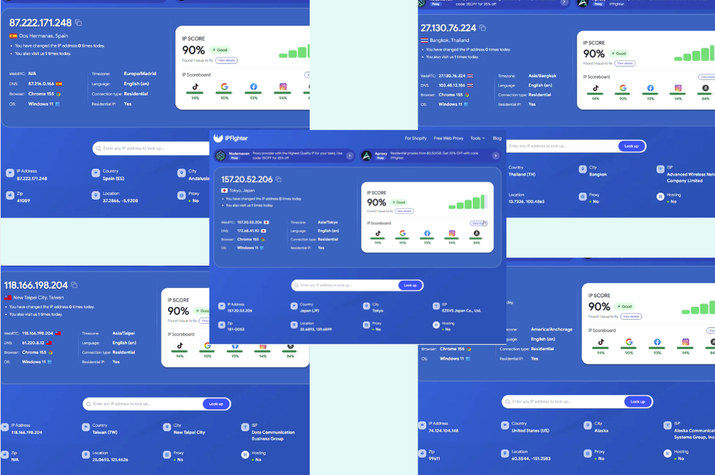
The quality of certain IP addresses included in a residential proxy plan
Location consistency
Google Search location results were generally consistent with the intended target across the five markets. The main exception was Japan Long Acting ISP, where some results pointed to China rather than Japan. This indicates that location consistency may vary between assigned IPs, even when the proxy is configured for a specific target country.
For the other tested combinations, Google Search returned locations consistent with the intended target. This is a positive sign for location-based browsing, although it does not guarantee that every website or geolocation service will identify an IP in the same way. Users who depend on precise regional results should verify the assigned IPs against their intended country or city before scaling up their workflows.
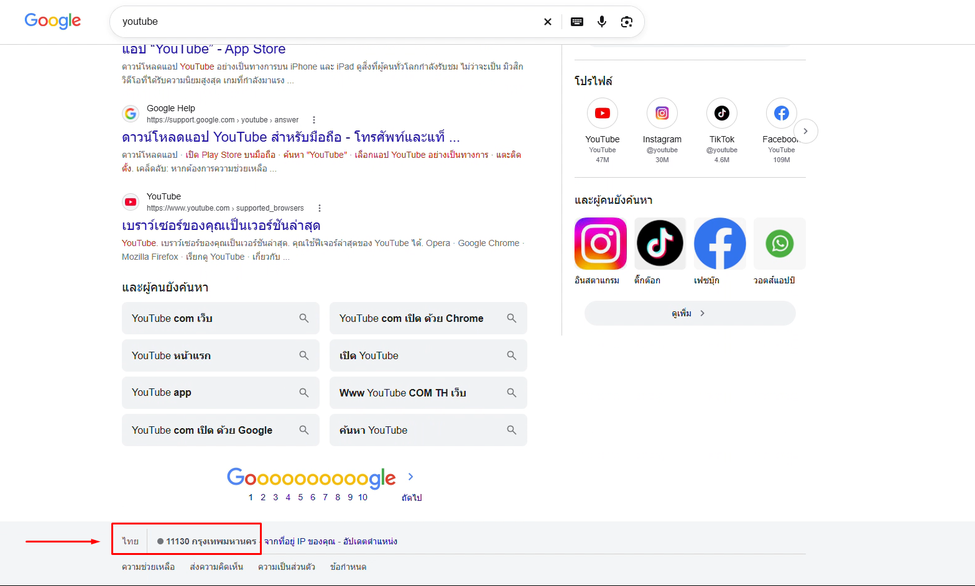
Google geo-location test verifying a Thailand residential IP address
Speed and latency
Long Acting ISP delivered higher download and upload speeds than Residential in the US, Japan, and Taiwan. In Spain, Residential was faster in both directions. In Thailand, Long Acting ISP had a higher upload speed but a similar download result. The throughput advantage therefore depended on the target country.
Latency also varied. The Japan Residential sample had the lowest listed ping at 179 ms, while the Taiwan and Thailand Residential samples showed wide ping ranges. All five Long Acting ISP samples had relatively high ping values, including the US sample at 399 ms. Higher throughput can help transfer data, but it does not automatically mean faster responses or more consistent connections.
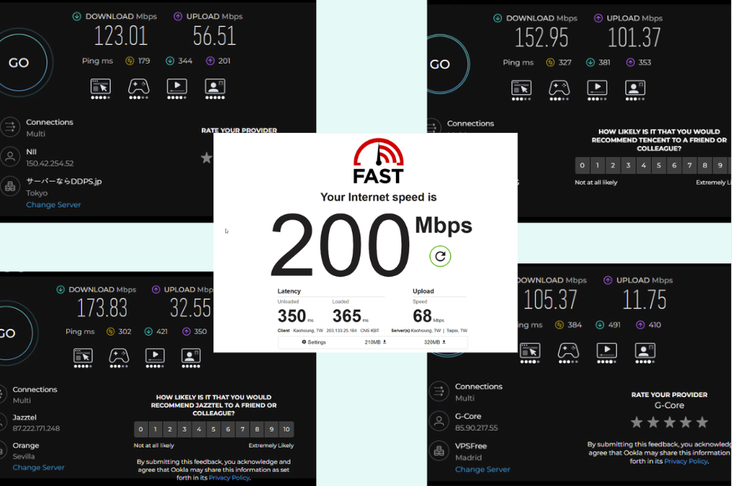
Sample speed test metrics for Residential and Long Acting ISP proxy lines
DNS observation
The only DNS mismatch explicitly recorded in the supplied results was for the Thailand Long Acting ISP IP, whose DNS server was reported in Singapore while the proxy location was Thailand. A DNS server in another country does not by itself mean the tester's real IP or ISP was exposed. The DNS provider or ISP would need to be identified before drawing a stronger conclusion. If it is not the tester's real network, this should be described as a DNS location mismatch and a mild inconsistency, not a confirmed real-IP leak.
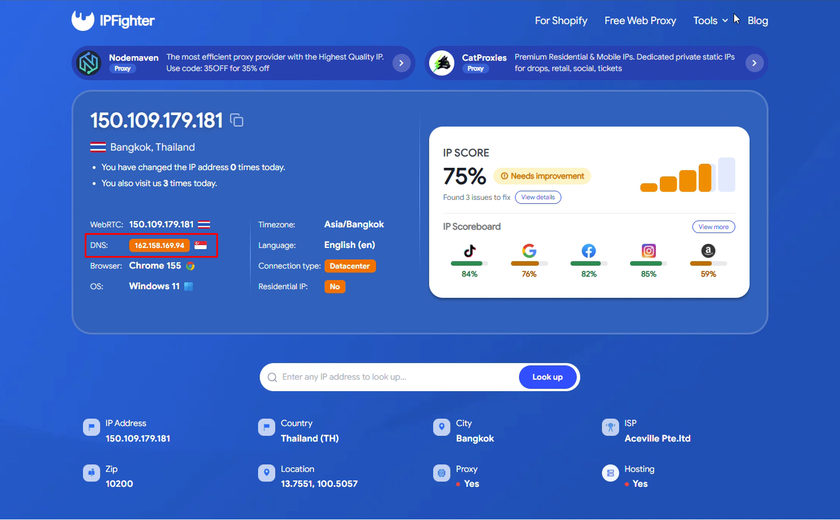
DNS location mismatch and a mild inconsistency, not a confirmed real-IP leak
During testing, both Residential and Long Acting ISP proxies handled social media searches, general web browsing, and HD video playback smoothly. No noticeable stuttering, repeated disconnections, or timeouts were observed during these activities. This is a positive practical result for both product types, although it does not eliminate the IP-quality, location, or latency concerns seen in individual tests.
Overall, both tested Aproxy products are worth considering depending on whether IP reputation and lower proxy-detection signals or higher throughput and longer sessions matter more to the intended workflow. These findings are based on five IPs per product and should be treated as a reference rather than a guarantee of network-wide performance. They do not establish the performance of Unlimited Residential, Static Residential, or Static Data Center proxies, which were not tested in this review. Actual results may vary by target location, test time, destination website, and network conditions.

Web browsing and watching HD videos are quite smooth
Read more:
-
How to check if a proxy is working and read your results
-
How to use web proxy safely: A practical guide
-
IP reputation check: How IPFighter scores your IP
6. How to get proxy from Aproxy
Aproxy provides a dashboard for purchasing proxy plans, managing usage, and retrieving connection details. The precise workflow may vary by product, but the general process is as follows.
Step 1. Create or log in to your account
Go to the Aproxy dashboard and create an account or log in. After activation, you can access the available proxy plans and trial options.
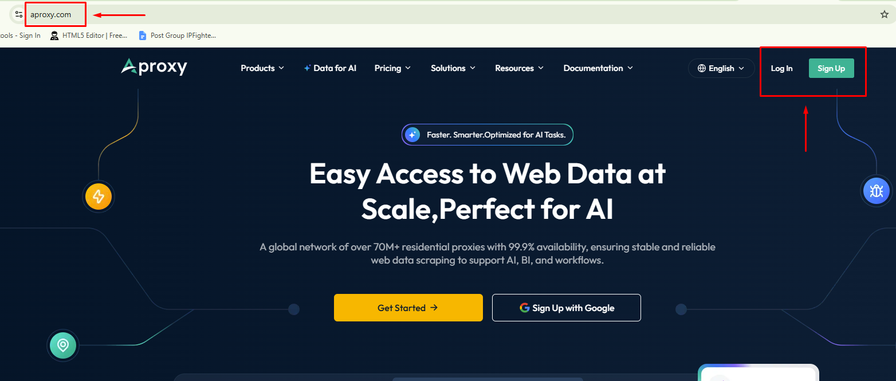
Create or log in to your account
Step 2. Purchase a proxy plan
Choose an available plan and set the traffic allowance or validity period where applicable. For products with geographic targeting, select a supported country or city. Note that Unlimited Residential does not offer country selection according to the provider's FAQ.
Before completing your purchase, don't forget to check for Aproxy promotional codes with a 20% OFF coupon code on IPFighter. Applying an existing discount code can significantly reduce your costs.
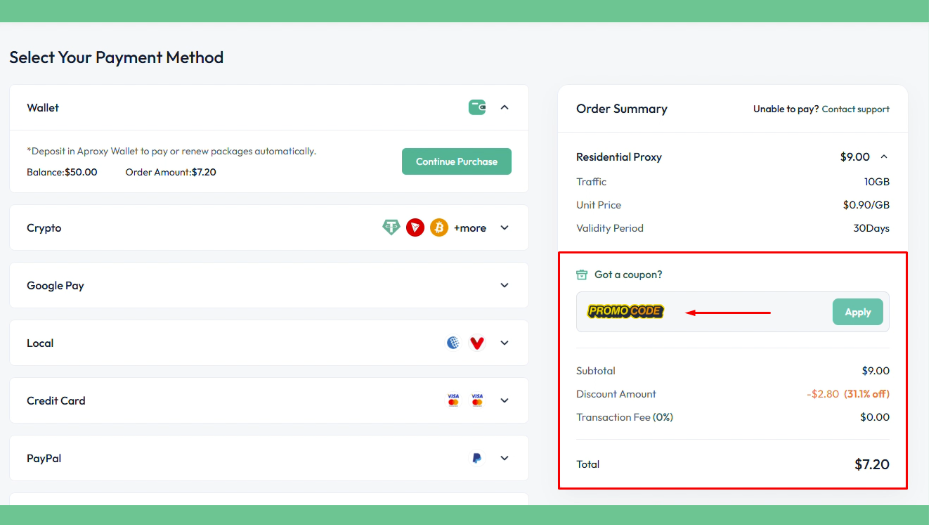
Purchase a proxy plan
Step 3. Configure your proxy
After successful purchase, for residential proxies and long acting isp proxies, configure the desired country, state, city, asn, and session duration,... Aproxy documents username/password authentication and API extraction using a whitelisted IP. For API extraction, add your current IP to the whitelist if required.
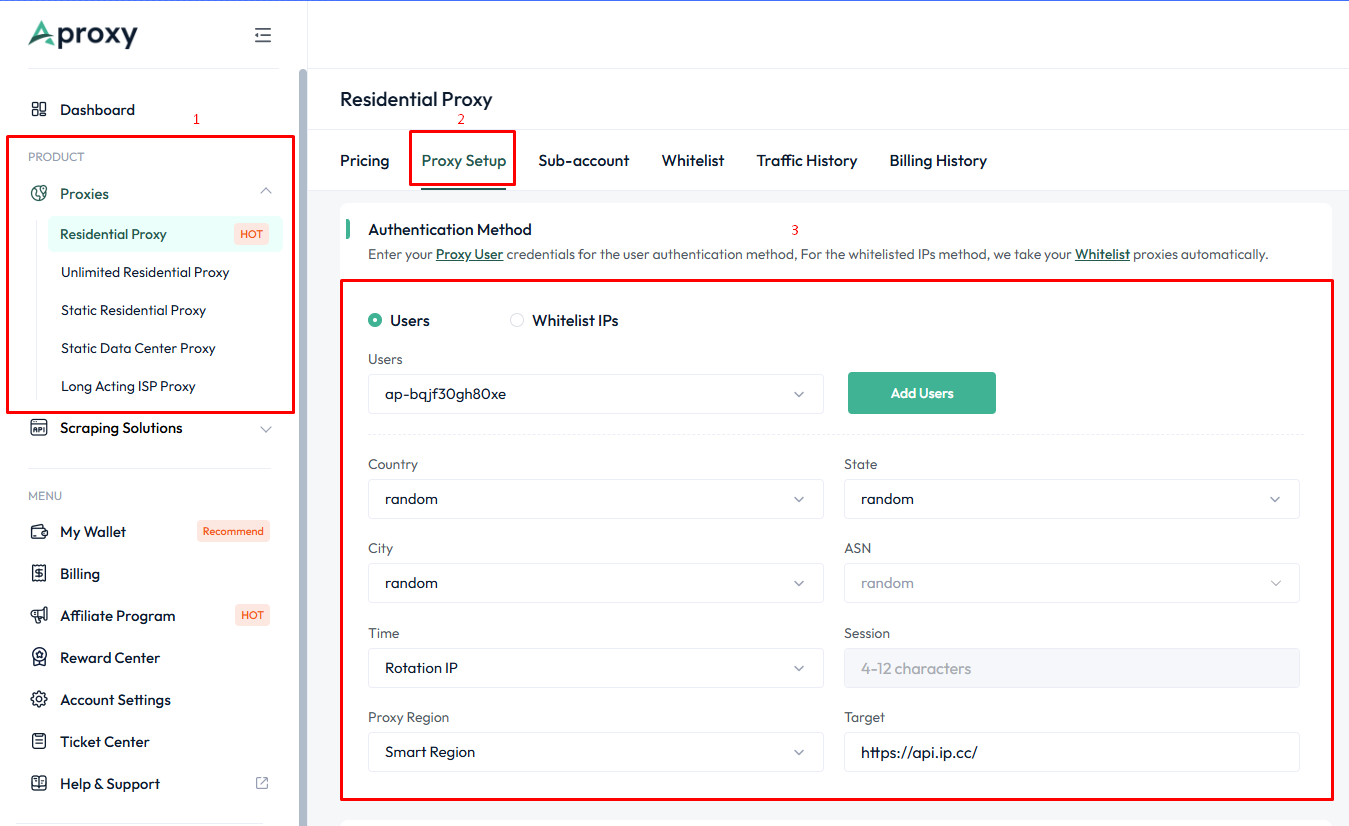
Configure your proxy
Step 4. Generate and copy your proxy
Finally, after completing the proxy setup, simply click Generate. You simply need to copy the proxy details into your proxy manager, scraping tool, or other supported application.
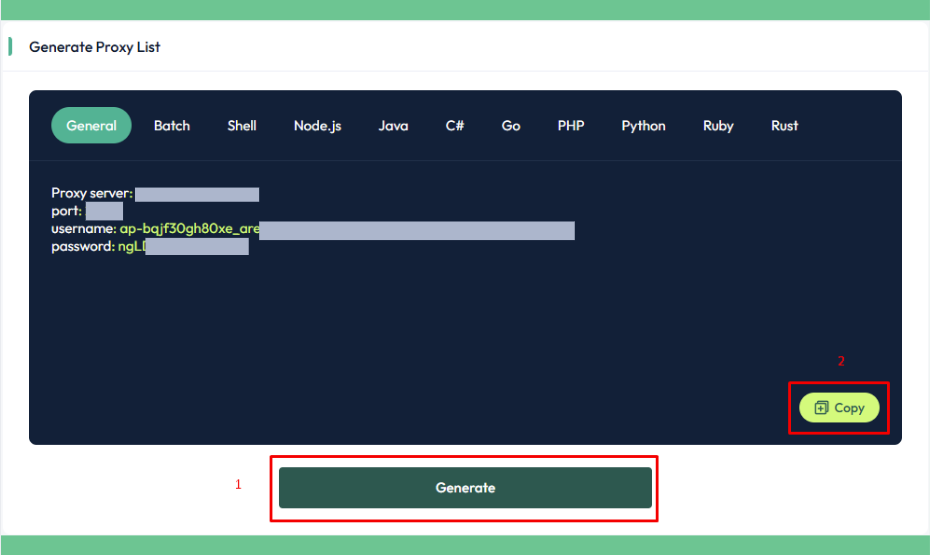
Generate and copy your proxy
7. Alternatives
If you are comparing proxy providers, the following services offer different product mixes and pricing approaches:
-
WhiteCloakProxy: Focuses on dedicated 5G mobile proxies with unlimited bandwidth and flexible IP rotation, making it worth considering for mobile-specific workflows.
-
Floppydata: Offers rotating residential, mobile, and data center proxies, alongside static residential and data center options.
-
ProxyPrivate: An alternative to compare when looking for private proxy services for browsing, account management, and other workflows that benefit from dedicated IP access.
You can also check out reviews of our other partners here:
-
IPFoxy review: Are its pure rotating residential proxies worth it?
-
CatProxies review: What do its five proxy types offer?
-
Geonix review: What makes its proxy services stand out?
-
Rapidproxy review: A closer look at its residential proxy network
8. Conclusion
Aproxy provides a multi-tier proxy infrastructure spanning rotating residential, unlimited residential, static residential, and datacenter options to accommodate diverse operational requirements. Across our hands-on testing, its residential line demonstrated superior IP trust scores and cleaner anti-bot profiles, whereas Long Acting ISP proxies excelled in connection throughput despite several nodes being flagged as datacenter ranges.
Because IP reputation, speed, and proxy classification vary significantly by location and pool assignment, these sample results should not be treated as uniform performance across Aproxy's full network. Before committing to a large-scale plan, verify your target IPs for location accuracy, WebRTC/DNS leaks, and blacklist status using IPFighter and explore our proxy promo codes page to claim exclusive discounts on your next purchase.
If you're planning to try Aproxy, check out the Aproxy promo code on the IPFighter page to get up to 20% off your purchase.
9. FAQ
What proxy types does Aproxy offer?
Aproxy lists five proxy products: Residential, Unlimited Residential, Long Acting ISP, Static Residential, and Static Data Center. It also offers scraping products, including web scraping and search-result APIs.
What is the difference between Residential and Long Acting ISP proxies?
Residential proxies provide dynamic residential IP access for general web data collection. Long Acting ISP combines an ISP-related proxy model with longer configurable sessions and traffic-based billing, allowing IP changes according to the selected session and extraction settings.
Does Aproxy offer unlimited residential traffic?
Yes. Aproxy's Unlimited Residential product advertises unlimited traffic and IP usage within the purchased time-based plan. However, country selection is not available for this product, and pricing depends on the selected configuration.
Does Aproxy offer static proxies?
Yes. Aproxy offers Static Residential and Static Data Center proxies. Both are designed to retain the same IP during the selected usage period, but they differ in IP type and intended use.
Does Aproxy offer a free trial or refunds?
Trial eligibility varies by product. Aproxy lists a 500 MB Residential trial option, while Unlimited Residential states that free trials are unavailable. Refunds are conditional and subject to the provider's published policy, so check the current terms before purchasing.
Read more
Aproxy review: Proxy options, pricing, and performance

AstroProxy review: Uncovering real speeds & IP quality
FlashProxy review: Is this proxy network worth it?
PrivateProxy review: Is it worth your investment?

IPFoxy review: Are its pure rotating residential proxies worth it?

CatProxies review: What do its five proxy types offer?