

Market research depends on accurate data from websites, search engines, and marketplaces, but prices, products, promotions, and search results can vary by location. Proxies for market research help researchers access location-specific data and collect information across multiple markets.
In this guide, IPFighter explains how proxies support market research, common use cases, how to choose the right proxy type, and what to consider when collecting web data at scale.
1. What are proxies for market research?
For market research, proxies are commonly used to route research traffic through different IP addresses and geographic locations. This allows researchers to view websites from different market perspectives rather than relying only on the data available from their own location.
For example, a company based in the US may want to compare how a competitor's products are priced in the US, Germany, and Japan. Without location-specific proxies, the researcher may only see the version of the website intended for the US market. With proxies, researchers can route requests through IPs associated with the markets they want to study.
Proxies for market research
Discover more:
-
What is a Proxy? Benefits, usage, and everything you need to know about proxies
-
What is bandwidth? Why does bandwidth affect website speed?
-
Best proxy providers in 2026: Compare top 6 services
2. Why do market researchers use proxies?
Without proxies, online research can produce incomplete or location-biased results because websites often personalize the information they display. Proxy for global research helps researchers access localized websites and compare prices, products, search results, and other market data across different regions.
-
Access location-specific data: View different prices, products, promotions, and search results from specific countries or cities.
-
Collect data at scale: Distribute requests across multiple IPs to reduce rate limits and support larger research projects.
-
Reduce location-based bias: Compare the same product or search result across regions instead of relying on data from a single market.
-
Maintain consistent research: Monitor competitor prices, product availability, or market trends regularly using the same target locations and session settings.
Using proxies in these scenarios helps researchers build datasets that better reflect how markets actually differ across locations.
3. Common market research use cases for proxies
Proxy-based research can support many types of competitive and market analysis. The most common applications involve collecting public web data that changes according to location, time, or market conditions.
3.1. Competitor price monitoring
Competitor pricing can change frequently, making regular monitoring valuable for businesses operating in competitive markets. Proxies can help researchers:
-
Track competitor prices.
-
Compare promotions and discounts.
-
Monitor price changes over time.
-
Compare pricing between countries.
Location-specific proxies are especially useful when competitors display different prices or promotions to visitors from different markets.
3.2. Product and availability research
Market researchers can use proxies to monitor product catalogs and availability across multiple regions. Common applications include:
-
Tracking product listings.
-
Monitoring stock or availability.
-
Comparing product catalogs between markets.
-
Identifying regional differences in products or offers.
This can help businesses understand which products are available in specific markets and how competitors position their offerings.
3.3. SERP and SEO research
Search engine results can vary significantly depending on the user's location. A keyword that ranks well in one country may produce completely different results in another. Proxies can help researchers:
-
Check keyword rankings from different locations.
-
Compare regional search results.
-
Monitor competitor visibility.
-
Analyze localized SERPs.
This makes location-specific proxies useful for international SEO research and competitor analysis.
3.4. Ad and campaign research
Advertising campaigns can also vary by geographic market. Researchers can use proxies to: Check whether ads appear in specific countries, compare localized ad placements, monitor competitor promotions, verify whether campaigns are displayed in target markets.
This can help businesses understand how competitors are positioning their products and whether their own campaigns are reaching the intended audience.

Ad and campaign research
3.5. Customer review and sentiment research
Customer reviews provide valuable information about how people perceive a product or service. Proxies can support research workflows that collect publicly available: Reviews and ratings, customer feedback, product complaints, recurring themes across different markets.
Comparing reviews across regions can also reveal differences in customer expectations, preferences, and common problems.
3.6. Market and trend monitoring
Market research is not always focused on a single competitor or product. Businesses may also want to identify emerging trends and changes in consumer interest. Proxies can support workflows for:
-
Tracking emerging products and topics.
-
Monitoring changes in consumer interest.
-
Comparing trends across regions.
-
Building datasets for longer-term market analysis.
Repeated data collection can help researchers identify patterns that may not be visible from a single snapshot.
3.7. Brand and marketplace monitoring
Businesses can also use proxies to monitor how their brands and products appear across online marketplaces and public websites. Potential applications include: Monitoring public brand mentions, tracking marketplace listings, identifying potentially unauthorized sellers,.. This can provide a broader view of how a brand appears across different online markets.
4. Which proxy type is best for market research?
There is no single proxy type that is ideal for every market research project. The right choice depends on factors such as the target website, geographic requirements, research volume, and whether the workflow needs fast rotation or consistent sessions.
|
Proxy type |
Best suited for |
Main advantage |
Main limitation |
|
Residential proxy |
Geo-specific research, competitor pricing, reviews |
Real-user IPs and broad geographic coverage |
Usually more expensive |
|
Datacenter proxy |
High-volume data collection, SERP research |
Fast and cost-effective |
More likely to be detected on protected websites |
|
ISP proxy |
Long-running research and stable sessions |
Stable IP with good performance |
Coverage can be smaller than some rotating pools |
|
Mobile proxy |
Mobile-focused research and carrier-specific testing |
Real mobile network IPs |
Usually higher cost |
5. What to look for when choosing proxies for market research
When selecting a proxy for research, focus on factors that can directly affect the quality and consistency of the data you collect.
-
Geographic coverage: Make sure the provider supports the countries or cities required for your research.
-
IP quality and reputation: Clean, reliable IPs can reduce unnecessary blocks and failed requests.
-
Rotation and session control: Choose rotation or sticky sessions based on whether your workflow requires new or consistent IPs.
-
Speed and stability: Stable connections help reduce failed requests, timeouts, and incomplete datasets.
-
Scalability: Consider the available IP pool, concurrent connections, and API capabilities if your research needs to grow over time.
Pricing is also important, but the cheapest option is not necessarily the most cost-effective if poor IP quality or unstable connections lead to incomplete research data.
6. How to use proxies for market research effectively
A proxy is only one part of a market research workflow. To collect useful data, researchers should first define what they need to measure and then configure their proxy setup accordingly.
Step 1: Define the research target
Start by identifying exactly what you want to collect. This could include: Prices, product availability, reviews, SERPs, advertisements, competitor data, etc.
Clearly defining the target helps determine the appropriate proxy type, locations, and rotation strategy.
Step 2: Choose the required locations
Determine which countries or cities are relevant to your research. For example, an international pricing study may require proxies from several countries, while a local competitor study may only require IPs from one specific market.
Step 3: Select the appropriate proxy type
Choose a proxy type based on your target website and workload instead of automatically selecting the most expensive option.
A high-volume project may prioritize speed and scalability, while location-sensitive research may place more emphasis on geographic coverage and IP quality.
Step 4: Configure rotation and sessions
Configure IP rotation according to the research workflow.
-
Use rotating IPs when collecting large volumes of data.
-
Use sticky sessions when maintaining a consistent IP or session is important.
The goal is to balance request distribution with the consistency required by the research task.
Step 5: Test the proxy
Before deploying a proxy at scale, check whether it provides the expected IP quality, location, and connection performance. Useful checks include:
-
IP quality and reputation
-
Geolocation
-
Proxy detection
-
Connection speed
-
DNS and WebRTC leaks
Before starting a market research workflow, you can check your proxy with IPFighter to verify its IP quality, location, detection status, and potential leaks.
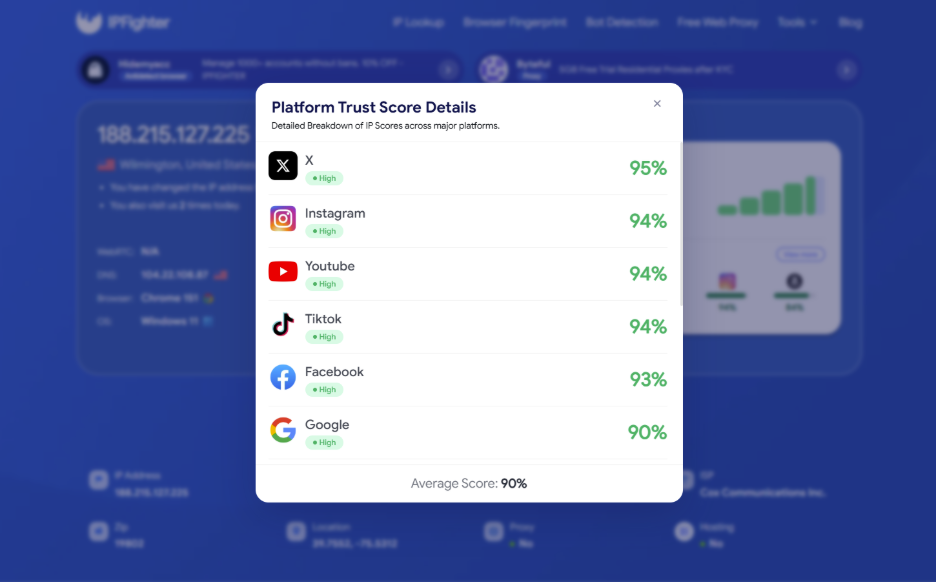
Quickly check proxy quality on IPFighter
Step 6: Validate the collected data
A proxy can help you access location-specific data, but it does not automatically make the resulting dataset accurate. Researchers should validate their results by comparing:
-
The same product across different locations.
-
The same keyword across search engines and locations.
-
Repeated requests at different times.
-
Multiple IPs within the same target market.
This helps identify inconsistencies caused by personalization, changing website content, IP differences, or other factors.
7. Best practices for proxy-based market research
Once the proxy setup is ready, a few simple practices can help improve data quality and reduce unnecessary collection problems.
-
Use location-matched IPs: Collect data from the market you are actually studying.
-
Rotate when necessary: Avoid relying on a single IP for large-scale collection.
-
Keep sessions consistent: Use sticky sessions when the workflow requires the same IP.
-
Monitor failed requests: Track timeouts, blocks, and CAPTCHA rates to identify potential problems.
-
Validate your dataset: Compare results across multiple IPs and locations before drawing conclusions.
-
Respect website policies: Collect only publicly available data and follow applicable laws and website terms.
These practices help ensure that the proxy supports the research process rather than becoming a source of unreliable or incomplete data.
8. Are proxies for market research legal?
Using a proxy is not inherently illegal. What matters is how the proxy is used, what information is collected, and which rules apply to the research activity. Publicly available data is not automatically free from every restriction, particularly when automated collection is involved. Researchers should consider:
-
Website terms of service: Check whether the website places restrictions on automated access or data collection.
-
Local laws: Requirements can vary depending on where the researcher and target website operate.
-
Privacy regulations: Take additional care when collected data contains personal information.
-
Copyright and database rights: Some datasets may be subject to additional legal protections.
-
Personal data: Avoid collecting or processing personal information unnecessarily.
Proxies are an infrastructure tool, not a legal exemption. Researchers should make sure their data collection methods comply with the rules and regulations that apply to their project.
Are proxies for market research legal
Read more:
-
Best residential proxy providers in 2026: Real-world tested
-
Best ISP proxy providers in 2026: Which one is worth buying?
-
Best mobile proxy providers in 2026: Hands-on testing results
9. Conclusion
Proxies can help market researchers collect public web data at scale while accounting for geographic differences. Common applications include competitor price monitoring, product research, SERP analysis, ad verification, customer review research, and market trend monitoring.
The right proxy depends on the research workflow, so factors such as IP quality, geographic coverage, speed, stability, and session control should be considered before scaling up. Before starting your next market research project, check your proxy with IPFighter to verify its IP quality, location, detection status, and potential leaks.
Looking for a new proxy for your market research workflow? Explore the latest proxy promo codes and provider discounts on our Coupons Partner page.
10. FAQ
Why do market researchers need proxies?
Market researchers use proxies to collect location-specific data, distribute requests across multiple IPs, and reduce the limitations of researching a market from a single IP or location.
Are residential proxies good for market research?
Yes. Residential proxies can be useful for location-sensitive research, competitor pricing, product monitoring, and other workloads where IP reputation and geographic coverage are important.
Can I use datacenter proxies for market research?
Yes. Datacenter proxies can be suitable for high-volume research when speed and cost efficiency are more important than using residential-looking IPs.
How do proxies help with competitor price monitoring?
Proxies allow researchers to check competitor prices from different locations and compare how pricing, promotions, and product availability vary between markets.
Can proxies provide location-specific market data?
Yes. Proxies from different countries or cities can help researchers access localized versions of websites and compare region-specific prices, products, promotions, and search results.
Read more

Proxy for trading: Can it improve your connection and privacy?


Anonymous Proxies review: What its proxy network offers

Web scraping proxy: How to collect web data more efficiently

Can a gaming proxy improve your gaming experience? What to know

Proxy server for streaming: Can it improve your experience?
Rapidproxy review: A closer look at its residential proxy network