

Picking the wrong proxy pool can quickly lead to account bans, persistent CAPTCHAs, and degraded automation performance. With proxy providers advertising bold figures around global coverage and session types, verifying actual node reputation and line speed before deploying them in production environments is essential.
In this LegionProxy review, IPFighter breaks down the provider's proxy infrastructure, pricing structure, and core features. Through hands-on benchmarks across multiple target countries, we test sample residential IPs for proxy detection flags, location accuracy, and connection throughput to help you determine if LegionProxy is worth adding to your stack.
1. General information
Before diving into the details, here's a quick overview of LegionProxy and its core specifications.
|
Website |
|
|
Founded |
N/A |
|
Proxy types |
Budget Residential, Premium Residential, Static ISP, Datacenter, IPv6, Unlimited |
|
IP pool |
74M+ residential and ISP IPs in 195+ countries |
|
Protocol |
HTTP, SOCKS5 |
|
Pricing model |
Per GB, per IP, or per day |
|
Payment |
Credit/debit cards and cryptocurrencies |
|
Trial |
Available upon request through Discord or Telegram |
|
Best for |
Web scraping, market research, SEO monitoring, account management, and other location-dependent workflows |
Discover more:
-
Best proxy providers in 2026: Compare top 6 services
-
Best free proxy sites in 2026: The full comparison guide
-
Best residential proxy providers in 2026: Real-world tested
2. Proxy types available at LegionProxy
LegionProxy provides six main proxy options, with two residential plans designed for users who need different levels of residential access. Each product uses a different pricing model or connection approach, so choosing the right one depends on the target website, traffic volume, and session requirements.
2.1. Budget Residential
Budget Residential is LegionProxy's lower-cost residential option, designed for users who need residential IP access for general online tasks and data collection. It uses a bandwidth-based pricing model, making it suitable for users who want to manage their spending according to traffic consumption. Key details include:
-
Advertised proxy pool: 42M+ residential IPs
-
Coverage: 195+ countries
-
Filtering: Country, state, city, and ISP
-
Rotation: Rotating and sticky sessions
-
Protocols: HTTP, SOCKS5 & UDP Support
This plan is worth considering for smaller scraping projects, general browsing, and workflows where residential IP access is important but the highest-tier option may not be necessary.
2.2. Premium Residential
Premium Residential is another residential option from LegionProxy. Like Budget Residential, it uses bandwidth-based pricing and supports rotating and sticky sessions. The provider positions its residential products for tasks involving websites with stronger anti-bot measures, although the exact technical differences between the Budget and Premium pools are not fully detailed on the public website.
-
Advertised proxy pool: 30M+ residential IPs
-
Coverage: 195+ countries
-
Filtering: Server, country, state, and city.
-
Rotation: Rotating and sticky sessions
-
Protocols: HTTP & SOCKS5
Users comparing the two residential plans should check the available locations, current pricing, and pool specifications in the dashboard rather than assuming that the Premium label guarantees a particular trust score or detection outcome.
2.3. Static ISP Proxies
Static ISP proxies provide dedicated IP addresses registered with internet service providers. Unlike rotating residential connections, these IPs are intended to remain consistent, which is useful for workflows that depend on maintaining the same connection identity.
-
Advertised proxy pool: 200K+ ISP IPs
-
Coverage: 9+ locations
-
IP type: Dedicated IP addresses
-
Bandwidth: Unlimited traffic
-
Protocols: HTTP & SOCKS5
Static ISP proxies are a suitable option for account management, e-commerce operations, and other activities where maintaining a consistent IP is more important than frequent rotation.
2.4. Datacenter Proxies
Datacenter proxies are designed for users who prioritize speed and cost efficiency. They use IP addresses associated with data centers rather than residential internet connections, making them suitable for high-volume tasks on websites with less restrictive anti-bot systems.
LegionProxy lists Datacenter proxies as one of its main products, with pricing based on usage duration rather than residential bandwidth.
-
Advertised proxy pool: 20K+ Datacenter IPs
-
Coverage: Across 100+ locations
-
Traffic: Bandwidth unlimited
-
Protocols: HTTP & SOCKS5
Users should consider the target website's detection requirements before choosing this option, as datacenter IPs may be easier for some platforms to identify than residential connections.
2.5. IPv6 Proxies
LegionProxy also offers IPv6 proxies for workflows that can operate through IPv6-compatible websites and services. IPv6 addresses provide a much larger address space than IPv4, making them useful for certain high-volume and cost-sensitive tasks.
-
Advertised proxy pool: 340+ Undecillion IPs
-
Coverage: 195+ countries
-
Unlimited IP diversity: Access billions of unique IPv6 addresses with automatic rotation.
-
Protocols: HTTP & SOCKS5
Before purchasing, check whether the target platform supports IPv6 connections. An IPv6 proxy is not a direct replacement for IPv4 when the destination website or application does not support it.
2.6. Unlimited Proxies
Unlimited proxies are intended for users who need predictable costs for bandwidth-heavy workloads. Instead of purchasing residential traffic by the gigabyte, users select a plan based on the available usage period and connection specifications.
-
Advertised proxy pool: 25K+ ISP-Grade IPs
-
Locations: US based proxies
-
Bandwidth: Unlimited traffic
-
Protocols: HTTP & SOCKS5
This model may be useful for continuous scraping or other high-volume activities where a fixed plan is easier to manage than tracking every gigabyte consumed. Users should review the available bandwidth, session settings, and fair-use conditions before choosing a plan.
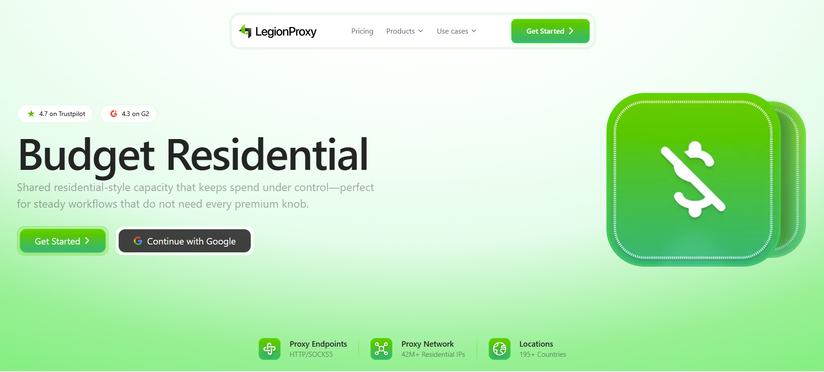
Budget residential proxy plan are available at LegionProxy
3. Key features of LegionProxy proxies
LegionProxy offers several features to help users manage residential connections and integrate proxies into different workflows. Its main capabilities focus on IP rotation, session control, geographic targeting, protocol support, and API integration.
-
Automated IP rotation: Provides a new IP for each request, helping distribute connections across multiple addresses. The provider also advertises smart retry logic to handle unsuccessful requests.
-
Sticky sessions: Allows users to maintain the same IP for longer sessions, with the provider's FAQ stating that sessions can last up to 24 hours. This is useful for logins and multi-step browsing activities.
-
Geographic targeting: Supports location filtering across 195+ countries, with country, state, city, and ASN targeting available where supported. This helps users select IPs for location-specific tasks.
-
Multiple proxy protocols: Supports HTTP(S) and SOCKS5 connections, making the proxies compatible with different browsers, applications, and automation tools.
-
API integration: Provides API functionality for users who want to manage proxy operations programmatically and integrate proxy services into their existing workflows.
These features give users flexibility in managing IP changes, maintaining sessions, and selecting connection locations. However, the actual availability of certain settings may vary by proxy type.
4. LegionProxy pricing overview
LegionProxy uses different pricing models depending on the proxy type. Residential plans are billed by bandwidth, Static ISP is priced per IP, while Datacenter, IPv6, and Unlimited products use time-based pricing. The provider's homepage currently advertises the following starting prices:
|
Proxy type |
Starting price displayed |
Pricing model |
|
Residential |
From $0.60/GB |
Per GB |
|
Static ISP |
From $1.90/IP |
Per IP |
|
Datacenter |
From $5/day |
Per day |
|
Unlimited |
From $25/day |
Per day |
|
IPv6 |
From $5/day |
Per day |
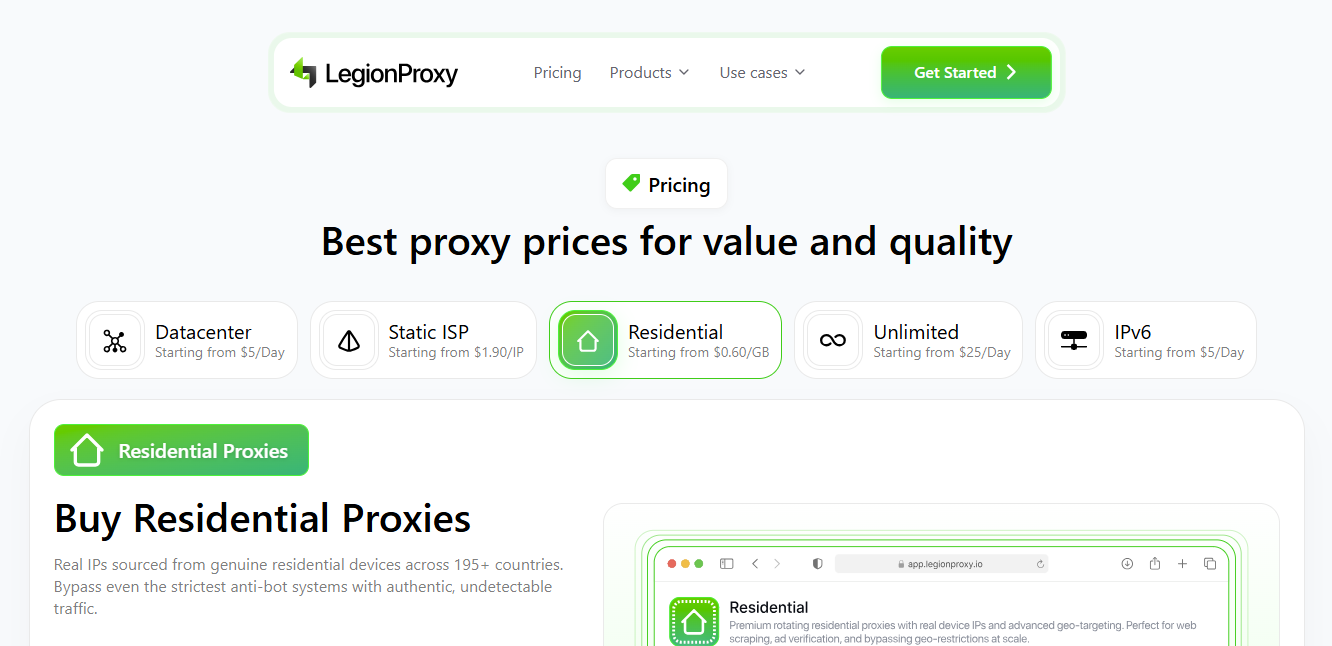
Prices for proxies plan at LegionProxy
If you're planning to purchase proxies from LegionProxy, don't miss the LegionProxy promo code available on IPFighter. You can save on your proxy purchase with exclusive discounts while choosing the plan that best suits your needs.
5. Performance test
To assess LegionProxy beyond its advertised specifications, we tested randomly selected IPs from its Budget Residential and Premium Residential plans across six target countries: Vietnam, the UK, Singapore, the US, the Philippines, and South Korea.
Our testing focused on three key aspects: proxy quality (via the IPFighter platform), connection speed, and geolocation accuracy on Google Search. Additionally, we examined data related to WebRTC and DNS (where applicable). The results presented below reflect only the specific IP samples tested and should not be interpreted as a performance guarantee for the provider’s entire IP infrastructure.
5.1. Preparation
Before evaluating the proxy, we first added it to our browser using the IPFighter Proxy Manager extension. This extension makes it easy to import, manage, and switch between multiple proxies directly within your browser, eliminating the need for manual proxy configuration.
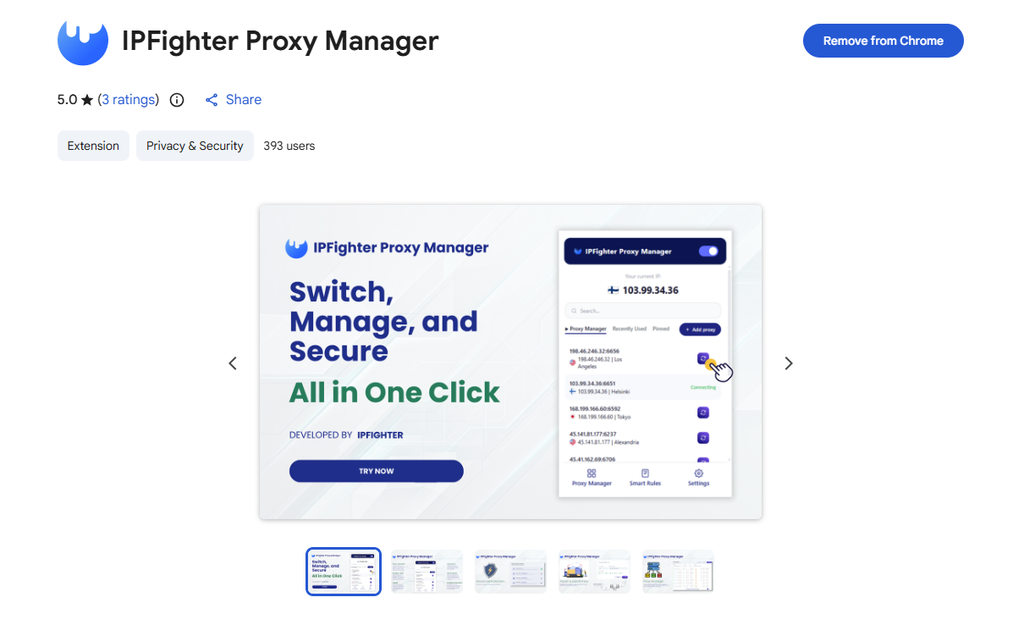
IPFighter Proxy Manager extension on Chrome
If you'd like to learn how to set it up, check out our detailed guide: A complete guide to the IPFighter Proxy Manager extension.
5.2. Test results
The following table summarizes the results from randomly selected IPs across six target countries. Vietnam, the UK, and Singapore were tested using Premium Residential, while the US, Philippines, and South Korea were tested using Budget Residential. Average IPFighter scores, speeds, and approximate latency are presented to make the overall results easier to compare.
|
Proxy type |
Proxy location |
IPFighter |
Speed test |
Google Search |
Overall assessment |
|
Premium Residential |
Vietnam |
Score: 80-85%; proxy not detected; all IPs blacklist clean. DNS location mismatches were observed, with servers detected in Hong Kong and Singapore. |
Download: ~50.5 Mbps; upload: ~19.1 Mbps; latency: ~209 ms |
Results varied by IP. Some searches returned locations in Da Nang or An Giang instead of the intended cities of Ho Chi Minh City or Hanoi. |
The tested IPs received good trust scores and were not detected as proxies, with clean blacklist results. However, Google Search sometimes returned a different Vietnamese city from the intended target. DNS servers were also detected in Hong Kong and Singapore, indicating location mismatches rather than evidence of a real IP leak. |
|
UK |
Score: 85%; proxy not detected; all IPs blacklist clean. DNS servers were detected in Germany and Singapore on some IPs. |
Download: ~10 Mbps; upload: ~11.6 Mbps; latency: ~392 ms |
All tested IPs returned locations consistent with the original target. |
The tested IPs showed consistent trust scores, no proxy detection, and clean blacklist results. Google Search also returned locations consistent with the intended UK regions. However, download speeds were relatively low, and DNS location mismatches appeared on some IPs. |
|
|
Singapore |
Score: 85-90%; proxy not detected; all IPs blacklist clean. One IP showed a WebRTC location mismatch after refreshing, although the detected location remained Singapore. |
Download: ~149.2 Mbps; upload: ~20.8 Mbps; latency: ~187 ms |
All tested IPs returned Singapore, matching the country-level target. |
The tested IPs showed good trust scores, clean blacklist results, and no proxy detection. Google Search consistently identified Singapore as the location. One IP showed a WebRTC mismatch after refreshing, but the result remained within the same country. This is a consistency issue worth monitoring, not evidence of the user's real IP being exposed. |
|
|
Budget Residential |
US |
Score: 90%; proxy not detected; all IPs blacklist clean. |
Download: ~26.5 Mbps; upload: ~23 Mbps; latency: ~441 ms |
Test results show that several IPs correctly matched the target, but some IPs still diverged to Columbia, South Carolina, and Reisterstown, Maryland, instead of the expected Los Angeles or New York City. |
The tested IPs received consistently high trust scores, avoided proxy detection, and were cleaned of blacklist listings. However, Google Search did not consistently match the intended city, with only the number like Tampa sample returning the expected location. Latency was also relatively high. |
|
Philippines |
Score: 65-70%; proxy not detected; checked IPs are clean, though one rotated IP hit a threat intel blocklist. Some IPs show WebRTC location mismatches, and a few DNS servers were located in Taiwan. |
Download: ~14.1 Mbps; upload: ~32.9 Mbps; latency: ~327 ms |
All results identified locations within the Philippines, but the detected cities did not match the intended targets of Manila, San Pedro, and Davao. |
Samples from the Philippines yielded the lowest IPFighter scores among the markets tested, averaging approximately 67%. Although the listed IP addresses were not identified as proxies and did not appear on any blacklists, one IP address that emerged during the IP rotation process was found on a threat intelligence blocklist. A discrepancy between the locations indicated by WebRTC and DNS also suggests some inconsistency in the geolocation signals; however, these findings alone are insufficient to definitively confirm that an actual IP address leak has occurred. Google Search correctly identified the country, but it did not always align with the target cities. |
|
|
Korea |
Score: 90%; proxy not detected; all IPs blacklist clean. |
Download: ~52.4 Mbps; upload: ~20.3 Mbps; latency: ~290 ms |
All results identified South Korea. The Incheon sample matched the intended city, while the other results only confirmed the country. |
The IP addresses tested consistently showed high trust scores, with no detection of proxy usage and no presence on any blacklists. Google Search correctly identified the country as South Korea for the test samples. Overall, this market yielded the most stable results among all those evaluated using IPFighter throughout the testing process. |
5.3. Overall performance findings
The test results show differences between the selected Premium Residential and Budget Residential samples across the six markets. Most tested IPs received good IPFighter scores and avoided proxy detection, but location accuracy and connection performance varied by country. The Philippines samples showed the most noticeable reputation and location inconsistencies.
IP quality and proxy detection
Most tested IPs from both residential plans received relatively high IPFighter scores and were not detected as proxies. The UK, Singapore, US, and South Korea samples generally showed strong trust scores, while Vietnam also returned good results. The Philippines was the main exception, with scores averaging around 65-70%.
The Philippines results deserve closer attention. Although the three listed IPs were clean of blacklist listings, an additional IP obtained during rotation appeared on the Thread Intelligence Blocklist. This suggests that IP quality may not be uniform throughout the rotating pool. A rotating residential service can assign different addresses over time, and some may have weaker reputation histories than others. Previous abusive activity or spam-related listings could be possible explanations, but the test alone cannot establish the exact reason for the low scores or blacklist entry.
Across the tested markets, IPFighter did not identify the listed samples as proxies. This is a positive result for the tested addresses, but it does not mean every IP in either residential pool will receive the same classification or be accepted by every website.
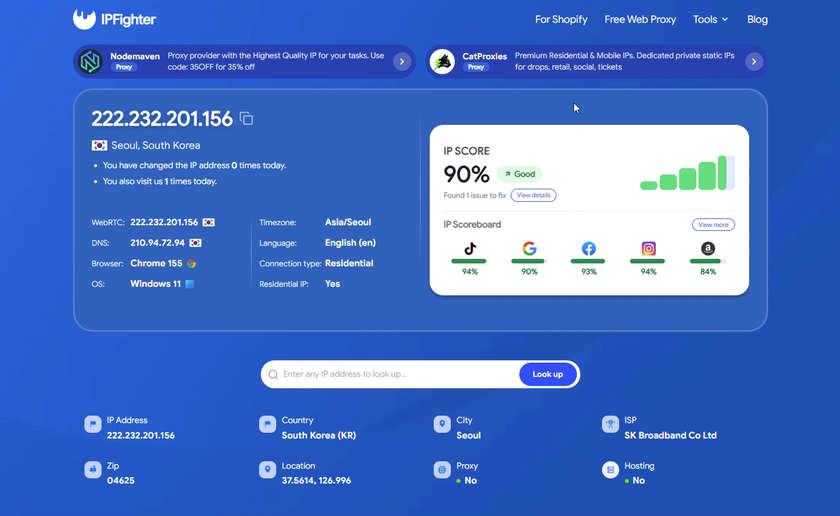
South Korea budget residential IP test results
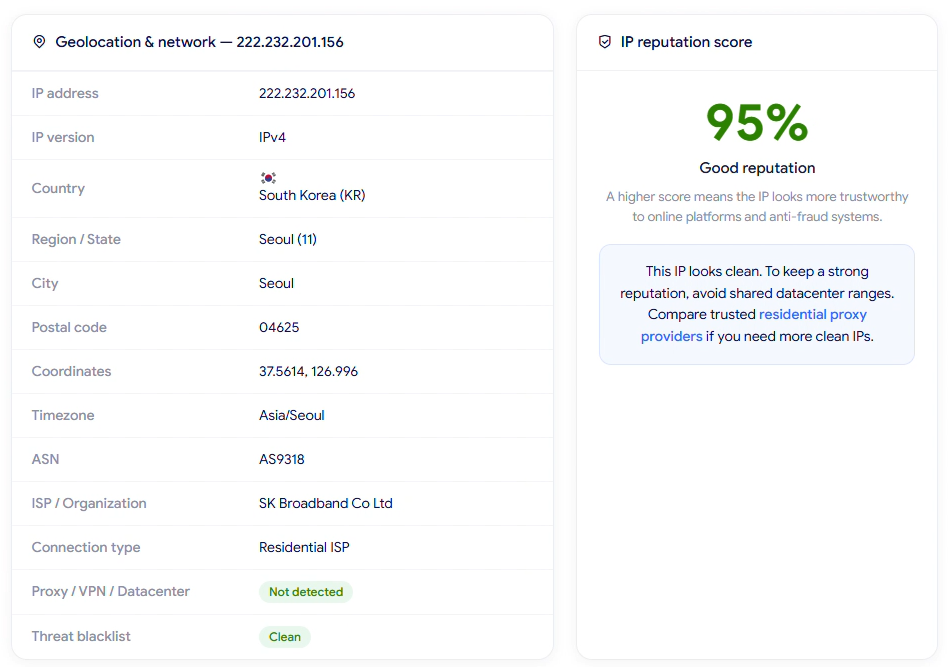
IP Lookup results on IPFighter
Location consistency
Google Search generally identified the correct target country across the tested markets, but city-level accuracy was less consistent. The UK and Singapore samples showed the strongest location alignment: Google Search returned the intended UK regions and Singapore, respectively. South Korea also showed country-level consistency, although not every result matched the intended city.
Vietnam, the US, and the Philippines had more noticeable city-level differences. Some Vietnamese IPs returned Da Nang or An Giang instead of the intended cities. In the US, only the Tampa sample matched its target, while other results pointed to different states. The Philippines samples were identified within the correct country, but their detected cities differed from the intended targets.
These findings suggest that country targeting was generally more consistent than city-level targeting in the tested samples. Users who depend on precise local search results, advertising checks, or city-specific data should verify the assigned IP before running larger workflows.
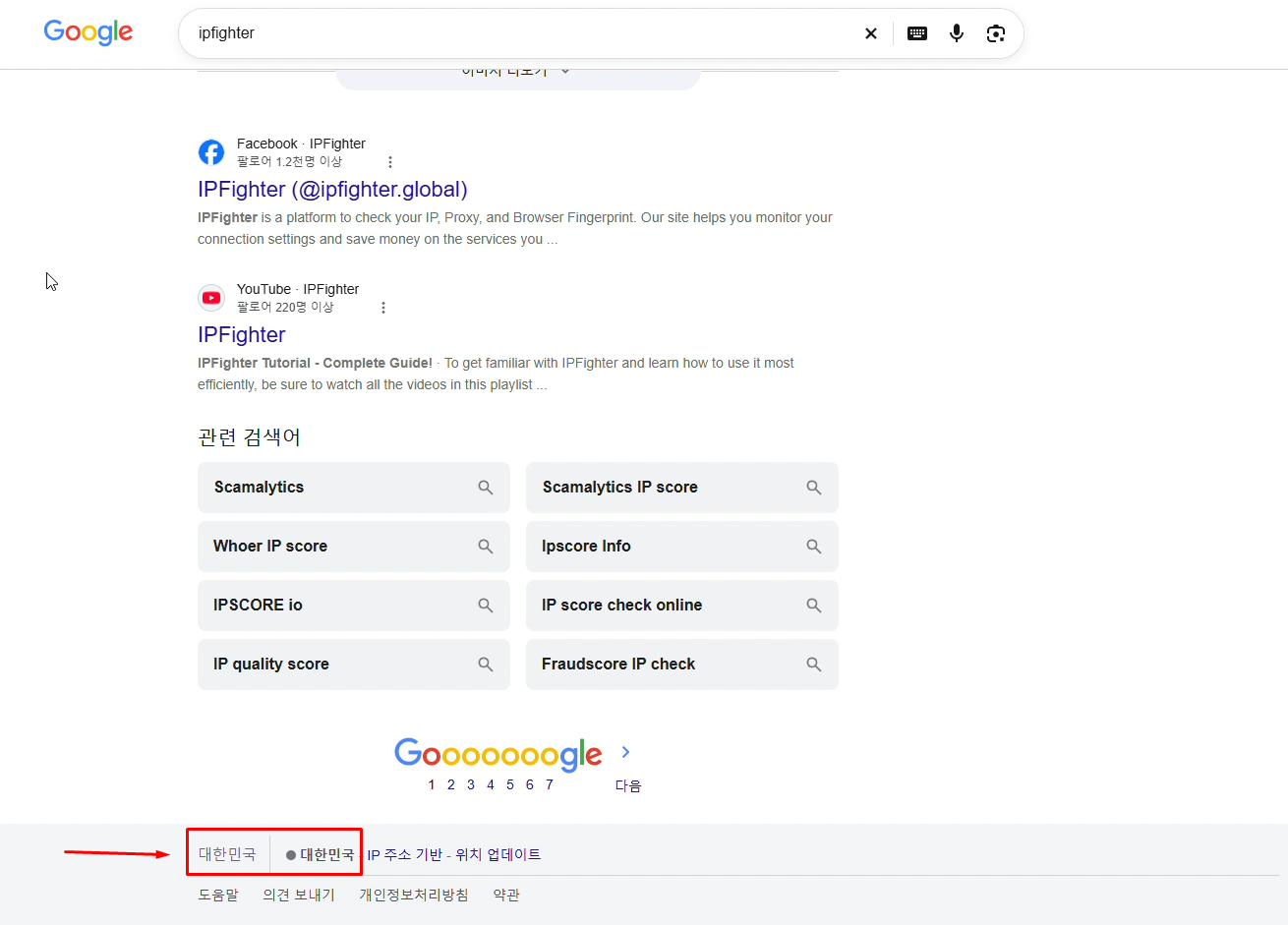
Results of the budget residential IP location check in Korea
Speed and latency
Connection speeds varied considerably by location. Singapore recorded the highest average download speed at approximately 149.2 Mbps, followed by South Korea at around 52.4 Mbps and Vietnam at 50.5 Mbps. The UK had the lowest average download speed, at approximately 10 Mbps.
Upload performance showed a different pattern. The Philippines recorded the highest average upload speed at approximately 32.9 Mbps, while the UK had the lowest at around 11.6 Mbps. Latency was also relatively high in some markets, particularly the US and UK, where the averages were approximately 441 ms and 392 ms, respectively.
Overall, the results indicate that LegionProxy's residential performance depends heavily on the selected location. Singapore delivered the strongest download performance among the tested samples, while the UK showed more limited speeds. Users should run their own tests from the locations and target services relevant to their workflows rather than assuming uniform performance across the network.
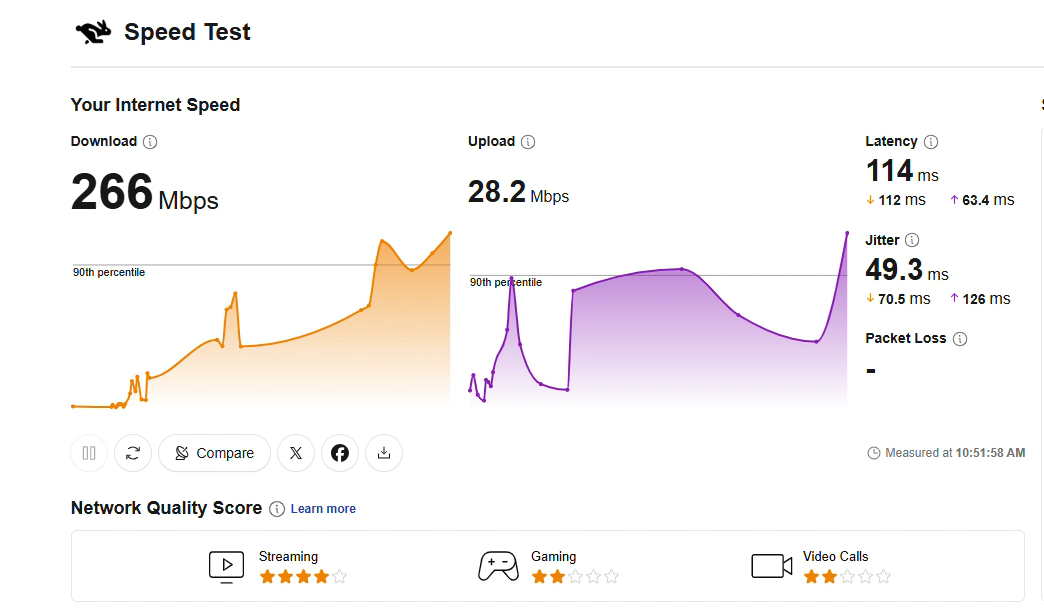
Results of premium residential IP speed tests in Singapore on Speed test Cloudflare
WebRTC and DNS observations
The WebRTC and DNS findings should be interpreted separately because a location mismatch does not automatically indicate that the user's real IP address has been exposed. For Singapore, one IP showed a WebRTC mismatch after refreshing, but the detected location remained Singapore. This points to an inconsistency in the WebRTC address or location signal, not a confirmed real-IP leak.
The Philippines samples showed WebRTC mismatches, but the detected addresses remained within the Philippines. This is a location or address mismatch rather than proof that the tester's original IP was exposed. Some DNS servers were also detected in Taiwan, which indicates a DNS location mismatch between the proxy and the DNS resolver. Without evidence that the DNS address belongs to the tester's original ISP or network, it should not be classified as a true DNS leak.
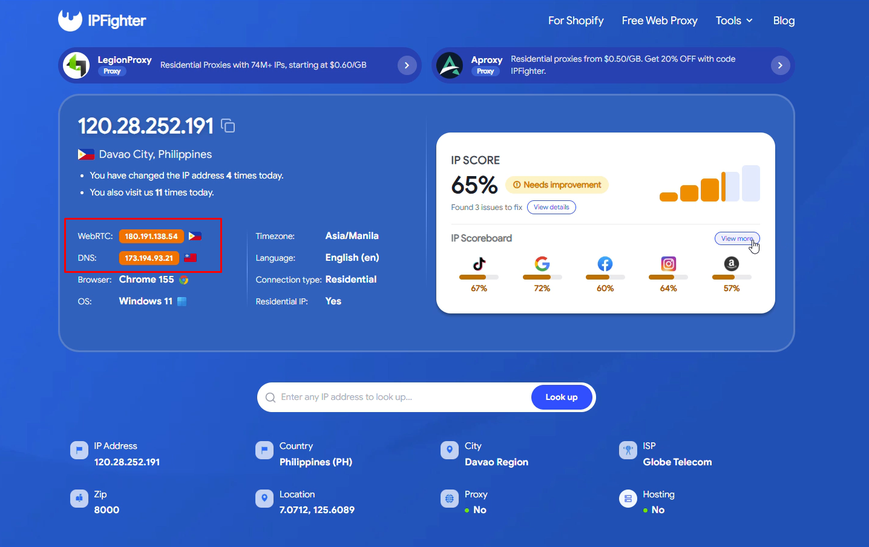
Philippines proxy test showing WebRTC and DNS mismatches
Vietnam and the UK also showed DNS servers in other countries, including Hong Kong, Singapore, and Germany. These results suggest that DNS requests may be resolved through servers outside the proxy's selected location. However, a different DNS server country alone does not establish that the user's real IP is exposed.
In short, the tests identified some WebRTC and DNS location inconsistencies, especially in Singapore and the Philippines. None of the reported observations is sufficient on its own to confirm exposure of the tester's real IP. Users should compare these results with a non-proxy baseline and repeat checks before drawing a final conclusion.
Browsing experience: In practical use, both "Budget" and "Premium" residential proxies provide fairly stable speeds for routine activities such as watching videos, browsing websites, and performing Google searches. Premium residential proxies may feel slightly faster in certain scenarios, but the difference is relatively minor-certainly not significant enough to make the budget-tier options feel noticeably slower during everyday web browsing.
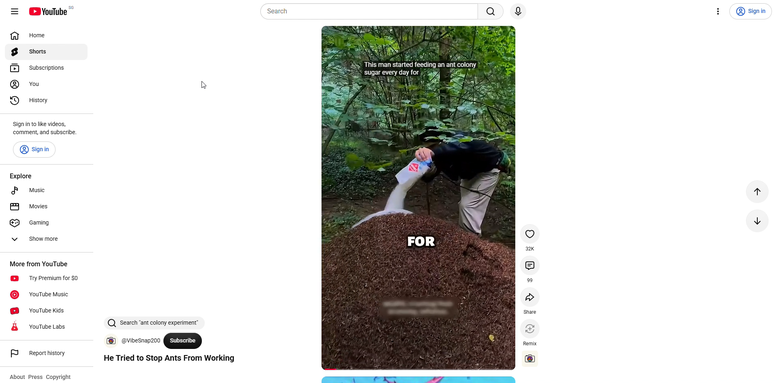
Access YouTube using LegionProxy’s premium residential IPs
Read more:
-
How to use web proxy safely: A practical guide
-
How to know if you have a WebRTC leak: Reading your results
-
Explaining how to know if you have a DNS leak
6. How to get proxy from LegionProxy
Getting started with LegionProxy involves creating an account, purchasing a plan, and generating proxy credentials through the dashboard. The process is relatively straightforward for users who already know which proxy type and location they need.
Step 1. Create or log in to your account
Visit the official LegionProxy website and select the option to get started. Register with your email address and create a password to access the dashboard.
After signing in, you can manage your balance, purchased plans, and generated proxy connections from your account.
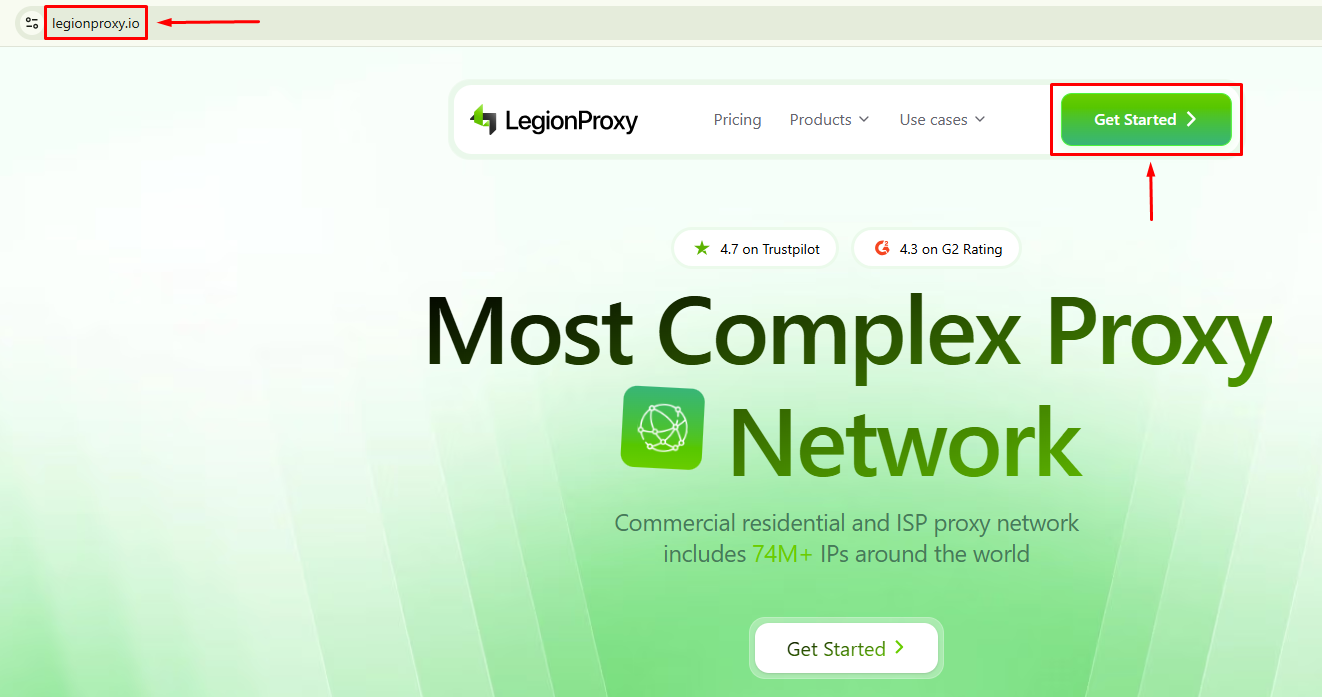
Create or log in to your account
Step 2. Purchase a proxy plan
Open the purchase section and select the proxy type that matches your requirements. For residential access, compare Budget Residential and Premium Residential before deciding how much traffic to purchase.
Depending on the product, you may need to select a bandwidth allowance, IP quantity, or usage period. Check the available locations and pricing before completing the order.
Before completing your purchase, don't forget to check for LegionProxy promo codes on IPFighter to claim a free 200MB+ proxy traffic trial. Applying an active promo offer can significantly reduce your testing costs.
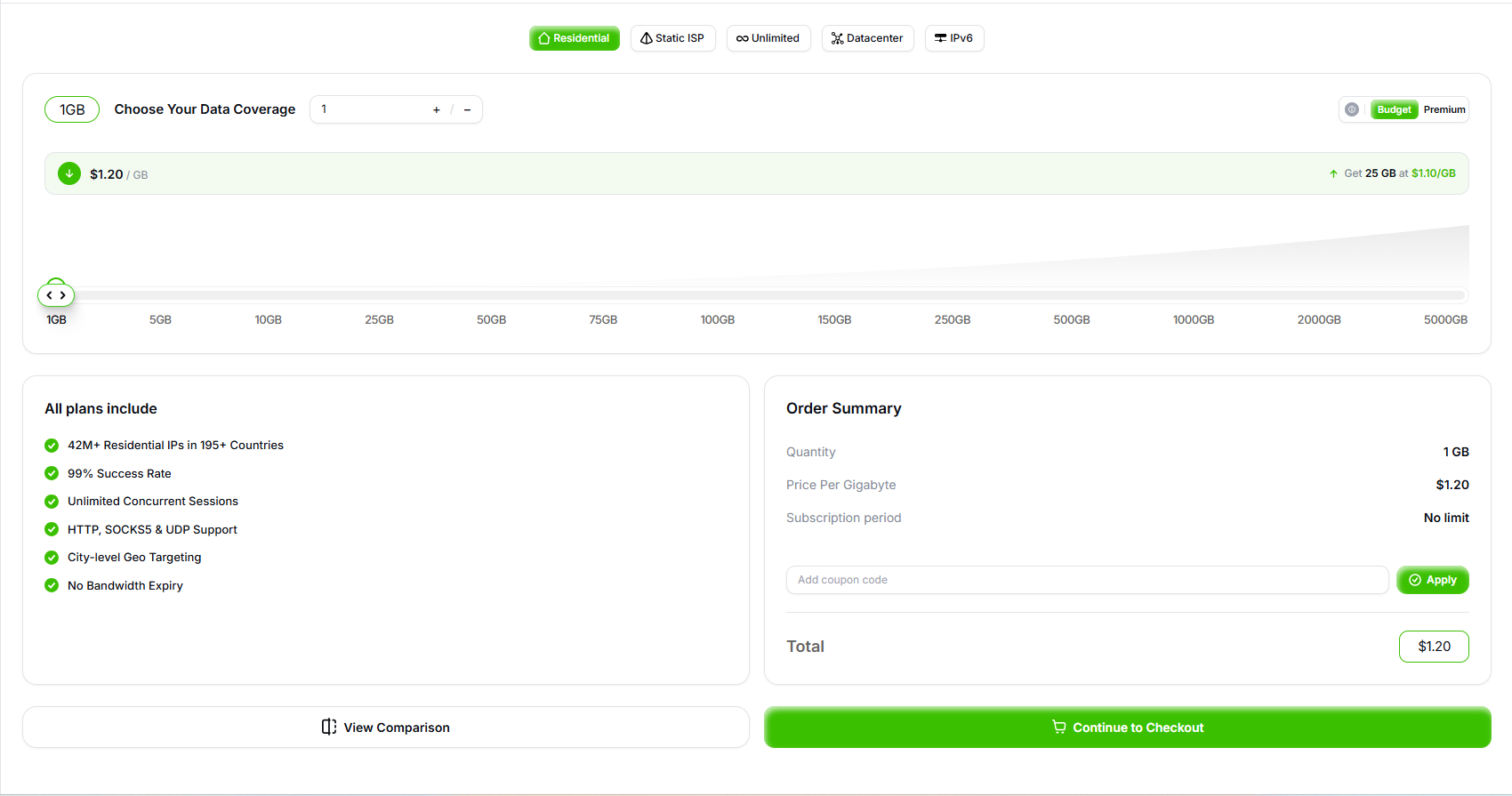
Purchase a proxy plan
Step 3. Configure your proxy
After purchasing a plan, open the relevant plan in your dashboard and generate your proxy credentials. Select the supported protocol and connection settings required by your application.
For residential connections, choose between rotating and sticky sessions based on your workflow. Rotating sessions are useful when you need a new IP for each request, while sticky sessions help maintain the same IP during multi-step activities.
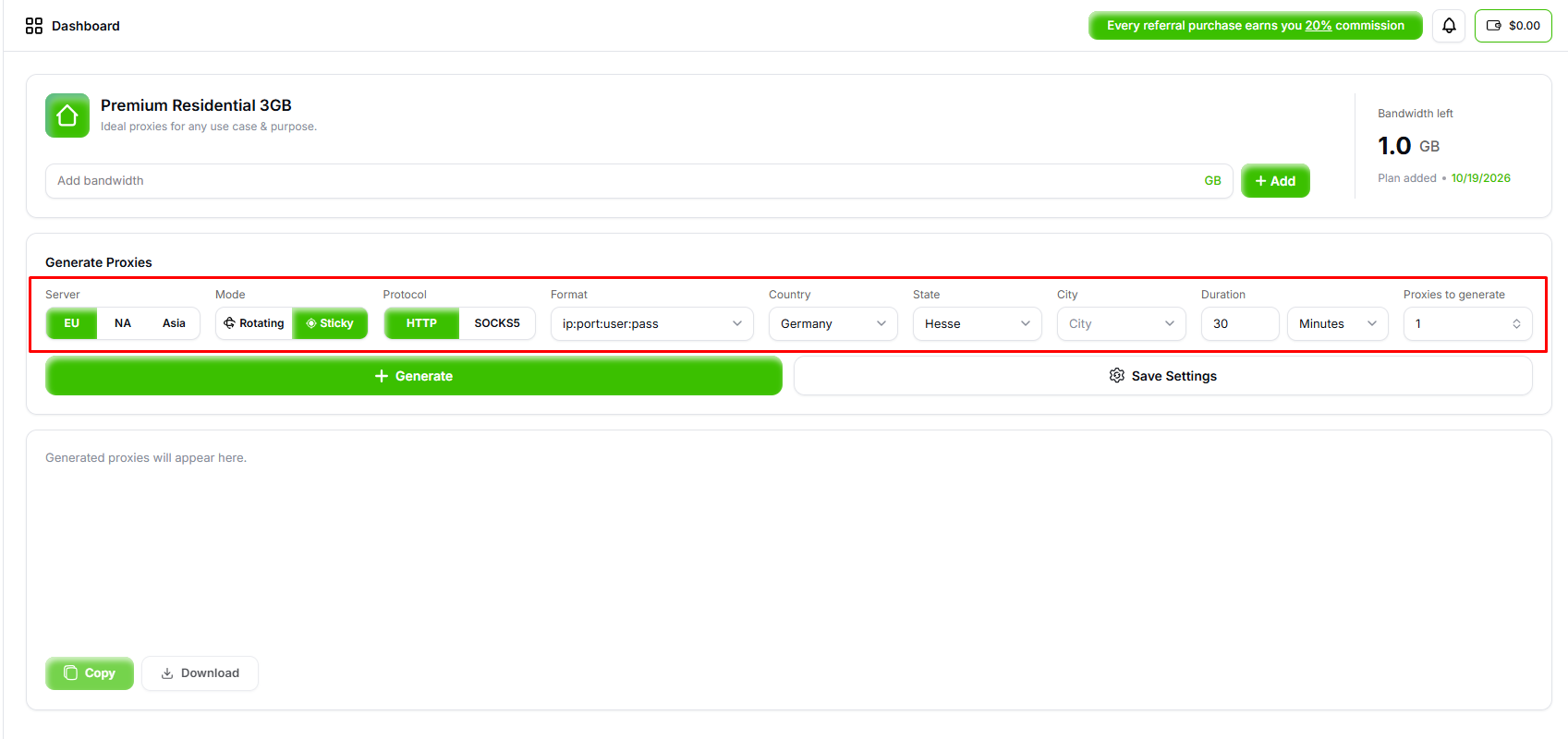
Configure your proxy
Step 4. Generate and copy your proxy
Enter the generated proxy host, port, username, and password into your browser or proxy-compatible application. Once connected, visit IPFighter to verify the quality of the IP address.
You can also perform DNS and WebRTC leak tests to check whether your browser is inadvertently exposing network information. Compare these results against your original connection (without using a proxy) to determine whether any observed differences actually constitute a leak.
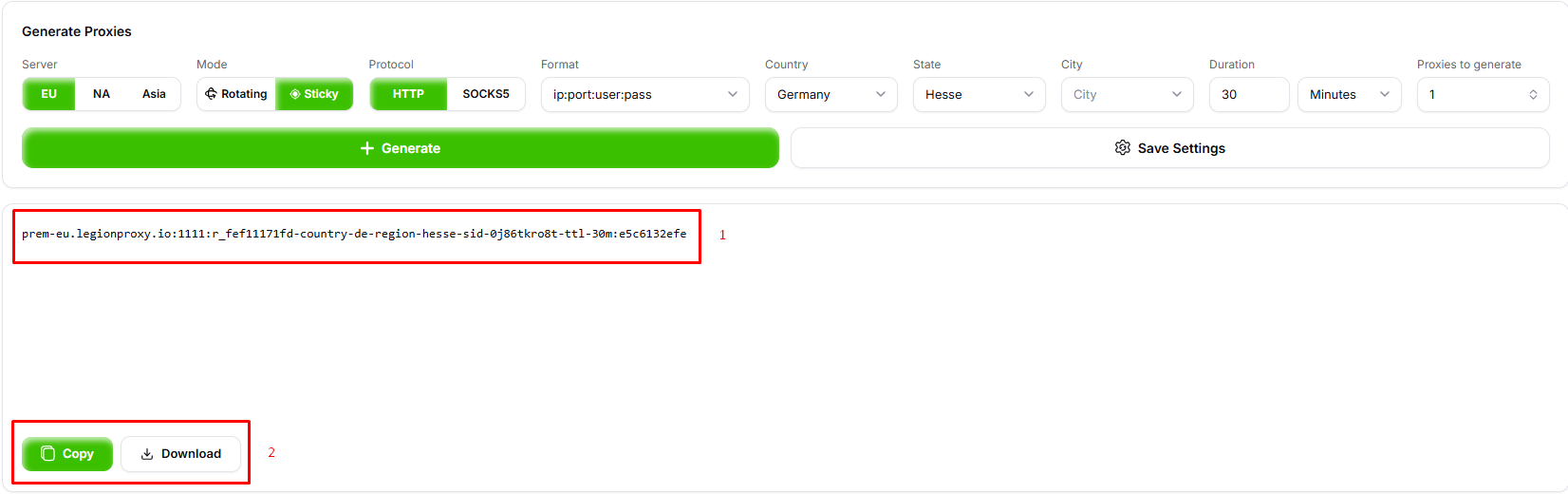
Generate and copy your proxy
7. Alternatives
Besides LegionProxy, you can also consider other providers offering similar residential proxy services.
-
ProxyWing: Offers residential, ISP, datacenter, and mobile proxies, with rotating and static options for different workflows. Its geographic targeting and range of IP types make it an alternative for users who need flexibility.
-
ProxyPrivate: Consider comparing its available private proxy options, IP locations, and session features against LegionProxy before choosing a provider.
-
Geonix: Offers residential and other proxy solutions for users who need IPs across different locations, making it an option to compare for web scraping and location-sensitive workflows.
You can also check out reviews of our other partners here:
-
Aproxy review: Proxy options, pricing, and performance
-
CatProxies review: What do its five proxy types offer?
-
AstroProxy review: Uncovering real speeds & IP quality
-
IPFoxy review: Are its pure rotating residential proxies worth it?
8. Conclusion
LegionProxy offers a flexible range of proxy options, from Budget and Premium Residential to ISP, Datacenter, and IPv6. In our tests, both Residential plans provided stable performance for everyday browsing, although Premium Residential was slightly faster in some cases. Results varied by location, so users should consider their specific targeting and performance needs before choosing a plan.
Overall, LegionProxy is worth considering if you need multiple proxy types and flexible session options. You can also explore IPFighter's proxy testing tools to check connection quality and visit IPFighter Coupons Partners for available proxy deals.
If you're planning to try LegionProxy, check out our LegionProxy promo codes on IPFighter to claim a free 200MB+ proxy traffic trial.
9. FAQ
Does LegionProxy offer a free trial?
Yes. LegionProxy states that users can request a trial by opening a ticket through its Discord server or contacting its Telegram support account. Trial availability and conditions should be confirmed with the provider.
What proxy types does LegionProxy provide?
LegionProxy lists Budget Residential, Premium Residential, Static ISP, Datacenter, IPv6, and Unlimited proxies. Each option uses a different pricing model and is intended for different connection requirements.
Does LegionProxy support SOCKS5?
Yes. LegionProxy advertises HTTP(S) and SOCKS5 support for its proxy connections. Check the product and generated credentials in your dashboard for the available endpoints.
Does LegionProxy support sticky sessions?
Yes. The provider supports both rotating and sticky sessions. According to its FAQ, sticky sessions can maintain the same IP for up to 24 hours, while rotating sessions provide a new IP for each request.
Do unused LegionProxy residential GB expire?
According to LegionProxy's FAQ, unused residential bandwidth does not expire and remains available until it is consumed. Check the current plan terms for any product-specific conditions.
Read more
LegionProxy review: Is it worth buying?

Aproxy review: Proxy options, pricing, and performance
AstroProxy review: Uncovering real speeds & IP quality
FlashProxy review: Is this proxy network worth it?
PrivateProxy review: Is it worth your investment?
IPFoxy review: Are its pure rotating residential proxies worth it?