

We tested 3 IPPeak IPs: two premium residential IPs in the US and Germany, and one static ISP IP in the US. None was detected as a proxy, none was blacklisted and DNS and WebRTC matched the target regions; the German residential IP downloaded at 760 Mbps, but latency ran from 248 to 403 ms and the ISP IP scored a lower 75/100.
Tested by Valerie Thorne · Test date: Nov 11, 2026 · Updated: Nov 20, 2026
IPFighter earns a commission if you buy through some links on this page. It does not affect our test results.
1. IPPeak overview
IPPeak is a Hong Kong-based provider selling four proxy products: Core and Premium residential, Unlimited residential, and static ISP proxies. The figures below are the provider's own, taken from IPPeak's website.
|
Website |
|
|
Based in |
Hong Kong |
|
Proxy types |
Core residential, Premium residential, Unlimited residential, ISP |
|
IP pool (provider claim) |
80M+ residential IPs |
|
Coverage |
195+ countries (Premium); 150+ (Core); 30+ (ISP) |
|
Targeting |
Country, state/region, city; ASN on Core and Premium; Unlimited needs support for country targeting |
|
Sessions |
Rotating or sticky (maximum sticky duration not disclosed); unlimited concurrent sessions; static on ISP |
|
Protocols |
HTTP, HTTPS, SOCKS5 (HTTP and SOCKS5 on Unlimited and ISP) |
|
Authentication |
Username/password, IP whitelist; code samples for Python, Node.js, Go, Java, PHP, C/C++ |
|
Pricing model |
Per GB, never expires (Core, Premium); per hour or day (Unlimited); per IP for 30 or 90 days (ISP) |
|
Payment |
Visa, Mastercard, UnionPay, Bitcoin, TRON, Tether, Alipay |
|
Trial / refund |
No free trial; no refunds under any circumstances |
2. Test results: IPPeak performance at a glance
All three IPPeak IPs were clean and correctly located; speed ranged from very fast to modest, and latency was high throughout.
2.1. Test setup
We tested two randomly selected IPs from IPPeak's Premium residential pool, one in the US and one in Germany, and one static ISP IP in the US, on Nov 11, 2026. Each IP was loaded into Chrome with the IPFighter Proxy Manager extension, then checked with IPFighter IP lookup, DNS and WebRTC leak tests, Fast.com and a Google search. A dash in the table marks a value our test did not record.
|
Proxy type |
Requested location |
Detected location |
IP score |
Proxy flag |
Hosting flag |
Download (Mbps) |
Upload (Mbps) |
Latency (ms) |
Test date |
|
Premium residential |
US |
West Palm Beach, Florida (IPFighter); Washington, DC (Google) |
90 |
No |
No |
53 |
52 |
248 |
Nov 11, 2026 |
|
Premium residential |
Germany |
Germany (Google) |
85 |
No |
[cần điền từ ảnh] |
760 |
12 |
403 |
Nov 11, 2026 |
|
ISP |
US |
Austin, Texas (Google) |
75 |
No |
[cần điền từ ảnh] |
15 |
4.2 |
285 |
Nov 11, 2026 |
2.2. IP quality: IPFighter score & platform scores
The two residential IPs scored 90 and 85, and the ISP IP 75. The US residential IP came from Comcast, a US home broadband provider, and scored 90–94% on Google, Facebook, TikTok and Instagram, with Amazon lower at 84%. IPFighter did not detect any of them as proxies, and all three had clean blacklist records. DNS resolvers and WebRTC results matched each IP's target region, with no leaks.
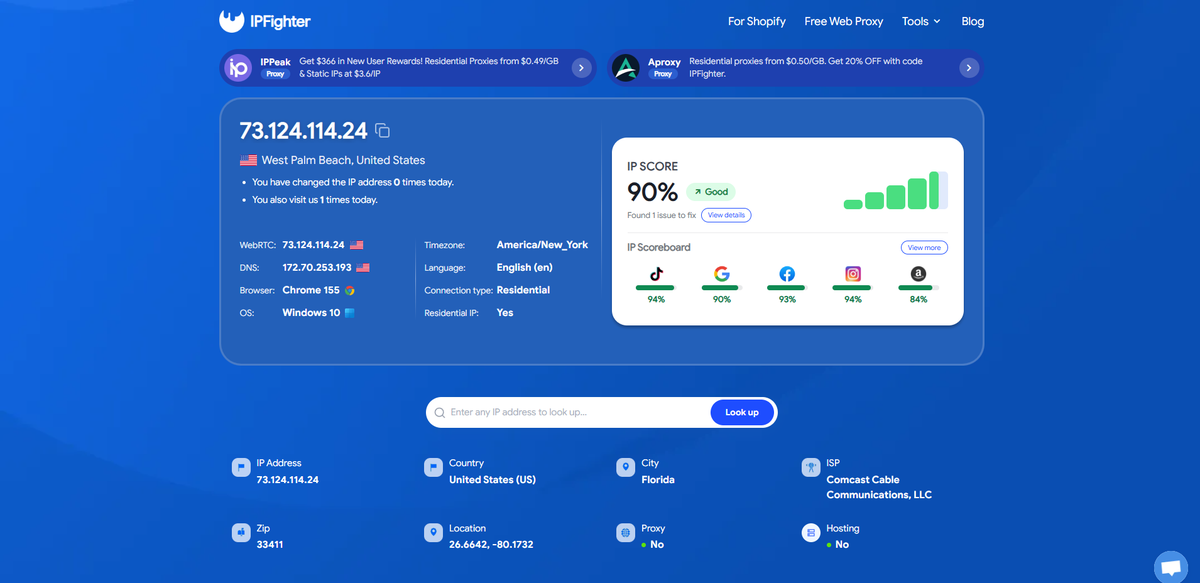
IPPeak US premium residential IP test results on IPFighter, IP score 90/100
|
Platform |
US residential IP (screenshot sample) |
|
|
90% |
|
|
93% |
|
TikTok |
94% |
|
|
94% |
|
Amazon |
84% |
Google placed every IP in its target market, down to Washington, DC for the US residential IP and Austin, Texas for the ISP IP. YouTube, TikTok and other social sites loaded smoothly on both proxy types, with no disconnections during routine browsing.
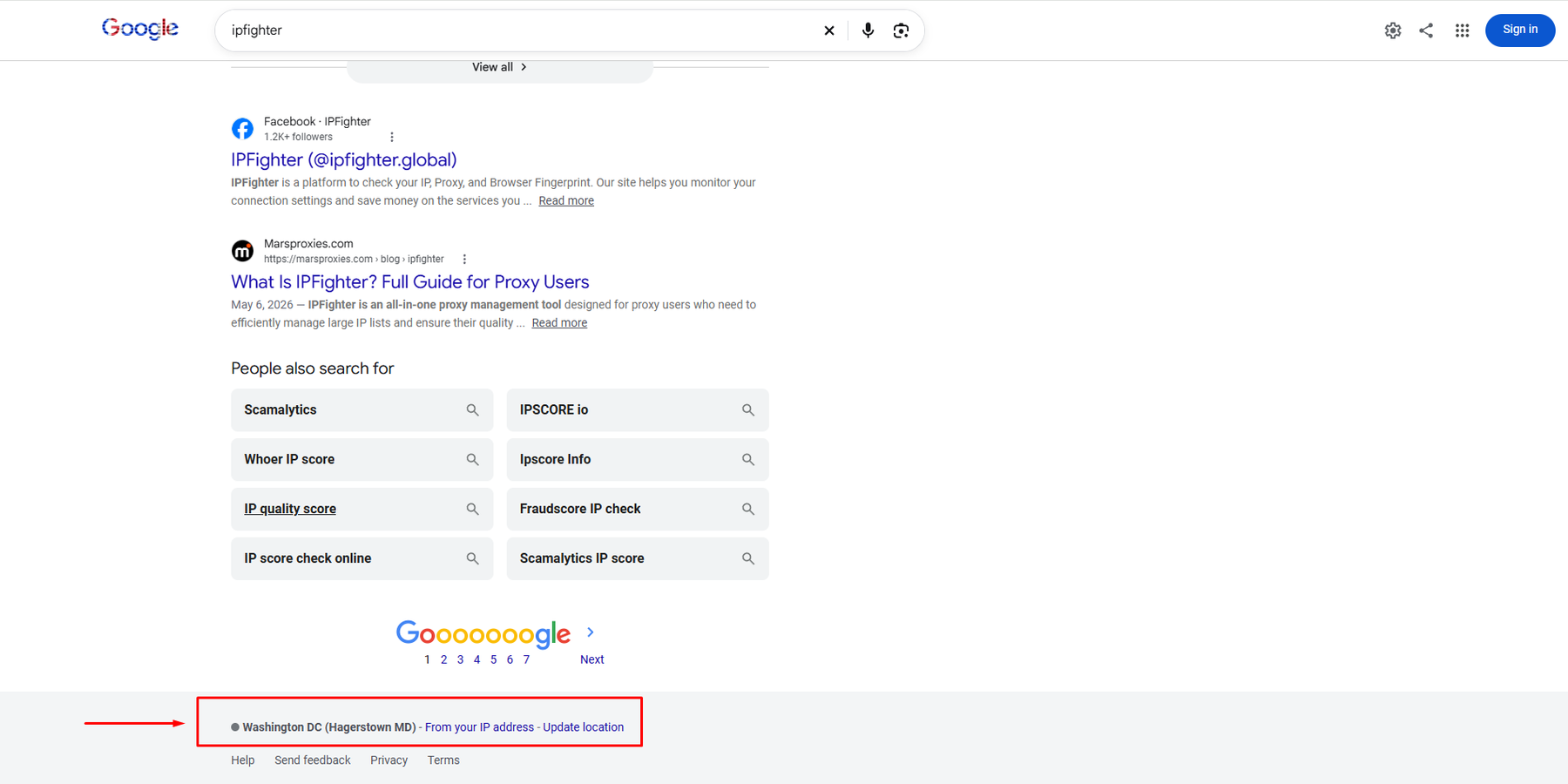
Results of the Core residential proxy IP location check in US
2.3. Speed & latency
The German residential IP downloaded at 760 Mbps, the fastest residential result in our comparison, though it uploaded at only 12 Mbps. The US residential IP was balanced at 53 Mbps down and 52 Mbps up, while the ISP IP was modest at 15 Mbps down and 4.2 Mbps up.
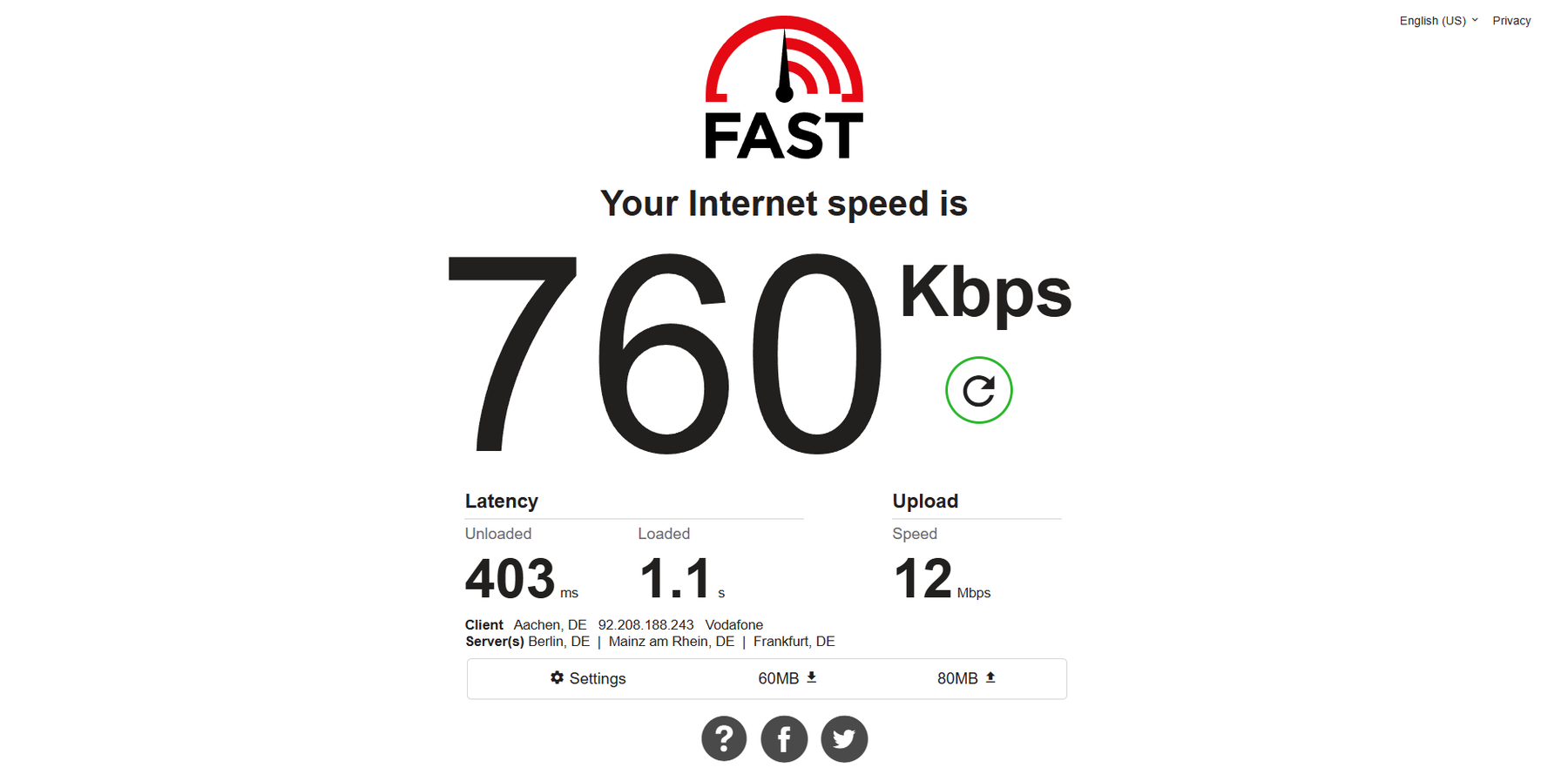
Results of Core residential proxy IP speed tests in Germany on fasttest
Latency ranged from 248 ms to 403 ms, so responses lag noticeably for real-time or step-by-step tools.
2.4. Provider claims vs our results
IPPeak advertises a 99.95% success rate on Premium residential. We did not measure success rate, but our two Premium IPs were clean, unflagged and correctly located. The ISP IP's 75/100 suggests static IPs may need more checking before use.
3. IPPeak vs Geonix vs FloppyData
On residential IPs, IPPeak matched Geonix's starting price, sat between its two rivals on IP score, and downloaded far faster than both.
|
Provider |
IP score |
Latency (ms) |
Download (Mbps) |
Starting price |
Best for |
|
IPPeak |
87.5 |
325.5 |
406.5 |
$0.49/GB |
Fast residential downloads with non-expiring traffic |
|
91 |
479.8 |
28.7 |
$0.49/GB |
Higher IP scores across many countries |
|
|
85 |
296.3 |
52.1 |
$1/GB |
Lowest latency, several proxy types on one balance |
Residential results from each provider's own IPFighter review. IPPeak figures are the average of its 2 Premium residential IPs; its download average is driven by one German IP at 760 Mbps (the US IP reached 53 Mbps). Geonix is the average of 5 IPs and FloppyData of the IPs in its review. Starting prices are each provider's lowest per-GB rate; IPPeak's $0.49/GB is its Core plan, while Premium starts at $1.05/GB.
Geonix scored 3.5 points higher at the same starting price but responded about 155 ms slower. FloppyData answered about 30 ms faster and costs about twice as much per GB. IPPeak's standout is raw download speed, though it depends heavily on the location.
4. Plans & pricing
IPPeak charges per GB for Core and Premium residential, with traffic that never expires, and by time for Unlimited and ISP plans.
|
Proxy type |
Starting price |
Unit |
Minimum purchase |
Trial / refund |
|
Core residential |
0.49–1.19 |
per GB, never expires |
5 GB ($5.95) |
No trial; no refunds |
|
Premium residential |
1.05–3.00 |
per GB, never expires |
Not listed publicly |
Same terms |
|
Unlimited residential |
$8/hour to $1,050/30 days |
per time period, unlimited traffic |
1 hour ($8) |
Same terms |
|
ISP |
From $0.12 |
per IP per day, on 30- or 90-day terms |
30-day term |
Same terms |
With no trial and no refunds, the cheapest ways to test are the Core 5 GB plan for $5.95 or an Unlimited 1-hour plan for $8. At $0.49/GB at volume, the Core plan sits at the lower end of the residential providers we have tested, whose starting prices range from $0.16/GB to $7.30/GB.
IPFighter readers get 10% off with the IPPeak promo code.
5. Pros & cons (based on our tests)
IPPeak's tested IPs were clean and could be very fast; latency, the ISP score and the lack of any trial or refund are the drawbacks.
Pros
-
Clean IPs: no proxy flags, clean blacklists and no DNS or WebRTC leaks on all three IPs.
-
Accurate location: Google matched every IP to its target market, including Washington, DC and Austin, Texas.
-
Very fast at best: the German residential IP reached 760 Mbps down; the US IP was balanced at 53/52 Mbps.
-
Non-expiring, low-cost traffic: Core residential from $0.49/GB, with a 5 GB entry plan for $5.95.
Cons
-
High latency: 248–403 ms across all three IPs.
-
Weaker ISP result: the static ISP IP scored 75/100 and downloaded at 15 Mbps.
-
Uneven speed by location: 760 Mbps in Germany against 53 Mbps in the US.
-
No trial and no refunds: every test purchase is non-refundable.
IPPeak is good value for residential traffic if you can absorb the latency and test with a small plan.
6. Who should use IPPeak?
IPPeak suits buyers who want clean residential IPs and fast downloads at a low per-GB price, and who can test with a small paid plan.
Good fit
-
Web scraping and SEO monitoring: clean, unflagged IPs and downloads of 53–760 Mbps on the residential pool.
-
Market research by location: Google matched every tested IP to its target market, down to the city in the US.
-
Irregular usage: Core and Premium traffic never expires, and Unlimited plans can be bought by the hour.
Consider another provider
-
Higher IP scores across more countries: Geonix averaged 91/100 across 5 countries in our tests, at the same $0.49/GB starting price.
-
Lower latency: FloppyData averaged 296.3 ms, about 30 ms faster than IPPeak's residential IPs.
Pick IPPeak for fast, low-cost residential traffic; pick Geonix or FloppyData when trust scores or response time matter more.
7. Final verdict
IPPeak's Premium residential IPs were clean, correctly located and, in Germany, very fast at 760 Mbps, with traffic that never expires from $0.49/GB on the Core plan. That makes it a good fit for scraping, SEO monitoring and location-based research. High latency, a weaker 75/100 ISP IP and the absence of any trial or refund mean you should start with the smallest plan before committing.
8. FAQ
Are IPPeak residential IPs clean?
In our test, yes. The two Premium residential IPs scored 90/100 (US) and 85/100 (Germany), with no proxy detection, clean blacklists and no DNS or WebRTC leaks. Social sites and YouTube loaded without disconnections. Scores vary by IP, so check new IPs with IPFighter IP lookup before using them on valuable accounts.
Is IPPeak fast enough for scraping?
Often very fast. Our German residential IP downloaded at 760 Mbps and the US IP at 53 Mbps; the ISP IP was slower at 15 Mbps. Latency ran from 248 to 403 ms, so running requests in parallel works better than tools that wait on each response.
What is the difference between IPPeak Core and Premium residential?
Core starts at $0.49/GB and covers 150+ countries with a 99.5% advertised success rate; Premium starts at $1.05/GB and covers 195+ regions with a 99.95% advertised rate. Both support rotating and sticky sessions, and traffic on both never expires. We tested Premium IPs.
Does IPPeak offer a free trial or refunds?
No to both: IPPeak publishes no free trial and states that it does not issue refunds. The cheapest way to test is the Core 5 GB plan for $5.95, which never expires, or an Unlimited 1-hour plan for $8. Check the result with IPFighter before scaling up.
Read more
DuoPlus review: Convincing Android fingerprints, but mixed proxy and DNS results


IPPeak review: Clean, fast residential IPs with high latency and a weaker ISP result
LegionProxy review: 82.5% average IP score, but inconsistent city targeting
Aproxy review: Japan residential IP scores fell to 40%, while ISP speeds reached 200 Mbps
AstroProxy review: 90% IP scores, but slow speeds
FlashProxy review: Very fast and cheap, but low IP scores and DNS mismatches