

Every IP address on the Internet belongs to a larger network operated by an ISP, cloud provider, hosting company, or enterprise organization. ASN lookup helps identify which network owns a specific IP address and provides valuable information about its infrastructure and routing.
But what exactly is an ASN, and why is ASN data important for network analysis, cybersecurity, and proxy verification? In this guide, IPFighter explains what ASN lookup is, how it works, and the practical ways it can be used to investigate network ownership and Internet infrastructure.
1. What is an autonomous system (AS) and ASN?
To understand how ASN lookup works, it's important to first understand the two core concepts behind it: Autonomous Systems (AS) and Autonomous System Numbers (ASNs).
1.1. Understanding the Autonomous System (AS)
Before understanding ASN lookup, it's important to understand the concepts behind Autonomous Systems and Autonomous System Numbers.
An Autonomous System (AS) is a collection of IP networks operated by a single organization under a common routing policy. Large companies, internet service providers, cloud providers, and content delivery networks often manage their own autonomous systems.
1.2. Defining the Autonomous System Number (ASN)
An Autonomous System Number (ASN) is a unique identifier assigned to each Autonomous System.
Examples include:
-
AS15169 → Google
-
AS8075 → Microsoft
-
AS13335 → Cloudflare
-
AS16509 → Amazon AWS
ASN numbers allow different networks across the Internet to communicate and exchange routing information efficiently. ASN numbers are primarily used by the Border Gateway Protocol (BGP), which acts as the Internet's routing system.

Defining the Autonomous System Number (ASN)
Discover more:
-
What is an IP Address? Everything you need to know
-
How public IP addresses work on the internet
-
Public IP address lookup: How to check and understand your IP details
2. What is ASN lookup?
Once an ASN has been assigned to a network, its information can be queried through a process known as ASN lookup.
2.1. Definition of ASN lookup
ASN lookup is the process of identifying the Autonomous System associated with an IP address, IP range, or organization. It helps reveal who owns a network, where an IP originates from, and whether the traffic comes from a residential ISP, datacenter, mobile carrier, or another type of network infrastructure.
When you execute an ASN lookup using a professional network intelligence tool, you pull back the curtain on an IP's infrastructure, receiving several key data fields:
-
ASN identifier: The official global number assigned to the network (e.g., AS15169).
-
AS owner/organization: The legal name of the corporation or entity operating the network infrastructure (e.g., Google LLC).
-
Announced IP ranges (IP prefixes): The complete inventory of block ranges and total ip pool sizes assigned to that specific ASN.
-
Registry region: The Regional Internet Registry (RIR) responsible for managing that allocation (such as APNIC for the Asia-Pacific region or ARIN for North America).
-
Network type profile: The underlying classification of the infrastructure, identifying whether the network functions as a residential carrier (ISP), a commercial data center hosting hub, a mobile data network, or a private corporate intranet.
Together, these data points provide a much clearer picture of the network behind an IP address, making ASN lookup a valuable tool for network analysis, cybersecurity investigations, and proxy verification.

Definition of ASN lookup
2.2. Why does ASN information exist?
The Internet does not operate as one giant network. Instead, thousands of organizations maintain their own networks and exchange traffic with one another. ASN information exists to help:
-
Identify network ownership
-
Manage Internet routing
-
Exchange traffic between providers
-
Maintain global connectivity
Without ASN identifiers, large-scale Internet routing would become extremely difficult to manage.
3. Why is ASN lookup important?
ASN lookup provides much deeper visibility into network ownership than a basic IP lookup.
3.1. Identify network ownership
ASN lookup helps determine which organization owns and operates a network. Instead of only seeing an IP address, users can identify the ISP, cloud provider, hosting company, or enterprise responsible for that infrastructure. This is particularly useful when investigating unknown IP addresses, validating network sources, or verifying proxy providers.
3.2. Manage Internet routing
Every Autonomous System follows its own routing policies when exchanging traffic with other networks. ASN information helps network engineers understand how traffic moves across the Internet and how different networks connect with one another. This visibility is essential for troubleshooting connectivity issues and optimizing routing paths.
3.3. Exchange traffic between providers
The global Internet relies on thousands of independent networks exchanging routing information through BGP. ASN data allows ISPs, cloud providers, and enterprises to establish routing relationships and share traffic efficiently. Without ASN-based routing, communication between networks would be far more difficult to coordinate.
3.4. Maintain global connectivity
ASN infrastructure forms the foundation of the modern Internet. By providing a standardized way to identify and route traffic between networks, Autonomous Systems help ensure that users can access websites, applications, and online services across different countries and providers without interruption.

Maintain global connectivity
3.5. Blocking large-scale attacks
When a corporate server faces a distributed denial-of-service (DDoS) attack or an automated credential-stuffing assault, the incoming traffic often spans thousands of individual IP addresses. Trying to block each bad IP manually is an endless game of whack-a-mole.
By executing a rapid lookup, network security teams can analyze the incoming traffic to isolate the source networks. If the lookup reveals that 95% of the malicious requests are originating from a single foreign server farm or a compromised cloud provider ASN, engineers can apply a single firewall rule to block that entire ASN. This instantly drops all traffic from that specific ip pool and protects the server from being overwhelmed.
3.6. Identifying network ownership
In the commercial proxy market, transparency can be an issue. Providers frequently market budget-friendly proxy lists as premium residential proxies to justify a higher price tag. For professional developers running sensitive data scraping operations or managing social media assets, running traffic through a misrepresented proxy can lead to rapid account bans.
Executing an ASN lookup strips away marketing claims. By checking the IP structure through an ASN tool, you can see the true network classification:
-
If the registry shows the ASN belongs to a known consumer broadband provider like Comcast, AT&T,... you are holding a true isp proxy.
-
If the tool reveals the ASN traces back to a cloud hosting company like Amazon AWS, DigitalOcean, or Choopa, the proxy is actually a data center IP, allowing you to pull it from your production setup before it triggers anti-bot filters.
4. ASN lookup vs. IP lookup: Core differences
Although ASN lookup and IP lookup are related, they serve different purposes.
|
Feature |
ASN lookup |
IP lookup |
|
Primary focus |
Network ownership |
Individual IP details |
|
Shows ASN |
Yes |
Sometimes |
|
Shows routing data |
Yes |
Limited |
|
Shows ISP information |
Yes |
Yes |
|
Accuracy |
Generally very reliable because ASN registrations are maintained through official registries |
May vary depending on proxy usage, VPNs, or database freshness |
|
Best for |
Network analysis |
Basic IP investigation |
5. Tools for performing ASN lookup
Several tools can perform ASN lookups and provide network intelligence data.
5.1. Netlas.io
Netlas.io is designed for security researchers who need deeper visibility into Internet infrastructure. Users can search by IP address, ASN, domain, or organization name to explore network assets, SSL certificates, exposed services, and ASN-related infrastructure. Some advanced features may require registration or a paid plan.
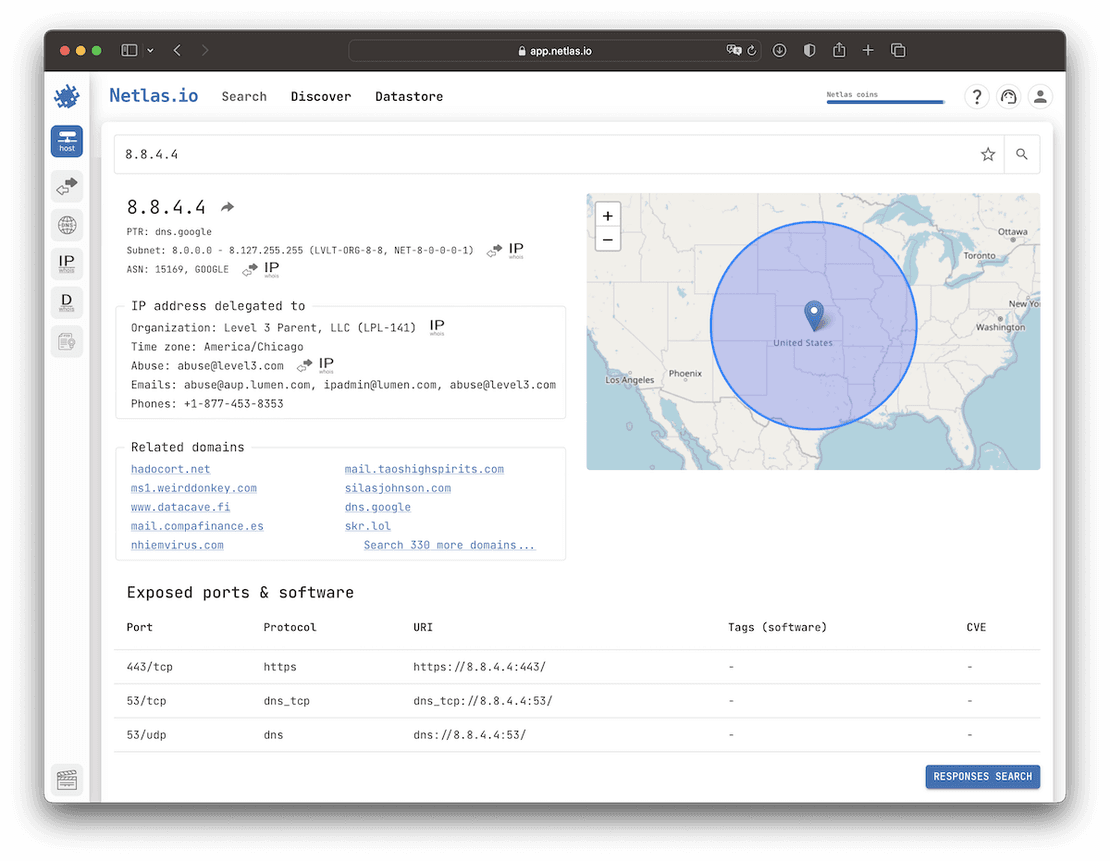
Netlas.io is one of the ASN Lookup tools
5.2. IPinfo.io / MaxMind
IPinfo.io and MaxMind provide commercial ASN data through APIs and web-based lookup tools. Users can search individual IP addresses directly through their websites, while developers can integrate ASN data into applications for automated traffic classification and network analysis. Advanced usage often requires an API subscription.
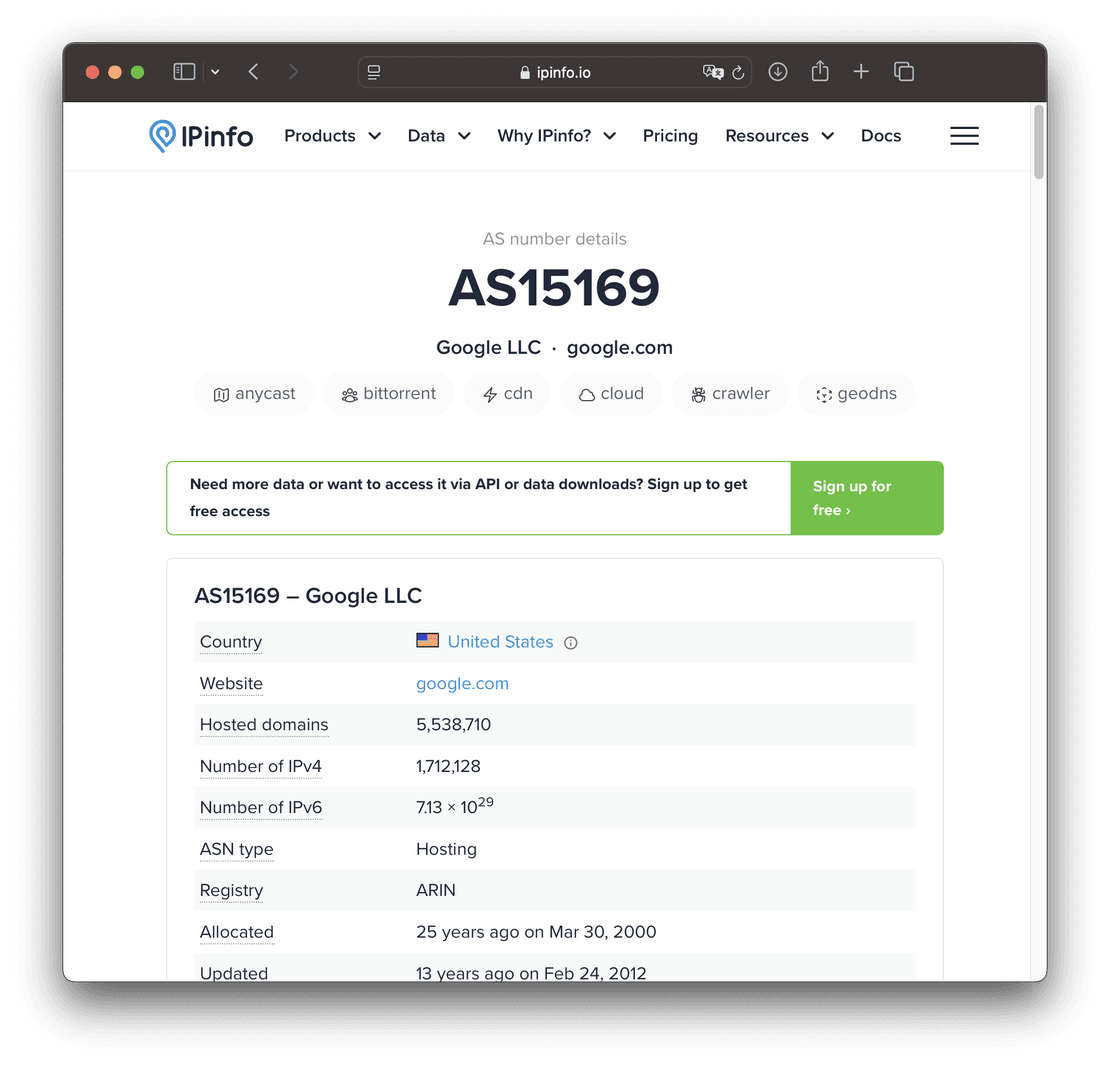
IPinfo.io is one of the ASN Lookup tools
5.3. DNS robot ASN lookup
DNS Robot offers a straightforward ASN lookup interface that requires only an IP address or ASN as input. The platform returns information such as ASN ownership, country, network ranges, and registration details, making it suitable for quick investigations.
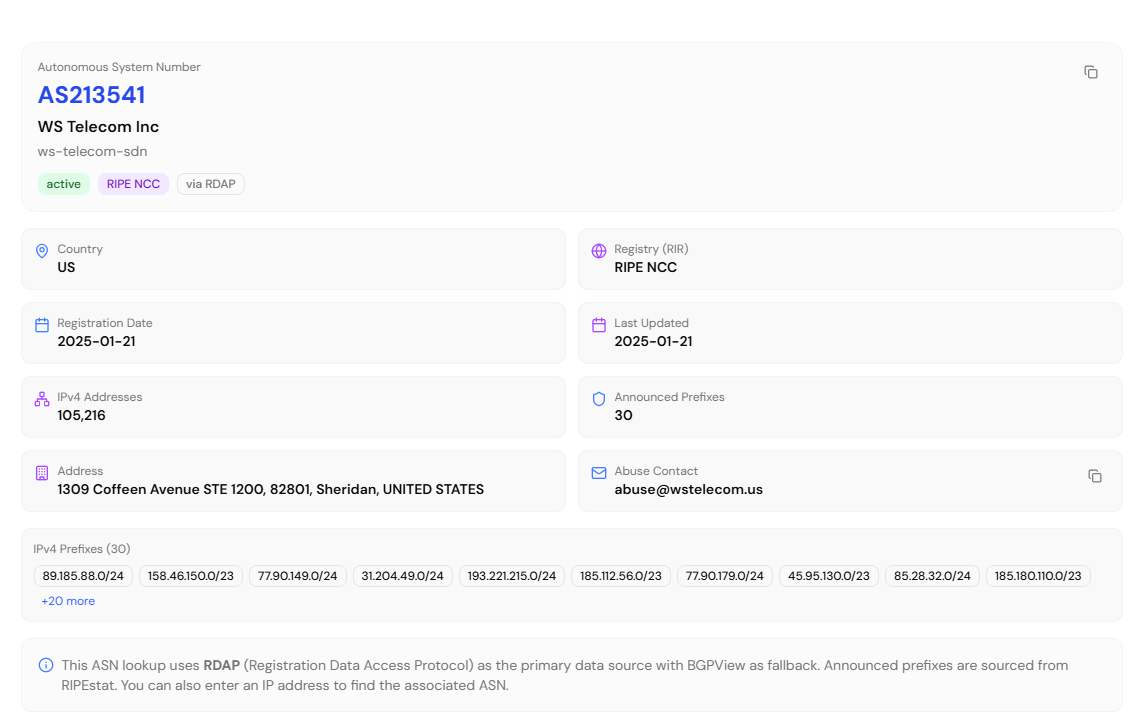
ASN lookup using a DNS robot
5.4. APIVoid ASN lookup
APIVoid provides ASN lookup capabilities alongside broader IP intelligence tools. Users can enter an IP address to retrieve ASN information, geographic details, routing data, and additional security-related insights that may assist with network investigations.
For a more complete analysis, ASN lookup data can be combined with IP reputation checks on IPFighter to evaluate both network ownership and IP trustworthiness.
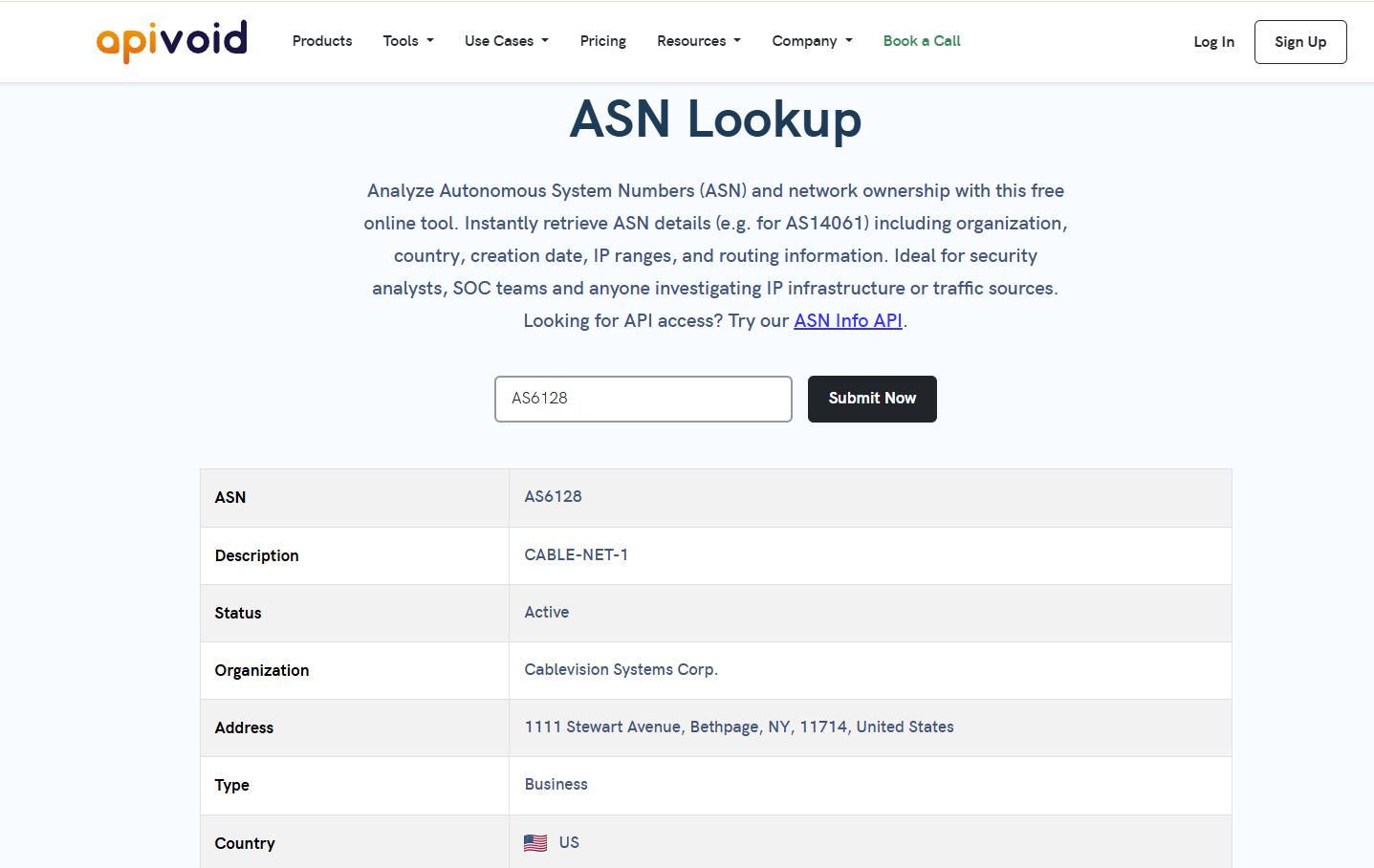
ASN lookup using a APIVoid
Read more:
-
How to find IP address on Windows, Mac, iPhone, and Android devices
-
How to find IP address on iPhone in seconds
- How to check if a proxy is working and read your results
6. Conclusion
ASN lookup is a valuable tool for identifying the network behind an IP address and understanding who owns and operates that infrastructure. It provides deeper insight than a standard IP lookup, making it useful for network analysis, cybersecurity, and proxy verification.
Whether you're investigating suspicious traffic or evaluating proxy networks, combining ASN data with ip reputation analysis can help you make more informed decisions. If you need clean, reliable network infrastructure to support your applications, check out the Coupons Partners directory on IPFighter to find exclusive proxy promo codes from trusted global networks today!
7. FAQ
What is ASN lookup?
ASN lookup is the process of identifying the Autonomous System Number associated with an IP address, IP range, or organization.
How do I find the ASN of an IP address?
You can enter the IP address into an ASN lookup tool, which will return the ASN number, network owner, and related routing information.
What is an Autonomous System Number?
An ASN is a unique identifier assigned to a network that participates in Internet routing through BGP.
Why is ASN information important?
ASN information helps identify network ownership, routing paths, ISP relationships, and potential security risks.
Can ASN lookup identify proxy networks?
Yes. ASN data often reveals whether an IP belongs to a residential ISP, cloud provider, hosting company, or known proxy infrastructure.
What is the difference between ASN lookup and IP lookup?
ASN lookup focuses on the network behind an IP address, while IP lookup focuses on details about the individual IP itself.
Can multiple IP addresses belong to the same ASN?
Yes. Most ASN operators control large IP ranges, meaning thousands or even millions of IP addresses can belong to the same ASN.
Read more

Why do I keep getting CAPTCHA? Here's what may be triggering it


What is a CAPTCHA? The check that separates people from bots

What is a mesh network and when should you use one?
What is an IP2 network? How it works, uses, and benefits
Explaining how to know if you have a DNS leak


How to know if you have a WebRTC leak: Reading your results