

Web scraping has evolved, and so have website defenses. Today, simple scripts and static IPs are easily caught by sophisticated anti-bot systems. To scale, you need the "special ops" of the proxy world: Backconnect proxies.
In this guide, IPFighter breaks down how this stealthy technology works and why it’s the ultimate engine for high-scale automation.
1. What is a backconnect proxy service?
Backconnect proxy services are a type of dedicated proxy server that automatically rotates IP addresses randomly and continuously. Instead of manually configuring and managing dozens or hundreds of individual proxies, you simply connect to a single proxy endpoint provided by the service.
That single endpoint usually consists of one gateway IP address and one port. Behind that gateway, the provider maintains a large IP pool. Every time you send a request, the service automatically chooses an IP from that pool and uses it on your behalf.
The biggest difference compared to a normal proxy setup is that you do not need to manually manage each proxy address yourself. The backconnect system takes care of the entire rotation process automatically. They are commonly used for scraping, monitoring, automation, and other activities that would be difficult with a single static IP.
2. How does a backconnect proxy service work?
Understanding the technical mechanics of a backconnect service helps you optimize your scraping scripts and troubleshoot performance issues like latency or high bandwidth consumption.
Although the system may seem complex, the process can be broken down into four simple steps.
-
The single entry point (Gateway): The user configures their browser, bot, or scraper to connect to a single hostname and port (e.g., proxy.provider.com:8080). This is your only point of contact with the service.
-
Backconnection routing: Once your request hits the gateway, the backconnect server looks into its IP Pool. This pool is a massive database of available IP addresses, which can include residential IPs (real home devices), Mobile IPs (4G/5G) or Datacenter IPs. The server selects an IP that matches your criteria (location, protocol, etc.) and routes your request through it.
-
The rotation logic: This is the "secret sauce." Depending on your settings, the system will switch the IP:
Per request: Every single time your script asks for a page, it gets a new IP.
Sticky sessions: The system keeps you on the same IP for a set time (e.g., 5, 10, or 30 minutes), which is vital for tasks that require staying "logged in."
-
Response processing: The target website sends the data back to the proxy IP. The backconnect system then relays that data back to your gateway and finally to you. To the target website, the request looks like it came from a legitimate user, not a centralized server.
As a result, a backconnect proxy service makes the entire process much simpler for the user, while automatically handling IP selection, rotation, and routing.

How does a Backconnect proxy service work
3. What is a backconnect proxy used for?
Backconnect proxy services are mainly useful in situations where you need to send many requests without being blocked. If you only browse a website occasionally, you usually do not need a backconnect proxy. However, when your task involves hundreds or thousands of requests, rotating IPs becomes extremely important.
3.1. E-Commerce data analysis
Platforms like Amazon, Walmart, and eBay have the most sophisticated anti-scraping technology on the planet. If they see 1,000 requests coming from the same IP in one minute, they will instantly trigger a CAPTCHA or a block. Backconnect proxies allow you to distribute those 1,000 requests across 1,000 different residential IPs, making your scraper look like 1,000 separate customers browsing the site.
3.2. SEO monitoring
SEO professionals need to see how search results appear in different cities or countries. Since backconnect pools are often global, you can use them to check rankings in London, New York, and Tokyo simultaneously without Google ever realizing you are a bot.
3.3. Social media analysis
Scraping public data from platforms like X (Twitter) or Instagram requires massive volume. Because these sites monitor "rate limits" (how many requests an IP can make per hour), rotation is the only way to gather large datasets for sentiment analysis without getting banned.
3.4. Market research
Competitive intelligence requires constant monitoring of price changes and stock levels across thousands of URLs. Backconnect proxies provide the "scale" needed to perform these repetitive tasks smoothly and at high speeds.
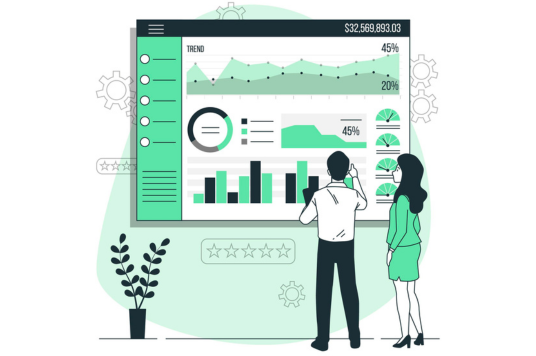
E-commerce data analysis is one of the use cases for backconnect proxies
4. The advantages and disadvantages
Like any tool, backconnect proxies have trade-offs. You must weigh the power against the cost.
4.1. Advantages of backconnect proxy
We can highlight the main advantages of backconnect proxies as follows:
-
Massive scalability: You can run thousands of threads simultaneously without worrying about IP management.
-
Superior anonymity: By using residential IPs in your backconnect rotation, you achieve the highest trust score possible.
-
Reduced development time: You don't need to build an IP rotation logic into your code; the provider does it for you.
-
Bypassing rate limits: Since each request uses a fresh IP, "Rate Limit Exceeded" errors become a thing of the past.
Overall, these advantages make backconnect proxies especially useful for large-scale scraping, automation, and other tasks that require both flexibility and a high number of requests.
4.2. Disadvantages of backconnect proxy
Besides its advantages, backconnect also has some limitations, as follows:
-
Higher costs: Because of the infrastructure required to manage millions of IPs, these services are significantly more expensive than static datacenter proxies.
-
Latency issues: Every time a request is routed through a gateway and then to a random IP, a few milliseconds of delay are added. If you use a provider with poor server distribution, this can slow down your scraping.
-
Not for everything: If your task requires a static IP (like managing a specific social media account for months), a backconnect proxy is actually the wrong choice because the IP will eventually change.
Because of these limitations, backconnect proxies are not always the best option. It is important to match the service to your actual use case before deciding to use it.
5. Datacenter proxies vs Backconnect proxies
Many people compare datacenter proxies and backconnect proxies because both are often used for scraping and automation.
However, they are not exactly the same thing. Here is a breakdown to help you choose the right one for your project.
|
Feature |
Datacenter proxy |
Backconnect proxy |
|
IP source |
Cloud Servers (AWS, DigitalOcean, etc.) |
Real User Devices (ISP-assigned) |
|
Trust score |
Low (Easier to detect as a bot) |
High (if it's a residential proxy) |
|
Rotation |
Usually Manual/Static |
Fully Automated |
|
Cost |
Cheap |
Premium |
|
Best for |
High speed, low-security sites |
Data collection from highly secure sites (Amazon, Google, social networks) |
|
Success rate |
Moderate |
High (depending on the type of proxy) |
Discover more:
-
What is a Proxy? Benefits, usage, and everything you need to know about proxies
-
The Latest Methods to Disable Proxy on Devices and Browsers
- How to improve IP score: A complete guide
6. How to evaluate a Backconnect proxy service
Before choosing a backconnect proxy provider, it is important to remember that the service itself is only as good as the IP pool and infrastructure behind it.
6.1. Critical factors in provider selection
Not all best proxy providers are created equal. Some claim to have millions of IPs but actually have "dirty" pools filled with blacklisted addresses. If you don't evaluate your provider, you risk wasting money on failed requests.
These are the important factors you should keep in mind:
-
IP quality & reputation: Are the IPs recognized as residential or are they flagged as Proxy/VPN by websites?
-
Pool size & diversity: Do they have IPs in the specific countries or even cities you need to target?
-
Rotation flexibility: Can you switch between per-request and sticky sessions easily?
-
Stability (uptime): If the gateway server goes down, your entire operation stops. Look for 99.9% uptime guarantees.
These factors will help you compare providers more effectively and avoid choosing a service that looks good on paper but performs poorly in practice.
6.2. The importance of IP checking
Before putting your proxy to work, you should always verify its health. Checking it through IPFighter is the simplest way to see what you're actually getting:
-
IP reputation score: Understand how likely a website is to trust that specific IP.
-
Blacklist status: See if your assigned proxy is already banned on major platforms.
-
DNS/WebRTC leaks: Ensure your real identity isn't leaking through the proxy.
By carefully checking the parameters of this IP address, you can ensure that the provider's IP address is actually as good as expected, saving you time and money when buying a proxy.
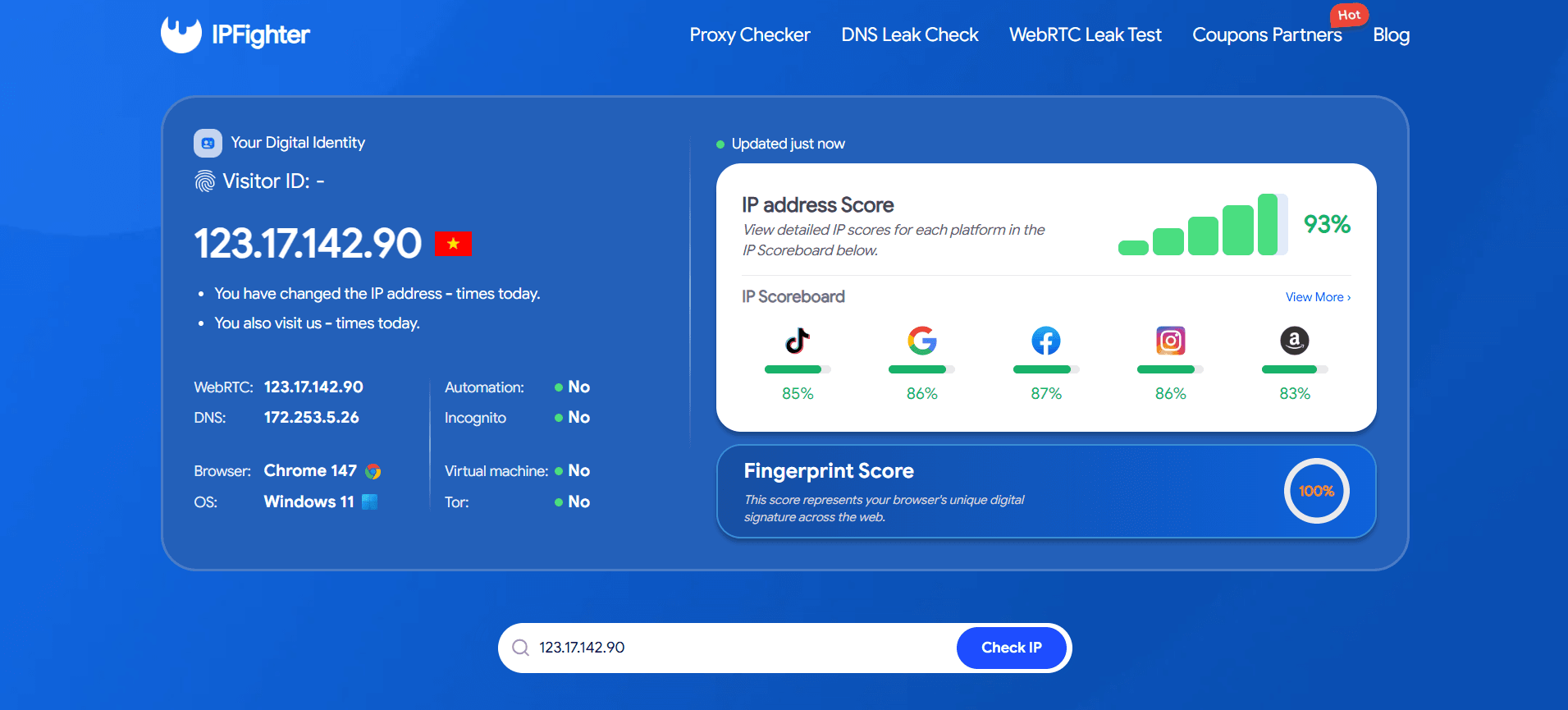
Check proxy on IPFighter
7. Conclusion
Backconnect proxy services are the backbone of modern web automation. They remove the headache of IP management, providing a scalable, stealthy, and highly effective way to gather data from the most protected corners of the internet.
However, they are not a set it and forget it solution. Success in web scraping depends on the quality of your IP pool. Always prioritize providers with a high IP reputation and use tools like IPFighter to verify your connection before launching a massive crawl. If you need to scale up, automate, and are looking for the right provider, you can visit the proxy promo codes section on the IPFighter website to get the most suitable and cost-effective proxy offers.
8. FAQ
What is a backconnect proxy service?
It is a proxy system that provides a single entry point (Gateway) and automatically rotates the outgoing IP address from a pool of thousands or millions of addresses.
How is it different from rotating proxies?
Technically, they are very similar. "Rotating proxy" describes the action (changing IPs), while "Backconnect" describes the architecture (connecting back through a gateway). Most modern rotating proxies use backconnect technology.
When should I use a backconnect proxy?
Use it when you need to perform high-volume scraping, SEO monitoring, or market research on websites that have strict rate limits or anti-bot protections.
Are backconnect proxies safe?
Yes, they are generally safer than static proxies because they mask your activity across thousands of IPs. However, always ensure your provider respects data privacy and that you aren't leaking your real IP through WebRTC.
Can they prevent blocks completely?
No tool can guarantee a 0% blocking rate, but reverse-connecting proxies (especially those using residential IP addresses) have a high success rate in the industry.
Read more
Rapidproxy review: A closer look at its residential proxy network


Coronium review: How do its dedicated 4G/5G proxies perform?
ProxyEmpire review: What do its proxy services offer?
Proxy001 review: Exploring its 100M+ residential proxy network
Difference between VPN and proxy: What’s the difference?
Proxies for market research: How to collect better market data